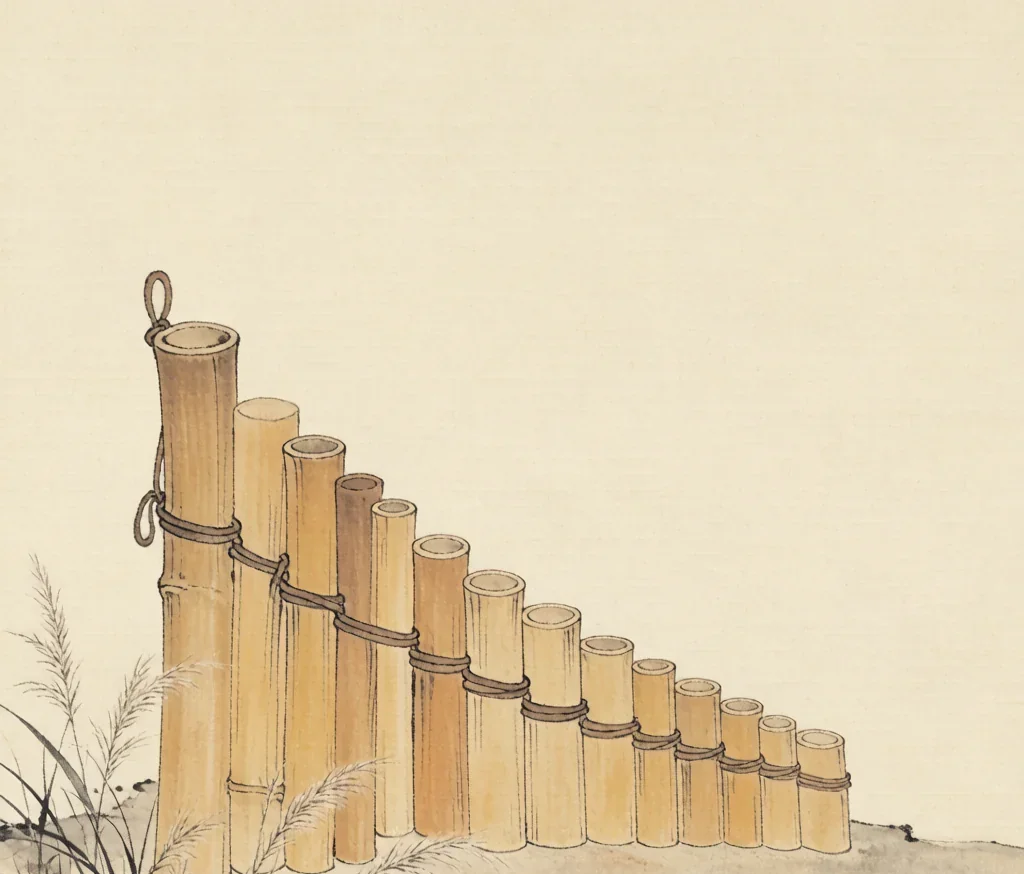
The 排箫 () is the panpipe, a row of bamboo tubes of graduated length bound side by side, each tube a stopped pipe that sounds a single note when the player blows across its open top. Among the oldest of all musical instruments, panpipes appear in the myth and archaeology of many cultures, and China has its own long tradition of them reaching back thousands of years. The pai xiao was an instrument of ritual and refinement in antiquity, later faded in everyday use, and has been revived in modern times as both a folk and a concert instrument with a pure, breathy, flute-like voice. This article explores its ancient roots, its construction, the way it sounds and is played, its place in myth, and its modern return.
The Panpipes in Antiquity
The pai xiao belongs to one of the most widespread instrument families on earth, the bundled panpipe, found from the Andes to the Balkans to East Asia. In China, panpipe-like instruments are attested from early periods, and the pai xiao was used in the ritual and court music of antiquity, where sets of tuned pipes also served a scientific purpose: they helped define standard pitches for the whole musical system. The idea of a row of fixed tubes, each giving one exact note, made the panpipe a natural tool for both music and measurement.
Historical sources describe pai xiao of varying numbers of pipes, sometimes arranged in a gentle fan or a straight row, and the instrument appears in art and poetry as a sound of the countryside and the open air. Because each tube is a closed pipe with a fixed pitch, the panpipe cannot be bent or slid like a flute; it offers instead a set of pure, stable tones, which may be why it was associated with simplicity and with the unchanging order of nature. Its antiquity is so great that it can fairly be called one of the foundational sounds of Chinese music.
Construction of the Tube Row
A pai xiao is made by selecting bamboo tubes of increasing length and binding them together so their tops line up in a row the player can reach with the mouth. Each tube is closed at the bottom, so it sounds as a stopped pipe whose pitch depends on its length: the shorter the tube, the higher the note. The maker tunes the set to a scale, traditionally pentatonic, by cutting the tubes to the right lengths, and the finished instrument may hold from a dozen to more than twenty pipes.
The tubes are usually bound with cord, rattan, or a frame so they stay aligned, and the tops are often trimmed to a smooth row for the lips. Some modern pai xiao use other materials for durability, but bamboo remains ideal for its lightness and warm tone. Because every note is a separate physical tube, the instrument has no moving parts and little to maintain; its simplicity is part of its charm and also a reminder of how directly an instrument can embody a scale.
The Sound and How It Is Played
To play, the musician holds the row to the mouth and blows across the top of one tube at a time, much as with a bottle top, producing a soft, airy, flute-like tone. Moving from tube to tube steps through the scale, and quick alternation can suggest runs and trills. The sound is gentle and pure, with the natural breath noise of the air adding to its rustic, open-air character. Because the tubes are stopped and fixed, each note is stable and clear, without the sliding portamentos possible on a hole-flute.
Technique emphasizes clean movement between tubes and controlled breath, since blowing too hard spoils the tone and too soft fails to speak. Players learn to angle the instrument so the air lands correctly on each rim, and to shift quickly for fast passages. The pai xiao cannot sustain a chord the way a mouth organ can, but it can dance lightly across a melody, and its purity makes it lovely for slow, spaced-out phrases where each note hangs in the air like a drop of water.
Myth, Ritual, and the Name
The name pai xiao joins the character for "row" or "arrange" with the character for the vertical flute, marking it as the many-tubed relative of the single xiao. In the broader Chinese imagination, bundled pipes suit the ideal of harmony among different voices, each tube distinct yet joined in one instrument, an image that resonates with the cultural value placed on order and concord. Panpipes also appear in folk and pastoral imagery as the sound of shepherds and the countryside, far from the formality of the court.
In ritual music the fixed pitches of the pipes linked sound to cosmology, since standard pitches were thought to correspond to the seasons and to natural order. A row of correctly tuned pipes was thus more than an instrument; it was a small model of measured harmony in the world. This blending of music, number, and nature is characteristic of how the Chinese tradition understood sound not as mere entertainment but as a reflection of cosmic balance.
The Modern Revival
Like several old instruments, the pai xiao faded from common use in later imperial times, overshadowed by hole-flutes and other voices, but it never fully disappeared from folk life and was revived in the modern era. Today makers build refined concert pai xiao with chromatic ranges and improved tuning, and players perform both traditional melodies and new compositions. Its pure tone fits well in ensembles that want a breathy color, and it has found a niche in world-music and meditative settings where its simplicity is an asset.
The revival also benefits from the instrument's global familiarity: almost everyone recognizes panpipes, so the pai xiao serves as an easy entry point to Chinese wind music for new listeners. At the same time, its deep Chinese roots and its role in ancient pitch theory give it serious historical weight. The modern pai xiao therefore spans two worlds, the universal and the specifically Chinese, which helps explain why it has been taken up again with quiet enthusiasm.
Learning and Listening
For a beginner the pai xiao is wonderfully direct: there are no holes to cover and no keys, only a row of tubes to blow across, so producing the first notes is quick and satisfying. The challenge is even breath and clean movement between tubes, plus learning the layout of the scale along the row. A small pai xiao in a comfortable key is the best start, and simple folk tunes reward early practice immediately.
To listen well, notice how each note stands alone, pure and uninflected, and how the spaced phrases invite calm attention. The pai xiao rewards slow playing more than virtuosic display, and its sound suits dawn, fields, and quiet rooms. As one of humanity's oldest instruments, it connects the modern player to a musical instinct shared across continents and millennia: take a handful of tubes, blow across them, and hear order rise out of air. In China that instinct is called pai xiao, and it still sings.
❓ Frequently Asked Questions
📝 Chinese Vocabulary
排箫 — : the panpipes.
箫 — : vertical flute, the single-tube relative.
竹 — : bamboo, the tube material.
律 — : pitch standard, historically linked to tuned pipes.
音管 — : a single sound tube, each giving one fixed pitch
编管 — : an arranged set of pipes, another way to name the panpipe
五声 — : the pentatonic (five-tone) scale, the traditional tuning of the pipes
吹奏 — : to blow and play, the act of performing the paixiao
🎉 Fun Facts
- The pai xiao is one of the most ancient instrument types in the world, found in many cultures besides China.
- In antiquity, rows of tuned pipes helped define the standard pitches for the whole Chinese musical system.
- Because each tube is a fixed stopped pipe, the pai xiao cannot slide notes the way a hole-flute can.
- Its name combines the character for "row" with the character for the vertical xiao flute.
- Because each note is a separate physical tube, a paixiao player literally moves the instrument along the mouth to walk up and down the scale.
- Modern concert paixiao are often built chromatically with more than twenty pipes, letting the instrument play music far beyond its ancient pentatonic roots.