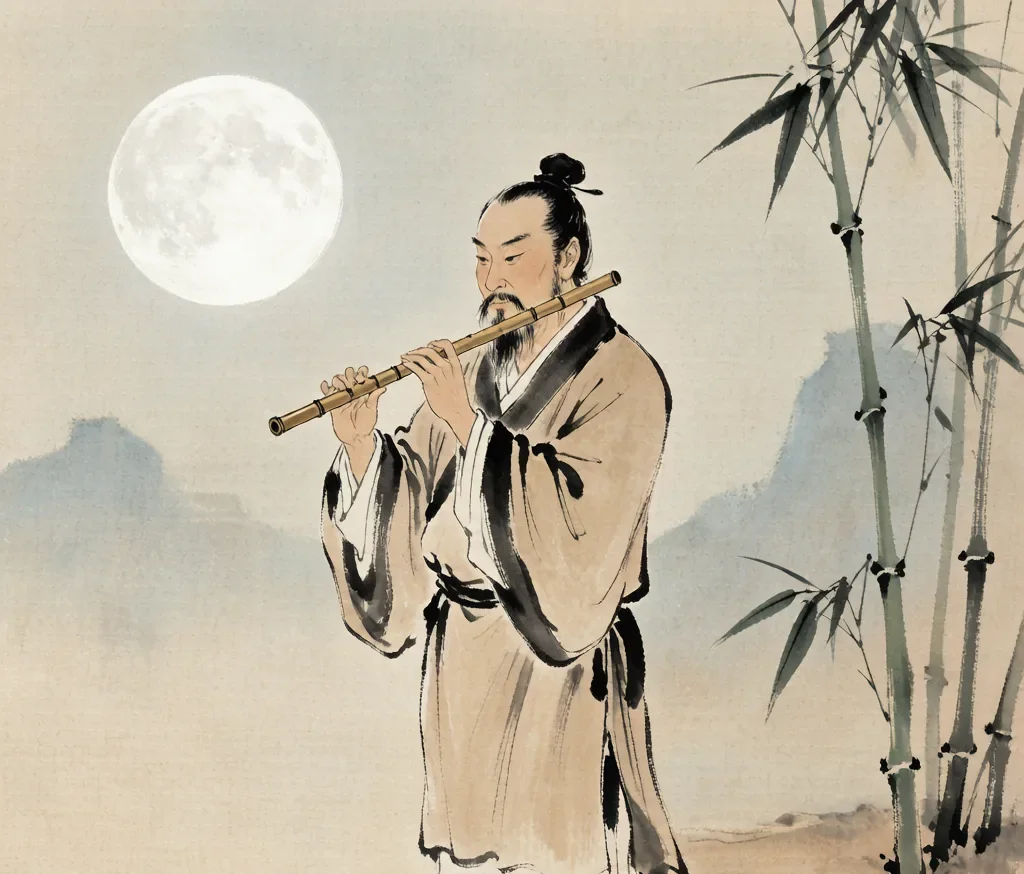
The zhuxiao (竹箫, "bamboo xiao") is the Chinese vertical, end-blown flute — a tube of bamboo held straight down and sounded by directing air against a notch or edge at the top. Often called simply the xiao, it is the contemplative counterpart to the bright transverse dizi: soft, breathy, and introspective, long favored by scholars and Daoist adepts for solo meditation and for accompanying song. Its pure, unfolding tone has made it an emblem of quiet refinement in Chinese culture.
Name and Identity
Zhu is bamboo and xiao a vertical flute, so zhuxiao means a bamboo vertical flute. Historically the term also covered a panpipe-like instrument, but in modern usage it denotes the single tube played vertically, also known as the dongxiao ("hole/barrel xiao") to distinguish it from the notched chiba type.
Its identity as the calm, vertical flute sets it against the horizontal, membrane-buzzed dizi in the Chinese imagination of two flute characters.
Construction
The xiao is a length of bamboo, closed at the top except for a notch or a "V" cut where the player's lower lip splits the airstream. Below are a few finger holes (commonly five to eight) and sometimes a thumb hole at the back; longer examples may have an extra joint.
Unlike the dizi it has no membrane hole, so its sound is plain and mellow. The bamboo's natural nodes and taper give each instrument a slightly individual voice, and makers select culms for straightness and density.
How It Is Sounded
The player holds the tube vertically and blows downward across the top notch, much like an organ flute or recorder without a mouthpiece. The air divides at the edge to generate the tone; finger holes then select pitches, with subtle half-holing for in-between notes.
Breath pressure and embouchure shape dynamics and a natural, speech-like vibrato, so the xiao can "speak" a melody with great intimacy — ideal for the scholar's studio.
Tone and Expressive Character
The xiao's timbre is soft, hollow, and slightly airy, lacking the dizi's brilliance. This makes it suited to slow, lyrical lines and to the long, breathing phrases of meditative music rather than fast virtuosic runs.
Chinese aesthetics prize exactly this restraint: the xiao is the sound of solitude, moonlight, and retreat from the world, a foil to louder public instruments.
Scholarly and Daoist Associations
For centuries the xiao was the gentleman's instrument, played by literati and Daoist recluses alone or with the guqin zither. Paintings show a scholar by a window or by a pine, flute in hand, embodying the ideal of refined leisure.
Its quiet volume matched the private study and the garden pavilion, spaces where loud music would have been rude. To play the xiao was to cultivate character as much as to make sound.
Role in Ensemble and Accompaniment
Beyond solo use, the xiao accompanies narrative singing and joins small ensembles where a soft wind is wanted. In the south it pairs with the dizi and plucked strings in chamber music, and it sometimes doubles a vocal line in opera arias.
Its blend is gentle; it supports rather than leads, a role consistent with its temperament.
Learning the xiao rewards patience above all. Because the tone is quiet, the beginner must first master a steady, centered breath before any melody can speak, and only then explore the microtonal slides that give the flute its voice-like grace. Teachers often begin students with long tones and simple pentatonic lines, treating the instrument as a discipline of listening as much as playing. That slow path suits the xiao's character: it is an instrument one grows into rather than shows off, and its devotees value the calm it cultivates as highly as any piece performed.
Repertoire
Traditional xiao pieces are often shared with the qin or drawn from folk melody, with evocative titles like Mei Hua San Nong (Plum Blossoms) and Ping Sha Luo Yan (Wild Geese on the Sandbank). Many are slow and atmospheric.
Modern composers have also written new works exploring the flute's color in chamber and orchestral settings, extending its repertoire without changing its essential calm.
There is also a philosophical dimension to the xiao's appeal. Its quiet, breathy sound makes the act of breathing audible, turning performance into something close to meditation; the player's breath, the bamboo's resonance, and the surrounding silence become a single experience. This is why the flute appears so often in poetry about emptiness and return, and why it suited the Daoist ideal of yielding softness over forceful brilliance. To hear the zhuxiao well is to listen not for notes but for space — the pauses and the air that give the melody its meaning, a lesson the instrument has taught for centuries.
Comparison with the Zhuli
The zhuli (horizontal dizi) is bright, membrane-buzzed, and agile; the zhuxiao is vertical, membrane-free, and serene. Together they map the two poles of Chinese flute sound — public brilliance versus private stillness.
Players often learn both, but temperament and context decide which to choose: a festival tune calls for the dizi, a moonlit evening for the xiao.
Modern Status
The xiao remains taught in conservatories and beloved by amateurs for its gentle learning curve and meditative quality. It appears in fusion, film music, and wellness contexts where calm timbre is valued.
As a living symbol of scholar culture, the bamboo vertical flute continues to voice the Chinese ideal of music as self-cultivation rather than show.
❓ Frequently Asked Questions
What is the zhuxiao?
The zhuxiao is the Chinese bamboo vertical flute, an end-blown tube also called the xiao, with a soft, contemplative tone.
How is it different from the dizi?
The dizi is held horizontally and has a buzzing membrane; the xiao is vertical, membrane-free, and much quieter and calmer.
How is the xiao played?
The player holds it vertically and blows downward across a notch at the top, fingering holes to change pitch.
Who traditionally played it?
Scholars and Daoist recluses prized it for private, meditative music, often alongside the guqin zither.
What does it sound like?
Soft, hollow, and slightly airy, suited to slow lyrical lines rather than fast virtuosic passages.
Is the xiao still played today?
Yes; it is taught in conservatories, enjoyed by amateurs, and used in fusion, film, and wellness music.