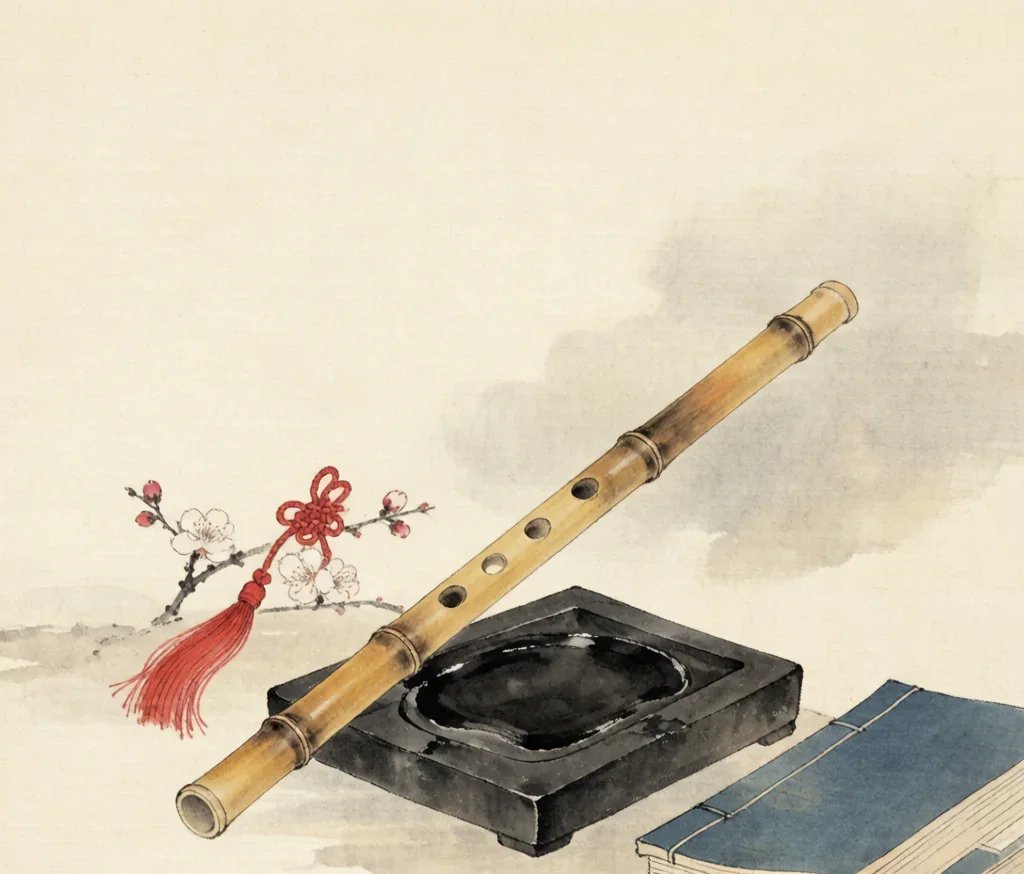
Long before the first bronze bell was cast or the first silk string was stretched across a zither, there was the flute. In the floodplains of the Yellow River, nearly 9,000 years ago, people carved the wing bones of cranes into hollow tubes, drilled finger holes, and breathed music into existence. These Jiahu bone flutes are the oldest playable musical instruments ever discovered in China — and they are the ancestors of the dizi, the bamboo flute that has been the voice of the Chinese people for millennia.
The Jiahu Bone Flutes
In the 1980s, archaeologists excavating the Neolithic site of Jiahu in Henan Province uncovered something extraordinary: more than 30 flutes made from the wing bones of red-crowned cranes, dating from 7000 to 5700 BCE. When tested, these ancient instruments proved to be fully playable, producing a scale remarkably similar to the Chinese pentatonic scale that would emerge thousands of years later. The Jiahu flutes represent the earliest evidence of musical instrument making in China — and some of the oldest playable instruments in the world.
The fact that these Neolithic people chose the bones of cranes — birds associated with longevity and spiritual transcendence in later Chinese culture — suggests that music already held a special, perhaps sacred, significance. The crane's call, high and piercing, may have been the original inspiration for the flute's voice. Even in the Stone Age, the Chinese were listening to nature and translating its sounds into music.
Bamboo and the Birth of the Dizi
Over the millennia, the material of Chinese flutes shifted from bone to bamboo, a plant that grows abundantly throughout China and has profound cultural significance. Bamboo is hollow — a natural tube, perfectly suited to become a flute. Its straight, segmented form embodies the Confucian virtues of integrity and uprightness. And its ability to bend without breaking in the wind represents resilience and flexibility. The dizi, made from bamboo, carries these symbolic meanings along with its music.
The modern dizi as we know it emerged during the Han Dynasty (206 BCE–220 CE), when a crucial innovation transformed the instrument: the addition of a membrane hole. Between the embouchure hole (where the player blows) and the finger holes, a small hole was drilled and covered with a thin membrane, traditionally made from the inner skin of a bamboo shoot. When the flute is played, this membrane vibrates sympathetically, adding a distinctive buzzing, reedy quality to the tone. This sound — bright, nasal, and slightly rasping — is the dizi's signature. No other flute in the world sounds quite like it.
The Secret of the Membrane
The membrane, called dimo in Chinese, is what sets the dizi apart from every other flute on Earth. It is a piece of tissue-thin material, carefully stretched across the membrane hole and held in place with a natural adhesive. When the player blows into the flute, the air column inside vibrates, and those vibrations cause the membrane to buzz. The result is a tone that combines the purity of a flute with the nasality of a reed instrument — a hybrid sound that is instantly recognizable.
Applying and adjusting the dimo is an art in itself. If the membrane is too loose, the sound becomes harsh and uncontrolled. If it is too tight, the distinctive buzz disappears and the dizi sounds like an ordinary flute. The player must find the perfect tension, and the membrane must be replaced regularly as it loses elasticity. In humid weather, the dimo absorbs moisture and slackens. In dry weather, it tightens. The dizi player, like the guqin player with silk strings, must be constantly attentive to the instrument's condition — a relationship of care and sensitivity.
Two Flutes, Two Worlds
There are two main types of dizi, each with its own voice and repertoire. The qudi is the longer, lower-pitched flute, associated with the kunqu opera tradition of southern China. Its tone is mellow, lyrical, and deeply expressive — perfect for the elegant, poetic arias of kunqu. The bangdi is shorter and higher-pitched, originating in the clapper operas of northern China. Its tone is bright, penetrating, and energetic — ideal for the lively, percussive music of the north.
These two flutes reflect the cultural geography of China itself: the gentle landscapes and refined arts of the south, the bold spirit and robust traditions of the north. Together, they cover the full emotional range of Chinese music, from the most delicate whisper to the most exuberant celebration.
The Dizi Repertoire
The dizi has a rich repertoire of both traditional and modern works. Pieces like "Birds in the Shade" and "Three Variations on the Plum Blossom" showcase the instrument's ability to imitate nature — birdsong, wind, water — and to evoke the landscapes that have inspired Chinese artists for centuries. The dizi can chirp and warble like a flock of sparrows, or it can sing a long, slow melody that seems to stretch across an entire mountain range.
In the 20th century, the dizi moved from folk ensembles and opera pits to the concert stage. Virtuoso players like Lu Chunling and Zhao Songting developed new techniques — flutter-tonguing, circular breathing, multiphonics — that expanded the instrument's capabilities. Composers wrote concertos, sonatas, and solo showpieces that challenged players and delighted audiences. Today, the dizi is a standard instrument in the modern Chinese orchestra, and its distinctive voice can be heard in film scores, popular music, and experimental compositions around the world.
The Living Flute
What makes the dizi so enduring? Perhaps it is the instrument's connection to nature. It is made from bamboo, a living plant. Its membrane comes from the same bamboo shoot. Its sound imitates birds, wind, and water. To play the dizi is to participate in a dialogue with the natural world — to breathe life into a piece of bamboo and let it sing.
Or perhaps it is the instrument's accessibility. Unlike the guqin, which requires years of study before a pleasing sound can be produced, the dizi is relatively easy to begin. A beginner can produce a clear tone on the first day. This accessibility has made the dizi the people's flute — an instrument that belongs not to the scholar's study but to the village square, the festival stage, and the living room. It is the sound of everyday joy.
From the bone flutes of Jiahu to the bamboo dizi of today, the flute has been a constant companion to the Chinese people for 9,000 years. It has witnessed the rise and fall of dynasties, the birth of philosophies, and the transformation of a civilization. And still, in parks and concert halls, in villages and cities, people put a piece of bamboo to their lips and make it sing.
The Dizi in Chinese Opera and Ensemble
Though often played as a solo instrument, the dizi is first and foremost an ensemble player. In Chinese opera it fills distinct roles: the larger, softer qudi accompanies the refined melodies of Kunqu, while the brighter, higher bangdi leads the driving music of clapper operas such as bangzi. Outside the theater the dizi sits at the front of regional instrumental ensembles across the north and south, from festival bands to teahouse groups, where its penetrating tone cuts through percussion and strings. In the modern Chinese orchestra it is a principal melody instrument, often paired with the erhu and the plucked strings. This versatility explains the dizi's presence in nearly every kind of Chinese music, from village celebration to the concert hall.
Notable Dizi Masters
Through the twentieth century a generation of performers transformed the dizi from a largely folk and opera instrument into a recognized concert soloist. Pioneers such as Feng Zicun and Liu Guanyue arranged traditional tunes, composed new pieces, and wrote pedagogical studies that standardized fingering and breath control for conservatory teaching. Their students carried the instrument into China's new music academies, where it joined the expanding Chinese orchestra. Figures like Yu Xunfa later expanded the repertoire with contemporary compositions and recordings that reached international audiences. Because the dizi had long been passed down orally, the work of these masters in notating and systematizing its music was decisive: it gave the flute a written tradition and a place on the modern stage while preserving the regional styles that first gave it life.
❓ Frequently Asked Questions
The dizi is a Chinese bamboo flute with six finger holes and a unique membrane hole covered with a thin bamboo or reed membrane that gives it a bright, buzzing timbre.
The membrane (笛膜, dí mó) vibrates with the air column, producing the dizi's characteristic bright, resonant tone that distinguishes it from other flutes.
The two main types are the 'qudi' (曲笛), tuned lower with a mellow tone, and the 'bangdi' (梆笛), tuned higher with a brighter, more piercing sound.
The dizi is a lead melodic instrument in both folk music and Chinese opera, and it is a standard member of the modern Chinese orchestra.
Both are transverse flutes, but the dizi is made of bamboo and has a membrane hole covered by the dimo, whose vibration adds a bright, reedy buzz absent from the metal flute. Traditionally it also has fewer keys and a more overtone-rich, folk color.
The basic fingerings come quickly, and many beginners produce a tune within a short time, which makes the dizi popular in schools. Achieving a beautiful, controlled tone — especially managing the membrane's tension — and mastering ornamentation, however, takes years of practice.
📝 Chinese Vocabulary
- 笛子 (dí zi) — The bamboo flute; one of the most ancient and widely played Chinese instruments
- 笛膜 (dí mó) — The membrane that covers the special hole on the dizi, giving it its distinctive buzzing timbre
- 贾湖骨笛 (jiǎ hú gǔ dí) — The Jiahu bone flutes; 9,000-year-old crane-bone flutes, the oldest playable instruments in China
- 曲笛 (qǔ dí) — The southern, lower-pitched dizi used in kunqu opera, with a mellow, lyrical tone
- 梆笛 (bāng dí) — The northern, higher-pitched dizi used in clapper opera, with a bright, energetic tone
🎉 Fun Facts
- The Jiahu bone flutes, made from crane wing bones around 7000 BCE, are among the oldest playable musical instruments ever found anywhere in the world.
- The dizi's unique membrane (dimo) is traditionally made from the inner skin of a bamboo shoot, carefully peeled and stretched across the membrane hole.
- Modern dizi players can use circular breathing to sustain notes indefinitely, a technique that allows for continuous, unbroken melodies.
- The dizi is one of the most widely taught traditional instruments in China, appearing in school music programs as well as in professional conservatories.
- Traditional dizi music is built largely on the pentatonic five-note scale, which gives it the familiar modal color of much Chinese melody.
- Players adjust the dimo membrane by breathing on it or tapping it gently, because changes in humidity alter its tension and therefore the brightness of the tone.