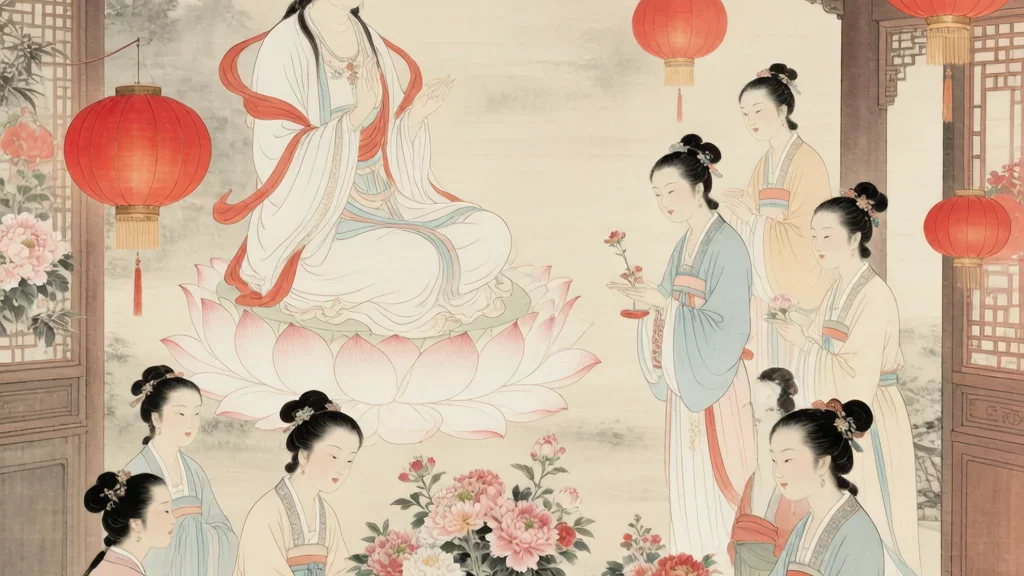
Guanyin's Birthday (观音诞, guān yīn dàn) honors Guan Yin, the Bodhisattva of Compassion, the most beloved figure in Chinese Buddhism. Unlike most festivals tied to a single date, Guan Yin is celebrated on three days a year, each marking a stage in her spiritual life. On these days temples fill with incense smoke and the sound of sutra chanting, while devotees offer vegetarian food, flowers, and prayers. For many Chinese, Guan Yin is less a distant saint than a tender, ever-present mother who hears every cry for help.
From India to China
Guan Yin began as Avalokiteshvara, a male bodhisattva of Indian Buddhism whose name means "the Lord who looks down." As Buddhism moved into China, the figure gradually changed. By the Tang and Song dynasties, Avalokiteshvara had taken on a gentle, often female, Chinese form—Guan Yin, "the one who observes the sounds (cries) of the world."
Scholars link the shift to China's own traditions of goddess worship and to a popular need for a compassionate, maternal savior. The name itself promises attentiveness: Guan Yin is said to hear the pleas of all who suffer, whatever their station, and to answer without distinction of rank or wealth.
The Three Birthdays
Guan Yin is honored on three feast days, all falling on the 19th day of a lunar month. The 19th of the second month marks her birth (诞辰, dàn chén); the 19th of the sixth month marks her enlightenment or attainment (成道, chéng dào); and the 19th of the ninth month marks her renunciation of household life to become a nun (出家, chū jiā). Each is observed with devotion.
The second-month birthday draws the largest crowds. Together the three days trace a life of awakening, from arrival, to realization, to complete devotion—a cycle devout believers mark with fasting, extra prayers, and a visit to the temple. The repeated dates keep compassion close through the year.
At the Temple
On each Guan Yin day, temples overflow with visitors. Worshippers offer incense, fresh flowers, and fruit, then join monks in chanting the sutras and the bodhisattva's name. At Mount Putuo (普陀山, pǔ tuó shān) off the coast of Zhejiang—Guan Yin's sacred mountain—pilgrims move from one temple to the next, many performing full prostrations.
Lowering the body to the floor with each step toward the altar, the faithful turn the climb into a moving act of devotion. Free vegetarian meals are served to all who come. The atmosphere is less solemn than joyful: families treat the day as a small pilgrimage and a chance to make merit together.
A Household Goddess
Beyond the monastery, Guan Yin sits in countless homes. In Chinese folk religion she is worshipped not only by Buddhists but also by Taoists and non-religious families as a giver of children, a protector of travelers, and a healer of the sick. The classic image is the white-robed Guan Yin holding a slender vase of pure water and a willow sprig.
Small shrines with her statue appear in kitchens and parlors, and many women pray to her for a safe childbirth. This domestic presence makes her the rare deity who bridges temple and home with equal ease, equally at home on a monastery altar and a family shelf. Many households light a daily stick of incense before her, asking for calm and safety as much as for miracles.
Vegetarian Vows
Devout observers mark Guan Yin days with vegetarian meals, and many Chinese Buddhists abstain from meat on the three feast days as an act of compassion toward living things. Temples and lay groups serve free vegetarian feasts—tofu rolls, mushroom dishes, braised gluten, and sweet lotus-seed soups—to anyone who visits.
The practice ties the festival to the bodhisattva's core virtue of mercy. Even people who eat meat the rest of the year may keep a vegetarian day on Guan Yin's birthday, seeing it as a small, yearly renewal of kindness that costs little yet means much.
Guan Yin Across Cultures
Guan Yin's reach extends far beyond China. In Tibet she is the male Chenrezig; in Japan she is Kannon, in Korea Kwanseum, and in Vietnam Quan Âm—each a local form of the same compassionate ideal. Chinese emigrants carried her image worldwide, so that Chinatowns from San Francisco to Singapore ring with her name.
In some Chinese Christian communities she has even been gently blended with the Virgin Mary, the two maternal figures sharing a role as comforter of the afflicted. Her image also travels in everyday life—small statues ride dashboards and sit on shop counters, a quiet guardian through the ordinary day. Few religious figures have worn so many faces while keeping one clear promise: to answer the suffering of the world.
In Art and Story
In Chinese art Guan Yin is the single most depicted holy figure, rendered in thousands of forms—seated in meditation, standing on a lotus, or as the "Water-Moon Guan Yin" gazing at her reflection. Her legends are many: she rescues sailors from storms, answers the childless, and appears in the tale of "Guan Yin of the South Sea."
One beloved story tells of Miaoshan, a princess who defied her father to practice compassion and became the bodhisattva. These tales teach that mercy can outweigh rank and duty—a message that helps explain why ordinary people, not just monks, have loved her for a thousand years.
Living Devotion Today
Today Guan Yin's birthdays remain among the busiest days at Chinese temples, especially at Putuo Shan, where hundreds of thousands arrive for the second-month festival. The rites have also moved online: live-streamed chanting and digital incense offerings let the devout join from afar.
Yet the essence is unchanged. People come with the same requests—health for a parent, a child for a longing couple, safe passage for a traveler—and leave with the same comfort. In a fast-changing society, Guan Yin's birthday is a fixed point of mercy, repeated three times a year like a steady heartbeat of compassion.
❓ Frequently Asked Questions
📝 Chinese Vocabulary
观音 — : Guan Yin; Bodhisattva of Compassion.
菩萨 — : bodhisattva; an enlightened being who helps others.
观音诞 — : Guan Yin's Birthday; her feast day.
普陀山 — : Putuo Shan; Guan Yin's sacred mountain in Zhejiang.
慈悲 — : compassion; Guan Yin's core virtue.
素食 — : vegetarian food; eaten on Guan Yin days.
成道 — : enlightenment; the 6th-month Guan Yin feast.
出家 — : renunciation; leaving home to become a nun or monk (9th-month feast).
南海 — : South Sea; traditional abode of Guan Yin.
🎉 Fun Facts
- Guan Yin is the most depicted figure in Chinese Buddhist art, with thousands of iconographic forms.
- Her name means "One Who Observes the Sounds of the World"—hearing every prayer for help.
- In Japan she is Kannon, in Korea Kwanseum, and in Vietnam Quan Âm—local forms of the same ideal.
- The Virgin Mary and Guan Yin have been gently blended in some Chinese Christian communities.
- Mount Putuo, her sacred island off Zhejiang, draws hundreds of thousands of pilgrims each birthday.
- The classic image shows her with a vase of pure water and a willow sprig used to sprinkle mercy.
- Guan Yin began as the male Indian bodhisattva Avalokiteshvara before becoming female in China.