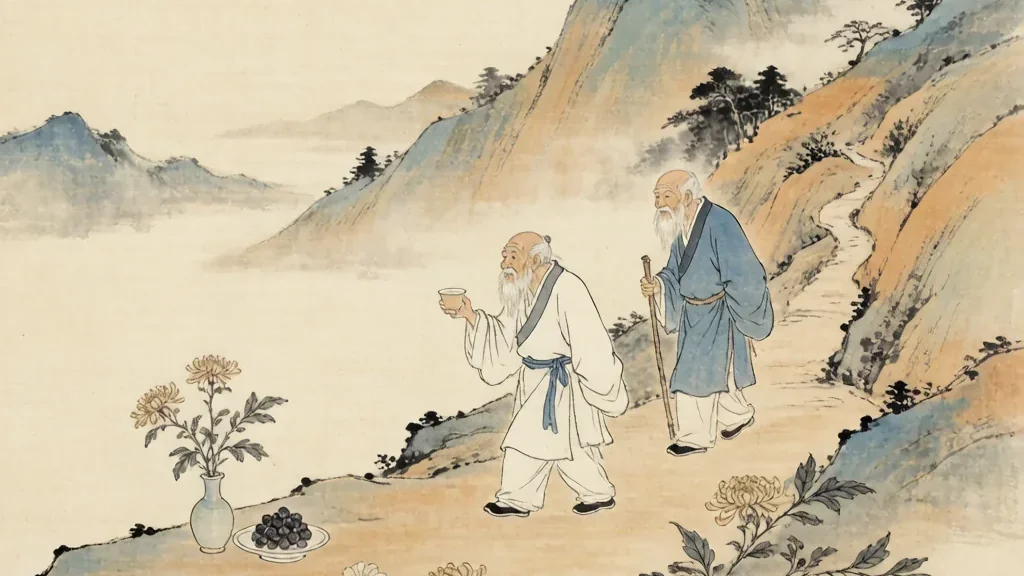
On the ninth day of the ninth lunar month, when autumn paints the mountains in shades of amber and gold, millions of Chinese people climb to high places. They carry sprigs of dogwood (zhūyú), sip cups of chrysanthemum wine (júhuā jiǔ), and breathe the crisp mountain air. This is Chongyang Festival (重阳节, Chóngyáng Jié) — the Double Ninth Festival — a celebration of height, health, longevity, and the triumph of human ingenuity over supernatural evil.
The name "Chongyang" means "double yang." In Chinese numerology and philosophy, the number nine is the ultimate yang number — the most masculine, active, and fiery digit in the cosmic order. When the ninth day of the ninth month arrives, yang energy reaches its peak. In traditional belief, this convergence of double yang energy is powerful but also dangerous — a time when the boundary between the human world and the spirit world grows thin, and malevolent forces may seek to cause harm.
And once, long ago, that is exactly what happened — until a young man named Huan Jing and his wise teacher found a way to fight back.
The Legend of Huan Jing and the Plague Demon
The story takes place during the Eastern Han Dynasty (25–220 CE), in a region nestled along the banks of the Ru River in what is now Henan Province. The people of this region lived simple but contented lives — until a plague demon (瘟魔, wēn mó) emerged from the waters of the Ru River and began terrorizing the countryside.
This was no ordinary sickness. The demon spread a devastating pestilence wherever it went. Entire villages fell ill within days. Crops withered in the fields. Livestock dropped dead. The people suffered from burning fevers, convulsions, and painful boils. Year after year, the demon returned, and year after year, the death toll mounted. The people of the Ru River region lived in constant terror, never knowing when the demon would strike next.
Among the afflicted was a young man named Huan Jing (桓景). Both of his parents fell victim to the plague and died. Huan Jing himself barely survived, and the grief and horror of his loss ignited a fierce determination within him. He swore an oath: he would find a way to destroy the plague demon and free his people from its tyranny forever.
The Journey to Immortal Fei Changfang
Huan Jing had heard rumors of a great immortal living in the remote mountains — Fei Changfang (费长房), a Taoist master who possessed profound magical powers and knowledge of the supernatural. Determined to learn the secrets that could defeat the demon, Huan Jing left his village and embarked on a grueling journey into the wilderness.
He climbed treacherous mountain paths, crossed raging rivers, and endured hunger and exhaustion. After many days of searching, he finally found the immortal's dwelling — a simple hut perched on a mist-shrouded peak. Huan Jing knelt before the master and told him everything: the plague, his parents' deaths, his vow of vengeance, and his willingness to do whatever it took.
Fei Changfang was moved by the young man's sincerity and courage. He agreed to take Huan Jing as his disciple, but warned him: the training would be arduous beyond imagination, and failure would mean death — not just for Huan Jing, but for everyone the demon would continue to kill.
For months, Huan Jing trained under the immortal's guidance. He learned to wield a magical sword that could cut through supernatural darkness. He studied the properties of protective herbs and learned which plants could repel evil spirits. He practiced breathing techniques that fortified the body's qi against disease. He memorized talismans and incantations. Through it all, he never forgot the faces of his parents or the suffering of his people.
One day, Fei Changfang summoned Huan Jing. "The time has come," the immortal said. "On the ninth day of the ninth month, the plague demon will emerge from the river once more. This is your chance." He gave Huan Jing three things: a sprig of dogwood (zhūyú), a flask of chrysanthemum wine (júhuā jiǔ), and the magical sword. "The dogwood will repel the demon. The chrysanthemum wine will protect those who drink it. And the sword — the sword is for you to finish what you started."
The Battle on the Mountain
Huan Jing returned to his village and instructed everyone to follow Fei Changfang's plan precisely. On the morning of the ninth day of the ninth month, every villager pinned a sprig of dogwood to their clothing, drank a cup of chrysanthemum wine, and climbed to the top of the nearest mountain. Huan Jing himself, armed with the magical sword, descended toward the river to confront the demon alone.
When the plague demon rose from the Ru River, it found the village deserted. Enraged, it began searching for victims. It sniffed the air and detected the scent of humans — on the mountain. The demon surged toward the peak, its foul miasma spreading before it like a wave of sickness.
But when the demon reached the villagers, something extraordinary happened. The scent of dogwood burned the demon's nostrils and made it recoil. The chrysanthemum wine the villagers had drunk created a protective barrier that the plague's poison could not penetrate. The demon shrieked in frustration and confusion — it had never encountered resistance before.
At that moment, Huan Jing attacked. The magical sword blazed with celestial light as he struck the demon again and again. The battle was fierce — the demon fought with the accumulated malice of years of unchecked destruction — but Huan Jing's training, his righteous fury, and the protective power of the herbs and wine proved stronger. With one final, decisive strike, he drove the sword through the demon's heart.
The plague demon dissolved into black smoke that the mountain wind scattered into nothingness. The Ru River ran clear again. The pestilence that had haunted the region for so long was broken forever.
Traditions Born from Victory
From that year onward, the people celebrated the ninth day of the ninth month by repeating the actions that had saved them: climbing to high places (登高, dēnggāo), wearing dogwood (茱萸, zhūyú), and drinking chrysanthemum wine (菊花酒, júhuā jiǔ). What began as a protective ritual against a specific supernatural threat evolved into a beloved festival celebrating health, longevity, and the beauty of autumn.
The tradition of climbing heights is the centerpiece of Chongyang. In ancient times, people would climb mountains, towers, or even just the highest point in their village. Today, hiking on Chongyang is a national pastime. Parks and scenic areas fill with families and friends enjoying the autumn scenery, breathing the crisp air, and symbolically "rising above" misfortune. The act of climbing represents aspiration, progress, and the human drive to reach higher — both literally and spiritually.
Chrysanthemums are the signature flower of Chongyang. In Chinese culture, the chrysanthemum symbolizes longevity, nobility, and the ability to flourish even as winter approaches. Chrysanthemum exhibitions are held in cities across China during the festival, showcasing spectacular displays of golden, white, and purple blossoms. Drinking chrysanthemum wine or tea is believed to promote health, improve eyesight, and ward off illness — a direct echo of the protective draught that saved Huan Jing's villagers.
Dogwood (zhūyú) — specifically the fruit of the Cornus officinalis plant — is worn as a protective charm. Its strong, pungent aroma was believed to repel evil spirits and disease. While this custom is less common today than it was in ancient times, it remains an important symbolic element of the festival.
Chongyang and the Honoring of Elders
In modern China, Chongyang has taken on an additional layer of meaning: it is now also celebrated as Senior Citizens' Day (老年节, Lǎonián Jié). The number nine (九, jiǔ) is a homophone for the word meaning "long-lasting" or "eternal" (久, jiǔ), making the Double Ninth Festival a natural occasion for wishing longevity to the elderly.
On this day, people visit their elderly parents and grandparents, bringing gifts of chrysanthemum flowers, longevity noodles, and specially prepared Chongyang cakes (重阳糕, chóngyáng gāo) — steamed rice flour cakes decorated with jujubes, chestnuts, and colorful flags. The word for "cake" (糕, gāo) sounds like "high" (高, gāo), reinforcing the festival's theme of ascending to greater heights.
Companies and community organizations hold events for seniors. Schools teach children about filial piety and respect for elders. The fusion of the ancient demon-slaying legend with the modern celebration of aging and wisdom makes Chongyang one of the most multilayered festivals in the Chinese calendar — a day that honors the past, celebrates the present, and wishes for a long and healthy future.
Chongyang in Poetry and Art
The Double Ninth Festival has inspired some of the most beautiful poetry in the Chinese literary canon. The Tang Dynasty poet Wang Wei (王维) captured the festival's bittersweet essence in his famous poem "Thinking of My Brothers on the Double Ninth Festival" (九月九日忆山东兄弟):
"Alone, a stranger in a strange land,
On every festive day, my longing doubles.
I know my brothers, far away, are climbing high,
Wearing dogwood — but one of us is missing."
These four lines, written over 1,200 years ago, still resonate today. They capture the universal experience of being far from loved ones on a day meant for togetherness — and the poignant image of dogwood sprigs worn in memory of an absent brother.
Chongyang is also deeply connected to Taoist philosophy. The festival occurs at the peak of yang energy, just before the year begins its inexorable turn toward yin — toward winter, darkness, and rest. Climbing mountains is not just about escaping a demon; it's about reaching toward the heavens, affirming life, and preparing the spirit for the colder months ahead. The chrysanthemum, blooming defiantly as other flowers fade, is a living reminder that resilience and beauty can coexist with the approach of winter.