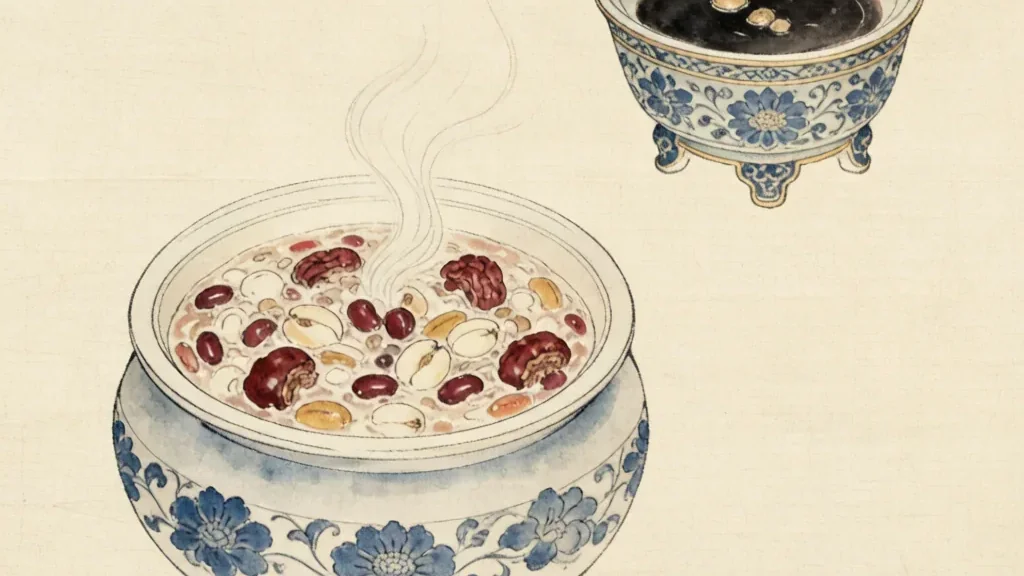
On the eighth day of the twelfth lunar month, as winter grips the land and the Chinese New Year approaches, the kitchens of China fill with the warm, nutty aroma of Laba congee (腊八粥, làbā zhōu). This thick, nourishing porridge — simmered from rice, millet, beans, nuts, dried fruits, and sometimes up to twenty or more ingredients — is the heart of Laba Festival (腊八节, Làbā Jié). It is a festival of gratitude, generosity, and the quiet wisdom that sometimes the simplest things — a bowl of porridge, a cup of garlic vinegar — carry the deepest meaning.
The origins of Laba Festival reach back over two thousand years, intertwining Buddhist tradition, ancient harvest rituals, and the timeless human need to give thanks for what sustains us. At its core is one of the most beautiful stories in Buddhist history: the tale of how a shepherd girl's simple act of kindness helped a starving ascetic become the Enlightened One.
The Story of Siddhartha and the Shepherd Girl
Around the 5th century BCE, in the region that is now northern India and Nepal, a prince named Siddhartha Gautama renounced his royal life to seek the truth about human suffering. He left behind his palace, his wealth, his wife, and his newborn son. He cut his long princely hair, traded his silk robes for the simple garments of a wandering ascetic, and set out into the world determined to find the path to liberation from birth, old age, sickness, and death.
For six years, Siddhartha practiced extreme asceticism. He ate almost nothing — sometimes just a single grain of rice a day, sometimes only a jujube fruit, sometimes nothing at all. He slept on beds of thorns. He exposed his body to the burning sun and the freezing night. He meditated for hours without moving, pushing his body and mind to their absolute limits.
But enlightenment did not come. Instead, Siddhartha grew weaker and weaker. His body, once strong and princely, became skeletal. His ribs pressed against his skin like the slats of a broken roof. His eyes sank deep into their sockets. He was close to death — so close that he could no longer meditate, could no longer think clearly, could barely remain conscious. He realized that starving himself was not the path to wisdom. The extreme of self-denial, he understood, was just as futile as the extreme of self-indulgence he had known in the palace.
On the verge of collapse, Siddhartha dragged himself to the banks of the Nairanjana River and collapsed beneath a tree. He was dying. And then — a miracle of ordinary kindness.
Sujata's Offering
A young shepherd girl named Sujata (sometimes called Nandabala in Buddhist texts) lived in a nearby village. She was a devout and compassionate soul who had made a vow to the spirit of a banyan tree: if she were blessed with a good husband and a son, she would make an offering of milk porridge each year in gratitude.
Her prayers had been answered — she had a loving husband and a healthy child. On the day of her annual offering, Sujata prepared a special bowl of milk porridge (乳糜, rǔmí), simmered with the richest milk from her cows and the finest grains she could gather. She carried it toward the banyan tree to fulfill her vow.
But when she arrived, she did not find the tree spirit she expected. Instead, she found a man — emaciated, barely breathing, his eyes half-closed — sitting in meditation beneath the tree. To Sujata, his presence was radiant despite his physical weakness. Something told her that this was no ordinary beggar.
Without hesitation, Sujata knelt and offered him the bowl of milk porridge. Siddhartha accepted it. The warm, nourishing food revived his body. For the first time in years, strength flowed back into his limbs. His mind, freed from the fog of starvation, became clear and sharp.
That very night, Siddhartha sat beneath the Bodhi tree and made a solemn vow: "I will not rise from this seat until I have attained complete enlightenment." Through the watches of the night, he meditated. He faced the temptations and terrors sent by Mara, the demon of delusion. And as the morning star rose in the eastern sky, Siddhartha Gautama became the Buddha — the Awakened One. The date was the eighth day of the twelfth lunar month.
How Laba Became a Chinese Festival
Buddhism arrived in China during the Han Dynasty (206 BCE – 220 CE), and with it came the story of Buddha's enlightenment and Sujata's offering of milk porridge. Chinese Buddhists began commemorating the day of Buddha's enlightenment — the eighth day of the twelfth lunar month — by preparing and sharing congee, the East Asian equivalent of the milk porridge Sujata had offered.
The custom spread from Buddhist temples to ordinary households. Temples would prepare enormous cauldrons of Laba congee and distribute it freely to the poor, the hungry, and anyone who came to the temple gates. This act of charity — 施粥 (shī zhōu, "giving congee") — became a central tradition of the festival, embodying the Buddhist values of compassion and generosity.
Over time, Laba also absorbed elements of ancient Chinese harvest and sacrificial rituals that predated Buddhism. The twelfth lunar month was traditionally called "La" (腊), a term that originally referred to the winter sacrifices offered to ancestors and gods. The eighth day — Laba — became a fusion of these indigenous traditions with the Buddhist commemoration, creating a uniquely Chinese festival that honors both spiritual awakening and earthly gratitude for the year's harvest.
The Art of Laba Congee
Laba congee is not just food — it is a work of culinary art and symbolic meaning. While every family and every region has its own recipe, a traditional Laba congee typically contains eight main ingredients (in honor of the eighth day), though many recipes call for far more. The core components include:
Grains: Glutinous rice, regular rice, millet, sorghum, and sometimes barley or wheat berries form the starchy base. Beans and legumes: Red beans, mung beans, kidney beans, and peanuts add protein and heartiness. Nuts and seeds: Lotus seeds, walnuts, almonds, ginkgo nuts, and chestnuts provide richness and texture. Dried fruits: Red jujubes (Chinese dates), longan, raisins, and goji berries bring natural sweetness. Seasonings: Rock sugar or brown sugar for sweetness; sometimes a pinch of salt to balance the flavors.
The congee is simmered slowly — often for hours — until all the ingredients meld into a thick, creamy, deeply comforting porridge. The aroma alone is said to be enough to warm a home on the coldest winter day. Each ingredient carries symbolic meaning: red beans for good fortune, lotus seeds for harmony and many children, jujubes for sweetness in life, and rice for abundance.
The act of sharing Laba congee is as important as eating it. Traditionally, the first bowl is offered to ancestors and household gods. Bowls are then shared with family members, neighbors, and friends. In many communities, people still bring congee to the homes of the elderly, the sick, and those who cannot prepare it themselves — a living continuation of the spirit of generosity that Sujata embodied.
Laba Garlic: The Other Festival Tradition
In northern China, Laba Festival is also associated with a completely different culinary tradition: Laba garlic (腊八蒜, làbā suàn). On the eighth day of the twelfth lunar month, families peel cloves of garlic and place them in jars filled with vinegar. The jars are sealed and left to steep until Chinese New Year's Eve.
During the weeks of steeping, something magical happens: the garlic cloves turn a brilliant, translucent jade green. The vinegar, now infused with garlic, becomes a tangy, aromatic condiment perfect for dipping dumplings — the essential food of Chinese New Year celebrations. The transformation of the garlic from white to green mirrors the transformation of winter into spring, and the Laba garlic becomes a bridge between the Laba Festival and the New Year festivities that follow.
The name "suan" (蒜, garlic) is a homophone for "calculate" (算, suàn), leading to a charming folk tradition: on Laba, businesses would settle their accounts for the year, and families would "calculate" their blessings and debts — both financial and moral — preparing for a clean start in the new year.
Laba as a Gateway to Chinese New Year
There is a well-known Chinese saying: "After Laba, it's the New Year" (过了腊八就是年, guò le làbā jiù shì nián). Laba marks the beginning of the intense preparation period leading up to the Spring Festival (Chinese New Year). From Laba onward, families begin cleaning their homes, shopping for New Year goods, preparing preserved meats, and writing Spring Festival couplets.
The twelfth lunar month is a time of reflection and anticipation. The old year is ending; the new year approaches. Laba congee, with its rich mixture of ingredients gathered from the year's harvest, is both a celebration of what has been and a hopeful offering for what is to come. The Buddhist story of Sujata reminds us that even the smallest act of kindness can change the course of history — and that enlightenment, whether spiritual or personal, is available to anyone willing to accept help and nourishment along the way.
Today, Laba Festival is celebrated throughout China and in Chinese communities around the world. Temples still distribute free congee to thousands of visitors. Families still gather around steaming bowls of the sweet, nutty porridge. And somewhere in every bowl is a whisper of that ancient story — the starving prince, the shepherd girl with her offering of milk and grain, and the morning star that rose over the Bodhi tree, signaling that compassion and nourishment are the truest paths to awakening.