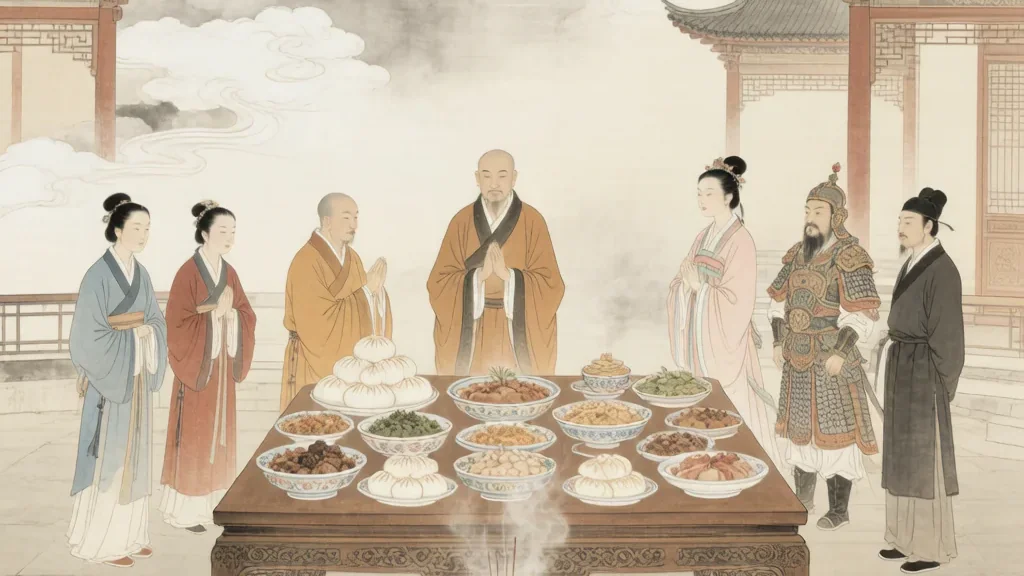
The Ullambana Festival (盂兰盆节, Yúlánpén Jié), widely called the Ghost Festival, is the day when the boundaries between the living and the dead grow thin. Observed on the fifteenth day of the seventh lunar month, it joins Buddhist compassion, Taoist cosmology, and folk custom into a single season of feeding hungry spirits, honouring ancestors, and expressing filial devotion.
The Mulian Legend
The festival derives from the Ullambana Sutra and the story of Mulian (目连, Maudgalyayana), a disciple whose mother was reborn among the hungry ghosts for her selfishness. Using his powers he saw her tormented by endless hunger, her throat too thin to swallow and her belly never filled.
Mulian appealed to the Buddha, who taught that on the fifteenth day of the seventh month he should make offerings to the monastic community, transferring the merit to free his mother. This tale of "Mulian rescues his mother" (目连救母) became the emotional core of the festival and a lasting parable of filial piety.
The tale travelled to China with the translation of the Ullambana Sutra and proved so moving that, by the sixth century, Emperor Wu of Liang (梁武帝, Liáng Wǔdì, r. 502–549) is credited with founding the first imperial Ullambana assembly, lifting a story of private devotion into a state rite of merit for all the dead.
The Hungry Ghost Realm
In Buddhist cosmology the hungry ghosts (饿鬼, èguǐ) are beings reborn in craving, with enormous bellies and pinhole throats that make eating impossible. During the seventh month the gates of the underworld open and these restless spirits roam the world of the living.
Offerings of food, incense, and paper money are believed to ease their hunger and earn merit for the giver. The festival thus turns fear of wandering ghosts into an act of generosity toward the suffering.
In Sanskrit these spirits are called "preta", meaning "the departed", and they dwell in one of the six realms of rebirth. Their endless hunger is also a symbol: it stands for craving that can never be satisfied, a quiet lesson the festival teaches even as it feeds the starving dead.
The Taoist Zhongyuan Festival
Taoism gives the day its own name, Zhongyuan Jie (中元节), the "Central Prime". It forms the middle of three "prime" festivals alongside Shangyuan (上元, the Lantern Festival) and Xiayuan (下元), each governed by one of the Three Officials.
On Zhongyuan the Earth Official (地官, Dìguān) descends to review the deeds of the living and pardon the sins of the dead, releasing them from suffering. Where Buddhism stresses mercy, the Taoist frame stresses cosmic accounting and forgiveness.
Folk Practices and Offerings
Families lay out elaborate meals for ancestors and burn spirit money, paper clothes, and paper houses so the dead may use them in the afterlife. An empty seat is often set at the table for visiting spirits, who are treated as unseen guests.
Temple and neighbourhood rites include chanting, the release of captive animals, and the performance of "ghost operas" (鬼戏) staged so that both the living and the wandering dead may watch. The mood is solemn yet communal.
Floating River Lanterns
A beloved custom is the floating of river lanterns (河灯, hédēng): small lamps set on lotus-shaped paper rafts and released onto streams and rivers to guide lost souls back to the underworld and to light the way for ancestors.
On the night of the fifteenth, waterways glow with hundreds of flickering lights. The lanterns blend beauty with reassurance, marking the spirits' safe return rather than their lingering among the living.
The Ghost Month
The single day sits inside a broader Ghost Month (鬼月, guǐyuè) lasting the entire seventh lunar month, when the hell gate is thought open. Many people avoid swimming, travelling at night, or starting major ventures, lest they disturb or be taken by spirits.
As the month closes the gates are sealed again, and the living resume ordinary life with the comfort that the dead have been fed, honoured, and sent home.
Regional Observances
In Taiwan the festival becomes the lavish Zhongyuan Pudu (中元普渡), with towers of offerings and the dramatic "grab-the-ghost" poles (抢孤, qiǎnggū) climbed for prizes. In Hong Kong the Chiu Chow community holds grand Yu Lan rites with giant paper effigies of deities paraded and burned.
Southeast Asian Chinese in Singapore and Malaysia stage getai (歌台) variety shows and communal feasts, while monasteries across the Chinese world hold all-night sutra chanting. The festival travels with the diaspora.
Ullambana Across East Asia
The wish to feed and honour the dead spread well beyond China. In Japan it became Obon (お盆), kept in mid-August, when families sweep graves and dance the bon odori (盆踊り) to welcome ancestors home, then float paper lanterns (灯篭流し, tōrō nagashi) to send them off again. In Korea the same fifteenth day is Baekjung (백중), once a rest day on which monks were fed.
In Vietnam the season is Vu Lan (Vu Lan báo hiếu), kept as a filial "Mother's Day": a red rose pinned to the chest means one's mother is alive, a white rose that she has passed. The customs differ, yet the seventh-month bond between the living and the dead is shared across the whole Sinosphere.
Food Offerings and Hungry Ghost Lore
Because the rite began as an offering to monks, the food set out is traditionally vegetarian — rice, noodles, fruit, and mock-meat dishes. A full Pudu (普渡, pǔ dù) banquet may pile dozens of plates on tall red tables, the richest spread saved for the "good brothers" (好兄弟, hǎo xiōngdì), the polite name folk use for hungry ghosts so as not to anger them by naming them directly.
Beside food, people burn joss paper and paper effigies of clothes, cars, and houses so the dead may live well in the next world. Folk belief says spirits fear peach-wood and willow and cannot cross running water — which is exactly why lanterns are floated on rivers to carry them safely home.
Similar Ghost Festivals Worldwide
The urge to feast the dead is nearly universal. Mexico's Día de los Muertos builds ofrendas — home altars of food, marigolds, and photographs — on 1–2 November, while Thailand's Phi Ta Khon masks hungry-ghost lore in merrymaking. Cambodia's Pchum Ben gives alms to monks for seven generations of ancestors, and Nepal's Gai Jatra honours the recently dead with cow processions.
Each culture sets its own season when the veil thins and the living repay their debt to those who came before. The Ullambana Festival is China's chapter of this worldwide act of remembrance.
Modern Meaning and Care
Today the Ghost Festival persists as a moment of filial remembrance in an urban age, even where belief has faded. City dwellers often burn offerings in designated bins rather than at gravesides, and some communities promote eco-friendly lanterns to spare the rivers.
At its heart the festival teaches that the dead are not forgotten and that kindness extends beyond the grave — a humane message that keeps an ancient rite relevant in modern life.
Governments have joined in as well. Taipei and Hong Kong now sponsor large, regulated Pudu events with fire-safety zones, while environmental groups hand out biodegradable river lanterns and LED candles so devotion no longer costs the rivers and skies their health.
❓ Frequently Asked Questions
📝 Chinese Vocabulary
盂兰盆节 — : Ullambana Festival; the Ghost Festival.
中元节 — : Zhongyuan Festival; the Taoist name for the day.
饿鬼 — : hungry ghost; a craving spirit of the dead.
目连 — : Mulian; the disciple who rescued his mother.
目连救母 — : Mulian rescues his mother; the founding legend.
河灯 — : river lantern; a floating light to guide spirits.
鬼月 — : Ghost Month; the seventh lunar month.
中元普渡 — : Zhongyuan salvation rite; Taiwan's grand observance.
地官 — : Earth Official; the Taoist god who pardons the dead on this day.
普渡 — : universal salvation; the communal feast offered to hungry ghosts.
好兄弟 — : "good brothers"; a respectful folk term for hungry ghosts.
🎉 Fun Facts
- The festival's name comes from the Sanskrit "ullambana", meaning "hanging upside down", a metaphor for the suffering of hungry ghosts.
- In Taiwan, the "grab-the-ghost" poles (抢孤) are greased wooden towers climbed in a race for offerings at the top.
- Hong Kong's Chiu Chow community burns giant papier-mâché effigies of deities during its Yu Lan rites.
- The Ghost Festival shares its season with Japan's Obon and Vietnam's Vu Lan, both honouring ancestors.
- Many people avoid swimming or late-night travel during Ghost Month, fearing water or wandering spirits.
- Floating river lanterns are released to guide lost souls back to the underworld at month's end.
- The medieval "Mulian rescues his mother" story became one of the most performed tales in Chinese opera.
- Emperor Wu of Liang is traditionally credited with founding the first imperial Ullambana assembly in the 6th century.
- In Vietnam, Vu Lan doubles as Mother's Day: a red rose means one's mother is alive, a white rose that she has passed.