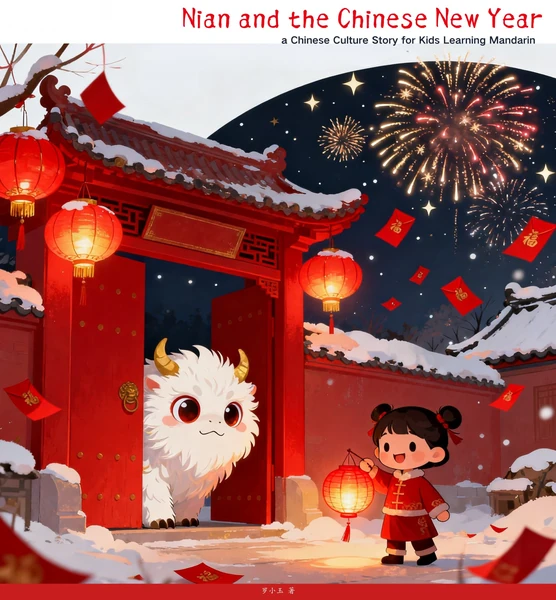
Every year, as winter begins to loosen its grip and the first hints of spring appear, over a billion people across China and the world gather with their families for the most important celebration in the Chinese calendar: Chinese New Year, or the Spring Festival. Streets glow with red lanterns, the air crackles with firecrackers, children receive crimson envelopes filled with money, and families feast on dumplings late into the night. But why red? Why firecrackers? Why the deafening noise?
The answer lies in a legend that has been told for thousands of years — the story of Nian (年), a terrifying monster whose name would eventually become the Chinese word for "year" itself. This is the origin story of Chinese New Year traditions, a tale of fear, cleverness, and the moment an entire village learned that courage comes in unexpected forms.
The Beast That Came Every Year
Long ago, deep beneath the mountains or at the bottom of the sea — depending on which version you hear — lived a monstrous creature called Nian. It had the head of a lion, the body of a bull, and a mouth large enough to swallow a grown man whole. Its eyes blazed like burning coals, and its roar could shake the walls of the sturdiest house.
For most of the year, Nian slept in its dark lair, undisturbed by the world above. But on the last night of the lunar year — New Year's Eve — the beast would awaken. Driven by an insatiable hunger, it would crawl out from its hiding place and descend upon the nearest village, devouring livestock, destroying crops, and, most terrifyingly, snatching away children who had not yet hidden themselves away.
The villagers lived in constant dread. Each year, as the calendar crept toward its final days, they would pack their belongings, gather their children and elderly, and flee into the mountains. They would huddle in caves, shivering in the cold, waiting for the beast to finish its rampage and return to its lair. Only then, when the first light of the new year broke over the horizon, would they dare to creep back down and survey the damage left behind.
This cycle of terror had gone on for as long as anyone could remember. The villagers had tried everything — offerings of food left at the village gate, prayers to every god they knew, even attempts to fight the creature with spears and arrows. Nothing worked. Nian was too strong, too fierce, too hungry.
The Arrival of the Mysterious Old Man
One year, as the villagers prepared for their annual evacuation, an unfamiliar figure appeared at the edge of the village. He was an old man — ancient, really — with a long white beard that reached his chest, kind but piercing eyes, and a walking stick carved with symbols no one recognized. He wore simple, weathered robes and carried nothing but a small bundle on his back.
"Why is everyone leaving?" the old man asked, though his calm smile suggested he already knew the answer.
The villagers hurriedly explained about Nian — the monster, the destruction, the fear. "You must come with us to the mountains, grandfather," an old woman urged him, pressing a warm bun into his hands. "The beast will be here by nightfall. It shows no mercy to anyone."
The old man thanked her for the bun but shook his head. "I will stay here tonight," he said. "And I will face this Nian."
The villagers were stunned. They pleaded with him, warned him, tried to drag him along. But the old man was firm. "Go to the mountains," he said. "Tomorrow morning, return to your village. You will find it standing."
Reluctantly, and convinced they were leaving the old man to his death, the villagers departed. As the sun sank below the mountains and darkness swallowed the valley, the old man set to work. He hung red paper scrolls on every door. He lit candles and lanterns until the entire village glowed crimson. He piled firecrackers — long strings of bamboo stuffed with gunpowder — in the village square. Then he put on a bright red robe, sat in the center of the village, and waited.
The Night of Fire and Noise
At midnight, the ground began to tremble. From the darkness, Nian emerged — huge, hideous, and hungry. It stomped into the village, expecting to find easy prey. But something was different. The village was bathed in red light, and at its center sat a single old man in a red robe, completely unafraid.
Nian roared and lunged forward. But the moment it saw the red decorations and the old man's red robe, it recoiled. The color seemed to burn its eyes. Confused and enraged, it tried to charge again. That's when the old man lit the first string of firecrackers.
Pop! Crack! Boom! The firecrackers exploded in a furious chain of light and noise. Nian froze, its massive body trembling. The sound was unbearable — sharp, loud, unpredictable. It tried to run, but the old man had set firecrackers all around the village. Every direction the beast turned, more explosions greeted it.
The old man stood up and banged two pieces of wood together — a loud, rhythmic clacking that echoed through the night. He lit more firecrackers, sending showers of sparks into the sky. Nian, terrified beyond anything it had ever experienced, let out a pitiful whimper and fled back into the mountains. It did not stop running until it was deep in its lair, trembling in the darkness.
A New Tradition Is Born
When the villagers returned at dawn, they could hardly believe their eyes. The village was intact. Not a single roof was damaged, not a single animal taken. And there, sitting calmly in the village square, was the old man — alive and smiling.
"How did you survive?" they asked, crowding around him.
The old man explained what he had discovered: Nian feared three things — the color red, loud noises, and bright light. Armed with this knowledge, the villagers would never need to flee again. They could defend their homes, their families, and their way of life.
From that year onward, every New Year's Eve, the villagers decorated their homes with red paper cutouts and couplets (春联, chūnlián). They set off firecrackers and fireworks. They lit lanterns and stayed awake all night — a tradition called 守岁 (shǒusuì), or "keeping watch over the year." They wore red clothing and gave children red envelopes filled with money — the beloved 红包 (hóngbāo). And they greeted each other not with fear, but with joy: "过年好!" (Guò nián hǎo!) — "Happy passing of the Nian!"
Over time, the phrase 过年 (guò nián) came to mean "celebrating the New Year," and the character 年, which once meant nothing but a terrifying monster, became the word for "year" — a beautiful transformation from fear into festivity.
The Deeper Meaning of Nian
The legend of Nian is more than just an exciting story. It carries profound cultural values that still resonate today. The old man's courage represents the power of wisdom over brute force — he didn't fight Nian with weapons, but with understanding and cleverness. The villagers' willingness to learn and adapt shows the importance of community and shared knowledge.
The color red, which terrified Nian, has become the defining color of Chinese celebrations. It symbolizes good fortune, joy, vitality, and protection from evil spirits. The firecrackers, originally bamboo tubes thrown into fires (the popping sound comes from air expanding inside the sealed bamboo segments), evolved into the elaborate fireworks displays that light up cities across China every Spring Festival.
And the tradition of staying awake all night — shǒusuì — carries a beautiful meaning. Families gather for a reunion dinner (年夜饭, niányèfàn), share stories, play games, and watch the New Year's Gala on television. Elders give red envelopes to children, passing on blessings of health and prosperity. By staying awake together, the family shows that they face the unknown of the coming year united, just as the villagers once faced Nian together.
The lion dance and dragon dance performances you see during Chinese New Year celebrations also trace their roots to the Nian legend. The loud drums and clashing cymbals, the bold red and gold colors of the lion costumes — all are echoes of that first night when an old man taught a village to fight fear with fire and noise.
Today, as fireworks burst over cities from Beijing to San Francisco, as red lanterns sway in doorways, and as children tear open red envelopes with delighted squeals, the spirit of that ancient village lives on. The Nian has become something to celebrate rather than fear — a reminder that even the scariest monsters can be overcome with courage, cleverness, and a little bit of red.
The Foods of Good Fortune
The New Year table is a quiet language of hope. Dumplings folded like old gold ingots promise wealth, and some hide a coin inside for the lucky eater. A whole fish is served but left partly uneaten, so that surplus carries into the next year. Sticky rice cake, whose name sounds like 'year high,' wishes every endeavor a rise, while spring rolls resemble bars of gold. Even the arrangement carries meaning: seats fill by seniority, and the first toast honors the elders. To eat the New Year meal is to consume blessing itself, each bite a small, deliberate wish for the months to come. Oranges and tangerines pile on the table for their golden color and lucky sound, and a plate of seeds or nuts is left out so the kitchen is never empty, a promise that the family will not go hungry in the year ahead.
Staying Up and Reuniting
After the feast comes shou sui, keeping watch. The family stays up together, talking, playing games, and watching the televised New Year's Gala as midnight approaches, unwilling to let the old year slip away unwitnessed. At the first hour of the new day, doors open, firecrackers burst, and the younger generation greets the elders with bows and good wishes. In the following days come visits to relatives and friends, each meeting opening with auspicious phrases. This rhythm of reunion, vigil, and calling on kin is what turns the defeat of a monster into the warmest celebration of the Chinese year. Red envelopes of money pass from elder to child, and the door gods pasted on the panels stand guard, so the household enters the new year both blessed and defended, its luck renewed by family gathered under one roof.