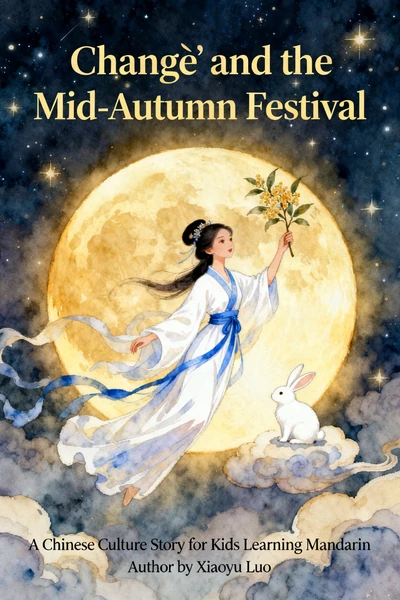
On the 15th night of the eighth lunar month, when the moon hangs fullest and brightest in the autumn sky, families across China and East Asia gather outdoors. They set out tables covered with round fruits, pots of fragrant tea, and ornate boxes of mooncakes — dense, sweet pastries stamped with intricate patterns. They gaze up at the moon, searching its silvery face for a shadow that, according to legend, is not a crater or a mountain, but a woman. Her name is Chang'e (嫦娥), and her story is one of the most beautiful and heartbreaking tales in all of Chinese mythology.
The legend of Chang'e and the Moon is the origin story of the Mid-Autumn Festival (中秋节, Zhōngqiū Jié), also known as the Moon Festival. It is a story woven from threads of heroism, love, sacrifice, and loneliness — and it explains why, on the brightest night of the year, we look up at the moon and think of those we love who are far away.
The Ten Suns and the Archer Who Saved the World
Long ago, the world was not the temperate place we know today. Ten suns — the sons of the Jade Emperor — took turns crossing the sky, each one lighting the earth for a single day before yielding to the next. But one day, the ten suns grew tired of their orderly rotation. "Why should we go one at a time," they said to each other, "when we could all shine together?"
And so, on a morning that would be remembered for millennia, all ten suns rose into the sky at once. The earth was plunged into catastrophe. Rivers boiled dry. Forests burst into flame. Crops withered in the fields. People and animals died by the thousands, scorched by the unbearable heat. The Jade Emperor, seeing the destruction his sons had caused, summoned the greatest archer in all the realms — a mortal named Houyi (后羿).
Houyi was a hero of legendary skill. His bow was carved from the wood of a sacred tree, and his arrows were forged in heavenly fire. The Jade Emperor gave him a divine mission: shoot down the rogue suns and restore order to the world. Armed with ten arrows, Houyi climbed to the highest peak on earth, drew his bow, and one by one, shot nine of the suns out of the sky. Each fell as a golden raven, leaving only one sun to warm the earth as it does today.
Houyi became a hero celebrated throughout the land. But his greatest reward was not fame — it was meeting Chang'e, a woman of extraordinary grace and kindness. The two fell deeply in love and were married. Houyi taught archery to young students, and Chang'e kept a warm and welcoming home. They lived happily, content in their mortal lives. But Houyi, being mortal, knew that one day death would separate him from his beloved wife.
The Elixir of Immortality
Determined to find a way to stay with Chang'e forever, Houyi embarked on a long and perilous journey to the Queen Mother of the West (西王母, Xī Wáng Mǔ), a powerful goddess who lived on the mythical Mount Kunlun. The journey tested every ounce of Houyi's strength and courage — he crossed burning deserts, climbed impossible peaks, and faced creatures that no mortal had ever survived.
Moved by his devotion, the Queen Mother granted Houyi a small vial containing the elixir of immortality. "This is enough for two people," she told him. "If you and your wife each drink half, you will live together forever. But if one person drinks it all, they will ascend to the heavens and become an immortal — never to return to the mortal world."
Houyi returned home with the precious elixir, his heart full of hope. He showed it to Chang'e and explained the Queen Mother's words. They agreed to drink it together on the 15th day of the eighth month, when the moon would be at its fullest — a symbol of their complete and eternal love. Houyi hid the elixir in a cabinet and continued his daily life, never suspecting that tragedy was already on its way.
The Fateful Choice
Among Houyi's students was a man named Feng Meng (逢蒙), who had learned archery from the master but whose heart was black with envy and greed. Feng Meng had overheard rumors of the elixir and became obsessed with obtaining it for himself. One day, when Houyi was away on a hunting expedition, Feng Meng saw his chance.
He burst into Houyi and Chang'e's home with a sword drawn, demanding that Chang'e hand over the elixir. Chang'e knew she could not fight him. She was not a warrior like her husband. But she also knew that if Feng Meng drank the elixir, he would become an immortal tyrant — and all of Houyi's sacrifices would be in vain.
With no time to think and no other choice, Chang'e ran to the cabinet, seized the vial, and drank the entire elixir herself. The effect was immediate. Her body grew light as a feather. A gentle, irresistible force began to lift her off the ground. She floated through the window and up into the sky, leaving Feng Meng cursing below. She rose higher and higher, past the clouds, past the stars, until she could no longer see the earth.
But Chang'e did not want to go to the distant heavens. She wanted to stay close to her husband, close to the world she loved. And so, as she ascended, she steered herself toward the closest celestial body — the moon. There, on that cold, silver sphere, she made her home. From the moon's surface, she could look down at the earth and watch over Houyi, forever separated by an ocean of stars.
A Love That Spans the Sky
When Houyi returned home and discovered what had happened, his grief was boundless. He ran outside and looked up at the moon, and there — if he squinted — he could see the faint outline of his wife's silhouette against the lunar surface. He set out a table in the courtyard and placed upon it Chang'e's favorite foods: round fruits, sweet cakes, and fragrant incense. Night after night, he would sit beneath the moon, speaking to the shadow he believed was his beloved.
According to some versions of the legend, the Jade Emperor took pity on the separated lovers. He allowed Houyi to build a palace on the sun, and once a year — on the 15th day of the eighth month — the sun and moon align, and the two are reunited, if only for a single night. Other versions say that Chang'e was joined on the moon by a Jade Rabbit (玉兔, Yù Tù), who pounds the elixir of life in a mortar, keeping her company in her eternal solitude.
The people, moved by Chang'e's sacrifice and Houyi's devotion, began to honor her on the anniversary of her ascent. They prepared offerings of food, lit lanterns, and gazed at the moon, sending their thoughts and prayers to the goddess who had given up everything for love. This tradition became the Mid-Autumn Festival, celebrated for over 3,000 years.
Mooncakes: The Taste of Reunion
No Mid-Autumn Festival is complete without mooncakes (月饼, yuèbǐng) — round, dense pastries that symbolize completeness and reunion. The round shape echoes the full moon and represents family unity. Traditional mooncakes are filled with lotus seed paste and salted egg yolks, which represent the full moon itself. Other popular fillings include red bean paste, mixed nuts and ham, and snow skin varieties made from glutinous rice.
Mooncakes also carry a hidden history. During the Yuan Dynasty, when China was under Mongol rule, Han Chinese rebels used mooncakes to secretly pass messages, hiding notes inside the pastries to coordinate an uprising. The plan succeeded, and the mooncake became not just a delicious treat, but a symbol of resistance and liberation.
Today, mooncakes are given as gifts to family, friends, and business associates. Elaborate gift boxes appear in shops weeks before the festival, and families gather after dinner to cut mooncakes into small wedges, sharing them with tea while telling the story of Chang'e to the youngest children, who gaze wide-eyed at the glowing moon above.
The Festival Today
Modern Mid-Autumn Festival celebrations blend ancient traditions with contemporary life. Families still gather for reunion dinners, but now they might video-call relatives who live far away. Children still carry lanterns — but many are now battery-powered and shaped like their favorite cartoon characters. The core ritual remains unchanged: stepping outside after dinner, looking up at the moon, and thinking of loved ones near and far.
In parks and public squares across China, people release sky lanterns carrying handwritten wishes into the night. In Hong Kong, the spectacular Tai Hang Fire Dragon Dance fills the streets with a 67-meter-long dragon made of burning incense sticks. In Vietnam, where the festival is called Tết Trung Thu, children parade with star-shaped lanterns and enjoy lion dances.
The legend of Chang'e resonates across cultures and generations because it speaks to something universal: the pain of separation and the hope of reunion. Whether you are separated from loved ones by distance, by circumstance, or by time, the full moon of the Mid-Autumn Festival reminds us that we all share the same sky — and that love, like moonlight, can travel across any distance.
The Moon Rabbit and the Palace of Cold
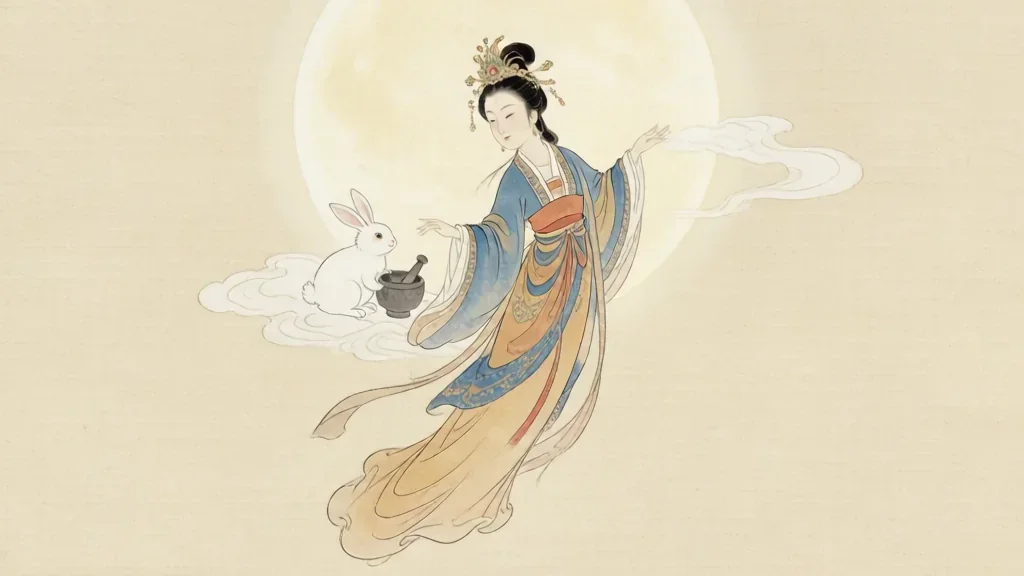
Beside Chang'e on the silent moon lives the Jade Rabbit, a figure as old as the legend itself. In most versions the rabbit pounds the elixir of immortality in a mortar, keeping the medicine of long life ever in preparation, and its busy shape is what some stargazers claim to see in the moon's bright plains. Chang'e's dwelling is called the Guanghan Palace, the 'Palace of Broad Cold,' a name that captures the lonely, silver stillness of her exile above the world. Together the goddess, the rabbit, and the cold palace form a small court in the sky, distant from human warmth yet watching over it. The image softens the tragedy: Chang'e is not alone, and her companion ties her to the very elixir that sent her upward. On Mid-Autumn night, when families look up, they are really looking for this quiet pair, the most familiar inhabitants of the Chinese moon.