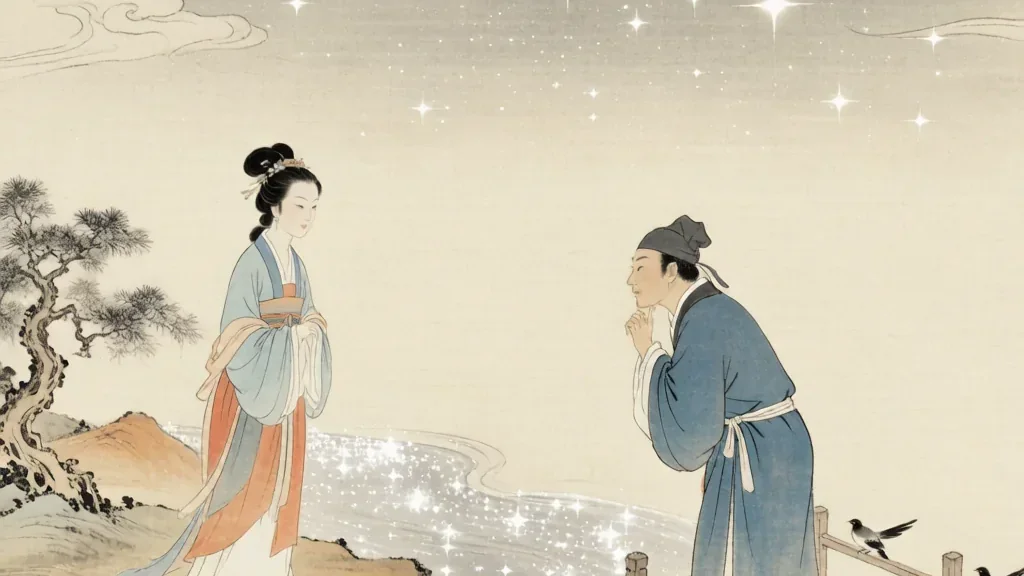
On the seventh night of the seventh lunar month, when the summer sky is clearest and the stars burn brightest, Chinese lovers look up and remember a story that has been told for over two thousand years. It is the story of Qixi (七夕, Qīxī) — China's Valentine's Day — and at its heart are two stars, separated by the entire Milky Way, who are allowed to meet only once a year.
This is not just any love story. It is a myth woven into the fabric of the cosmos itself. Look up on a clear summer night and you can see them: Vega (织女星, Zhīnǚ xīng), the Weaver Girl star, and Altair (牛郎星, Niúláng xīng), the Cowherd star, glittering on opposite banks of the great celestial river we call the Milky Way.
The Story of Niulang and Zhinü
Long ago, there lived a young cowherd named Niulang (牛郎). He was orphaned at a young age and treated cruelly by his elder brother and sister-in-law, who eventually drove him out of the family home with nothing but an old ox for company. Niulang was kind-hearted and hardworking. He tended his ox with devotion, and the two became inseparable companions. What Niulang did not know was that his ox was no ordinary animal — it was a celestial being who had been banished from heaven for a minor transgression.
One day, the ox spoke to Niulang. "Master," it said, "tomorrow, seven fairy maidens will descend from heaven to bathe in the crystal-clear lake at the foot of the mountain. They are the daughters of the Jade Emperor. Hide yourself among the reeds and watch. When you see the one whose weaving is the most beautiful, take her feathered robe — for without it, she cannot return to heaven."
Niulang was stunned that his ox could speak, but he trusted his faithful companion. The next day, he went to the lake and hid as instructed. Sure enough, seven celestial maidens descended on clouds, their silk robes shimmering with starlight. They laughed and splashed in the water, their beauty illuminating the forest. Among them, the youngest — Zhinü (织女), the Weaver Girl — was the most radiant of all. She was the goddess responsible for weaving the colorful clouds that decorated the sky at dawn and dusk.
Following the ox's advice, Niulang took Zhinü's feathered robe from where it lay on the bank. When the maidens finished bathing and prepared to return to heaven, Zhinü could not find her robe. Her sisters, bound by the strict rules of the celestial court, could not linger — they had to return before their absence was noticed. Zhinü was left behind, stranded in the mortal world.
Niulang emerged from his hiding place and returned the robe to the weeping fairy. But by then, something unexpected had happened. Looking into the cowherd's honest, gentle eyes, Zhinü felt a stirring in her heart that she had never experienced in the cold perfection of heaven. Niulang, in turn, was captivated by her grace and kindness. The two fell deeply in love.
A Life Together — and the Wrath of Heaven
Zhinü chose to stay in the mortal world with Niulang. They married and built a simple but joyful life together. Zhinü used her celestial weaving skills to create beautiful cloth that the villagers admired and purchased. Niulang tended his fields, and his faithful ox grew old contentedly. In time, they had two children — a son and a daughter — and their happiness seemed complete.
But heaven does not forget its own. The Queen Mother of the West (西王母, Xī Wángmǔ), the formidable goddess who governed the celestial realm alongside the Jade Emperor, discovered that Zhinü had abandoned her divine duties. The sky had grown dull without her weaving — the dawn clouds lacked their rose-gold brilliance, and the sunset had lost its fiery splendor. Enraged, the Queen Mother sent celestial soldiers to retrieve the wayward fairy.
The soldiers descended like a storm, seizing Zhinü and dragging her back toward heaven. Niulang, carrying their two children in baskets suspended from a pole across his shoulders, chased after them with desperate determination. He ran and ran, his children crying for their mother, his feet bleeding on the rocky ground. He was gaining on them — he could almost reach her — when the Queen Mother appeared between them.
With a single sweep of her silver hairpin, the Queen Mother drew a line across the sky. Instantly, the line transformed into a vast, raging river of stars — the Milky Way (银河, Yínhé). Niulang and Zhinü were separated forever, trapped on opposite banks of the celestial river, able to see each other but never to touch.
Zhinü wept by the eastern shore. Niulang, with their children, wept by the western shore. Their tears fell into the Milky Way, making its waters swell. The children cried for their mother. Even the Jade Emperor, from his distant throne, was moved by the sound of such sorrow.
The Bridge of Magpies
Moved by the depth of their love and the pitiful cries of their children, the magpies of the world took pity on the separated lovers. On the seventh day of the seventh lunar month, thousands upon thousands of magpies flew up from the earth and gathered across the Milky Way. They spread their wings and formed a living bridge — the Queqiao (鹊桥), the Bridge of Magpies — spanning the starry river.
Niulang and Zhinü rushed toward each other across the bridge of black and white feathers. They met in the middle, embracing with tears of joy and sorrow. For one precious night each year, they are together again.
Witnessing this annual miracle, even the Queen Mother's heart softened — slightly. She decreed that the magpie bridge would be permitted once a year, on the seventh night of the seventh month, forever. It is said that on Qixi night, you won't see a single magpie on earth — they have all flown to heaven to build the bridge. And if you sit quietly under a grapevine trellis, you might just hear the lovers whispering to each other across the stars.
Qixi Traditions Through the Ages
Qixi has been celebrated in China since the Han Dynasty (206 BCE – 220 CE), and over the centuries, rich traditions have developed around this romantic festival. In ancient times, Qixi was not primarily about romantic love between men and women — it was a festival where young women demonstrated their domestic skills, particularly needlework, to honor Zhinü, the patron goddess of weaving.
One of the most famous traditions is threading a needle under the moonlight (乞巧, qǐqiǎo — literally "begging for skills"). Young women would attempt to thread a needle with seven holes by moonlight. Success meant Zhinü had blessed them with dexterity and skill. Some would even float needles on water — if the needle's shadow formed a distinct shape rather than a blurry smudge, the girl was considered especially clever.
In some regions, women prepared offerings of fruit, flowers, and cosmetics to Zhinü, asking not only for skill in weaving but also for beauty and a good husband. Elaborate sewing competitions were held, with the winner earning great admiration and social status. The festival was, in many ways, a celebration of feminine artistry and accomplishment.
Modern Qixi: China's Valentine's Day
Today, Qixi has evolved into a romantic holiday comparable to Valentine's Day in the West. Couples exchange gifts — flowers, chocolates, jewelry — and enjoy candlelit dinners. Restaurants offer special Qixi menus. The internet fills with declarations of love, and social media platforms overflow with romantic imagery of the cowherd and the weaver girl.
Yet beneath the commercial layer, the ancient poetry of Qixi endures. The image of two lovers separated by an entire galaxy, reunited by the compassion of birds, speaks to something universal: the idea that love can transcend any distance, any obstacle, even the boundary between heaven and earth. In a country where many couples have been separated by work, migration, and circumstance, the story of Niulang and Zhinü carries a particularly poignant resonance.
On Qixi night, if the sky is clear, you can do what lovers have done for millennia: step outside, find Vega and Altair glittering on opposite sides of the Milky Way, and remember that even stars can fall in love — and even the heavens can be moved by a love that refuses to give up.