The Winter Solstice Festival, known in Chinese as 冬至 and pronounced , is one of the oldest and most quietly important observances in the Chinese calendar. Falling on the shortest day and longest night of the year, usually around December twenty-first or twenty-second, it marks the moment when the sun's energy begins to return and the days start to lengthen again. Long before it was merely a culinary occasion for dumplings or tangyuan, Dongzhi was treated as a pivotal point in the cosmic cycle, a time when families gathered, ancestors were honored, and the balance between darkness and light was acknowledged. This article traces the festival's deep history, its astronomical roots, the regional foods that define it, its role in family and ancestor worship, and the way it is celebrated in China and across the Chinese diaspora today.
The Astronomical Heart of the Festival
Dongzhi is anchored in observable astronomy. The winter solstice occurs when one of the Earth's poles is tilted farthest away from the sun, giving the Northern Hemisphere its shortest period of daylight and its longest night. In the traditional Chinese lunisolar calendar, this moment was precisely calculated by court astronomers, who used sundials, shadow measurements, and later elaborate armillary instruments to determine the exact turning point of the sun's path across the sky.
Chinese cosmology interpreted this astronomically as the low point of yang, the bright, active, masculine principle, and the high point of yin, the dark, receptive, feminine principle. After the solstice, yang begins to rise again, so Dongzhi was celebrated as the rebirth of light and warmth within the cold of winter. This made the day not an ending but a hopeful beginning, a subtle pivot in the annual rhythm that farmers, rulers, and ordinary families all watched closely.
Ancient Origins and the Zhou Dynasty
Historical records suggest that the winter solstice was already honored during the Zhou dynasty, more than two thousand years ago, when it was regarded as the start of the year in some contexts and as a time for solemn state ritual. Rulers of that era performed ceremonies to welcome the return of the sun, and the day carried political as well as spiritual weight, since the harmony between heaven and the human realm was thought to depend on correct observance of the celestial calendar.
By the Han dynasty, the solstice had become a clearly recognized annual festival with customs recorded in official histories. Over the following centuries, as Confucian ideals of filial piety grew stronger, the day increasingly centered on the family and the honoring of ancestors. What began as an astronomical and royal rite gradually became a warm domestic celebration, though it never fully lost its solemn, cosmological dimension.
Dongzhi in the Imperial Ritual Calendar
Under successive imperial governments, the winter solstice ranked among the most significant ceremonial dates, sometimes placed second only to the New Year. Emperors conducted grand sacrifices at the Altar of Heaven, most famously at the complex in Beijing that survives today, praying for good harvests and the stability of the realm. These state rites reinforced the emperor's role as the mediator between heaven and earth.
Officials were often granted a holiday so they could return home or rest, and the court observed taboos against harsh punishments or excessive labor near the solstice, reflecting the belief that one should act in harmony with the quiet, recuperative energy of the season. Common people, meanwhile, marked the day with food, family gatherings, and small offerings, blending the grand imperial symbolism with intimate household custom.
Regional Foods: Dumplings in the North
In northern China, the defining Dongzhi food is jiaozi, the crescent-shaped stuffed dumpling. A beloved folk explanation says that the custom honors Zhang Zhongjing, a renowned physician of the Eastern Han period who, legend tells, prepared a warming medicinal soup with ear-shaped dumplings to protect villagers from frozen ears during a bitter winter. Eating jiaozi at Dongzhi thus became associated with warding off the cold and keeping healthy through the harsh northern winter.
Northern families typically spend the afternoon making dumplings together, filling them with pork, cabbage, chives, or mutton, then boiling or pan-frying them for a steaming evening meal. The act of wrapping dumplings is itself a social ritual, with several generations gathered around the table, chatting as they fold. The hot, savory dumplings are believed to replenish the body's warmth exactly when the year is coldest.
Regional Foods: Tangyuan in the South
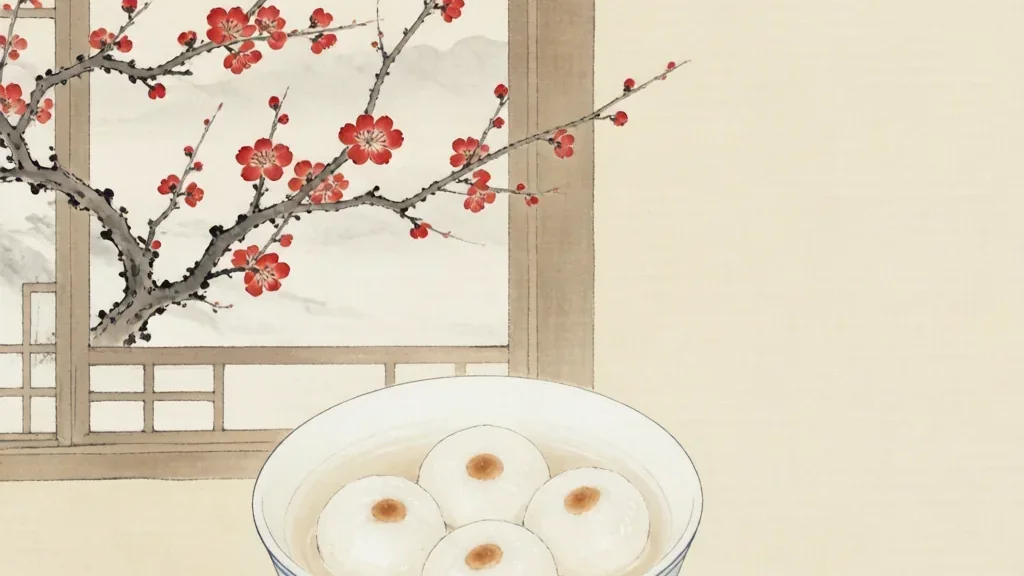
In southern China, the festival centers instead on tangyuan, glutinous rice balls served in a sweet ginger syrup or broth. These round, sticky spheres symbolize reunion, completeness, and family togetherness, making them a fitting food for a holiday built around gathering. The roundness of the balls echoes the full circle of the year and the wish for household harmony.
Families often make tangyuan in several colors, tinting the dough with natural ingredients such as spinach or red bean, and sometimes hiding a sweet filling of sesame, peanut, or red bean paste inside. In parts of the south, there is also a custom of presenting tangyuan to departed ancestors before the living eat, weaving the food into the broader practice of remembrance that runs through the festival.
Family Reunion and Ancestor Worship
At its emotional core, Dongzhi is a family festival. Because the day falls near the end of the year, it became a natural occasion for relatives to assemble, share a substantial meal, and take stock of the passing year. In traditional households, the oldest members were given special respect, and the gathering reinforced the Confucian value of filial devotion across generations seated at one table.
Ancestor worship formed another pillar of the observance. Families would prepare offerings of food, burn incense, and present the holiday meal to tablets or portraits of deceased relatives, asking for blessings and expressing gratitude. This linkage of the living and the dead at the year's darkest turning gave Dongzhi a depth that pure feasting lacks, reminding participants that they belonged to a long lineage stretching backward and forward in time.
Dongzhi as a Measure of the Year
In several regions, especially in parts of southern China and among overseas communities, there is an old saying that after Dongzhi a person adds a year to their age, so the festival once functioned almost like a birthday of the collective family. This meant that the winter solstice, rather than the lunar New Year, was historically the moment when ages were counted, a practice still recalled in folk proverbs today.
The festival also served practical agricultural purposes. With fields idle and the growing season paused, the solstice offered a natural pause for rest, accounting, and preparation before the busy spring. Calendrical records kept by villages used Dongzhi as a reliable anchor, since its astronomical fixity made it easier to track the passage of seasons than the shifting lunar months alone.
Customs of Calculation and Fortune
Traditional almanacs assigned the nine periods after the winter solstice, known as the Nine Cold Periods or Nine Winters, each lasting nine days, as a folk way to count down the deepest cold and anticipate spring. People would sometimes record the weather of each period to predict the coming agricultural year, blending observation with gentle superstition in a manner typical of rural Chinese timekeeping.
Another related custom involved the making of colored paper or embroidered representations of plum branches on which eighty-one petals were colored one by one, one for each day from the solstice until the arrival of spring. These small domestic rituals turned the long, dark stretch of winter into a countable, survivable sequence, giving households a shared activity that symbolized patience and hope.
Dongzhi in the Chinese Diaspora
Chinese communities abroad have carried Dongzhi with them, adapting its customs to new homes while keeping its essentials. In Taiwan, the festival remains widely observed, with families making tangyuan and offering them at ancestral shrines, and it is common for workplaces and schools to acknowledge the day. In Singapore and Malaysia, Chinese families gather for tong yuen meals that mirror southern mainland practice.
In Western countries, where December already holds many holidays, Dongzhi offers Chinese families a distinct cultural anchor, a chance to mark their own seasonal turning amid the general winter festivity. Community centers and temples often host public celebrations with food and performances, helping younger generations born abroad maintain a tangible connection to the rhythm of the traditional calendar.
Modern Meaning and Continuing Legacy
Today Dongzhi is not usually a public statutory holiday across mainland China, yet it retains strong cultural resonance, kept alive by family tradition, media reminders, and the simple appeal of a warm meal on the year's longest night. Restaurants promote dumpling and tangyuan specials, and social media fills with photographs of festive tables, showing that the observance has found a comfortable place in contemporary urban life.
The enduring power of Dongzhi lies in its layered meaning: it is at once a precise astronomical event, an ancient state ritual, a southern or northern culinary tradition, and an intimate family reunion. In a fast-changing society, the festival offers a rare moment to slow down at the darkest point of the year and trust, as generations before did, that the light is beginning its slow return.
❓ Frequently Asked Questions
When is the Winter Solstice Festival celebrated?
It falls on the astronomical winter solstice, typically December twenty-first or twenty-second in the Gregorian calendar, when daylight is shortest in the Northern Hemisphere.
Why do northern and southern China eat different foods?
Northerners eat dumplings to ward off the cold, tied to a legend of physician Zhang Zhongjing, while southerners eat tangyuan rice balls symbolizing reunion and family completeness.
What does Dongzhi mean in Chinese cosmology?
It marks the lowest point of yin and the rebirth of yang, the bright life force, so the day is celebrated as the slow return of light and warmth after the year's darkest point.
Is Dongzhi a public holiday today?
It is not generally a statutory public holiday across mainland China, but it remains widely observed through family meals, media coverage, and restaurant promotions.
How is the festival connected to ancestor worship?
Families prepare offerings and present the festive meal to ancestral tablets or portraits, asking for blessings and expressing gratitude to previous generations.
How is Dongzhi celebrated in the diaspora?
Overseas Chinese communities hold tangyuan meals, temple rites, and public events, keeping the custom alive and teaching younger generations the traditional calendar.