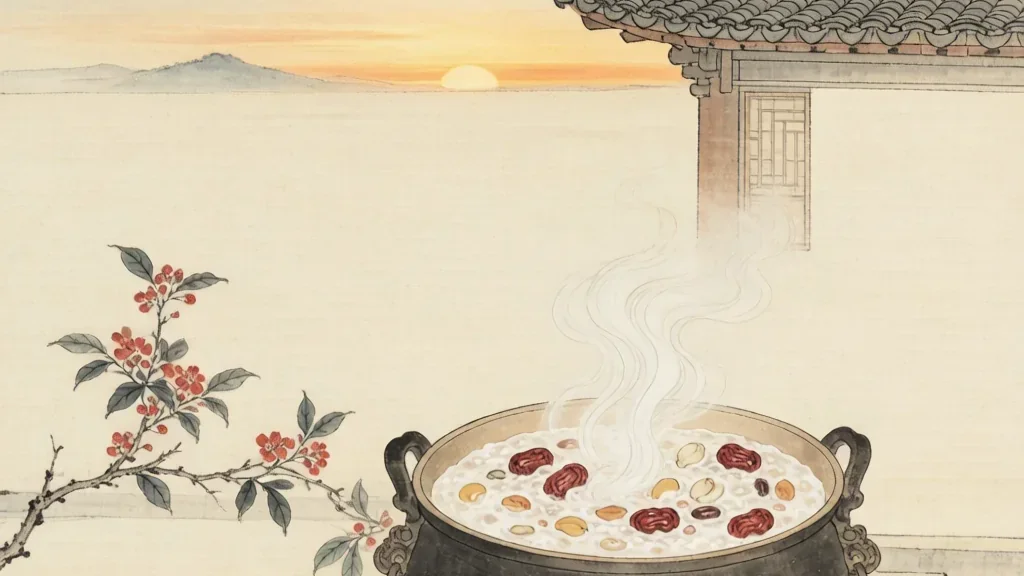
The observance of th twelfth lunar month, as the coldest part of winter settles in and the new year looms just weeks away, Chinese households cook a pot of thick, sweet grain porridge. This is 腊八 (Laba), the Laba Festival, named for the eighth day of the la month. The star of the day is 腊八粥 (Labazhou), Laba porridge, a mixture of rice, beans, nuts, and dried fruit that is as much a countdown as a meal. Eating it is the traditional signal that the Spring Festival preparations have begun, the first warm stir in the long run-up to the greatest homecoming of the year.
The Eighth Day of the La Month
The name breaks into two parts: "la" was the name of the twelfth lunar month in ancient times, and "ba" means eight, so Laba is simply the eighth day of that month. By this point the harvest was long in, the granaries full, and families had the stores to make a rich mixed porridge. The day therefore sits at the hinge between deep winter and the new year's approach, a natural moment to open the season of preparation.
In the old agricultural calendar the la month was also a time of year-end sacrifice and cleansing, when communities gave thanks and drove out the old. Laba carried that weight of closing one cycle and getting ready for the next, a theme that links it to the larger rhythm of the natural cycle described by the five elements (wu xing).
The Porridge of Many Grains
Laba porridge is the heart of the festival. A proper pot combines glutinous rice, red beans, mung beans, millet, corn, peanuts, walnuts, and an assortment of dried fruits such as dates, longan, and raisins, simmered until soft and lightly sweet. Recipes vary by region and family, and the more ingredients the better, since abundance in the bowl hints at abundance in the year.
The porridge is eaten hot and also offered. Families place a bowl before the household altar or at the door for the gods and ancestors, and share the rest with neighbors, a custom of giving that turns a single pot into a bond between households. To receive a bowl of someone's Laba porridge is to be wished a full and lucky year.
A Buddhist Origin Story
One well-known origin of the porridge ties it to the Buddha. According to tradition, Siddhartha Gautama, fasting in his search for enlightenment, grew weak and was fed a bowl of rice and milk by a shepherd girl, after which he sat beneath the bodhi tree and attained awakening on the eighth day of the twelfth month. Monasteries began cooking a mixed porridge on that day to commemorate the event, and the custom spread to lay households.
Whether or not every family knows the Buddhist link, the story gives the humble porridge a sacred depth. A bowl of grains becomes a small memorial to awakening and to the kindness that sustains a seeker. The festival thus sits comfortably at the meeting of folk harvest cheer and Buddhist observance, much as the Ghost Festival does.
The Countdown to New Year
Laba is effectively the starter pistol for the Spring Festival. The old saying goes that after Laba the new year is near, and from this day households begin the tasks of the season: cleaning the house, making preserves, buying new clothes, and, above all, securing travel home. The porridge is the first shared taste of the coming celebration.
In the past, the day also meant checking stores of ice and starting the curing of meats for the feasts ahead. The kitchen, already the warm center of the home in winter, became busier still. Laba reminds a family that the great reunion is no accident but the product of weeks of quiet preparation, begun with a single pot.
Local Variations
Not every region eats only sweet porridge. In the north, Laba is also a time for Laba garlic, garlic soaked in vinegar until it turns a jade green, a piquant side dish saved for dumplings at the new year. Some areas make Laba noodles, a noodle dish, instead of or alongside the porridge. The variations show how a single festival adapts to local taste while keeping its clock-setting role.
These regional differences are part of the festival's charm. Wherever one is, the dish announces the same thing: the deep cold is here, the stores are in, and the most important journey and meal of the year are only weeks away. The porridge is a local accent speaking a national sentence.
Why a Bowl of Grains Matters
Laba endures because it is the gentle on-ramp to the year's biggest festival. It asks little, a pot of porridge and a thought of the days ahead, yet it connects a family to the labor of the harvest, the kindness of shared food, and the approaching reunion. In a busy modern life, pausing to cook and give away a bowl of mixed grains is a small, grounding ritual that says the new year is coming, and we are ready.
Laba in the Temple Kitchen
The Buddhist face of Laba lives in the monastery kitchen. On the eighth day of the twelfth month, temples have long simmered enormous cauldrons of mixed congee and offered it freely at the gate, a practice of compassion that mirrors the shepherd girl's gift to the starving seeker. Monks chant sutras of thanksgiving as the porridge is served, and lay visitors queue for a bowl believed to carry the temple's blessing. The custom turns a humble grain dish into a public act of generosity, linking the individual household pot to a centuries-old stream of charity that still flows through cities every winter. Visitors often take a second bowl home for an elder, so the blessing travels beyond the gate, and the act of receiving becomes an act of giving in turn.
The Older Roots of La
Before Buddhism reached China, the twelfth lunar month was already 'La,' a time of year-end sacrifice to heaven, earth, and the spirits of ancestors. Communities slaughtered stock, offered thanks for the harvest, and drove out the old year with cleansing rites. When the Buddhist story of awakening arrived, it settled neatly onto this native foundation, so Laba became a double observance: a folk celebration of the stored harvest and a commemoration of enlightenment. That fusion is why the festival feels both earthly and sacred, a bowl of grains that remembers the field and the bodhi tree at once. Farmers once read the day's weather as a sign for the coming spring, and the leftover porridge was sometimes fed to livestock as a share of the season's good fortune.
❓ Frequently Asked Questions
📝 Chinese Vocabulary
腊八 — : The Laba Festival, eighth day of the la month.
腊八粥 — : Laba porridge, the festival's signature dish.
腊八蒜 — : Garlic pickled in vinegar until green.
腊八面 — : A Laba noodle dish of some regions.
腊月 — : The twelfth lunar month, the la month.
释迦牟尼 — : Sakyamuni, the historical Buddha, whose enlightenment on this day gave the festival its Buddhist meaning.
施粥 — : Giving congee, the charitable distribution of Laba porridge by temples to the community.
供佛 — : Making offerings to the Buddha, the devotional act at the heart of the monastery's Laba rite.
🎉 Fun Facts
- Laba is considered the official start of Spring Festival preparations, about three weeks before the new year.
- A proper Laba porridge can contain eight or more grains, beans, nuts, and dried fruits.
- The festival's Buddhist story connects the porridge to the Buddha's meal before enlightenment.
- Families traditionally share the porridge with neighbors, turning one pot into a bond between homes.
- Major temples still cook huge cauldrons of Laba porridge and give it away free; in Beijing, crowds line up before dawn at famous monasteries for a blessed bowl.
- The word 'la' in Laba connects to ancient year-end sacrifices to heaven and earth, so the festival carries the memory of winter thanksgiving rites older than Buddhism.