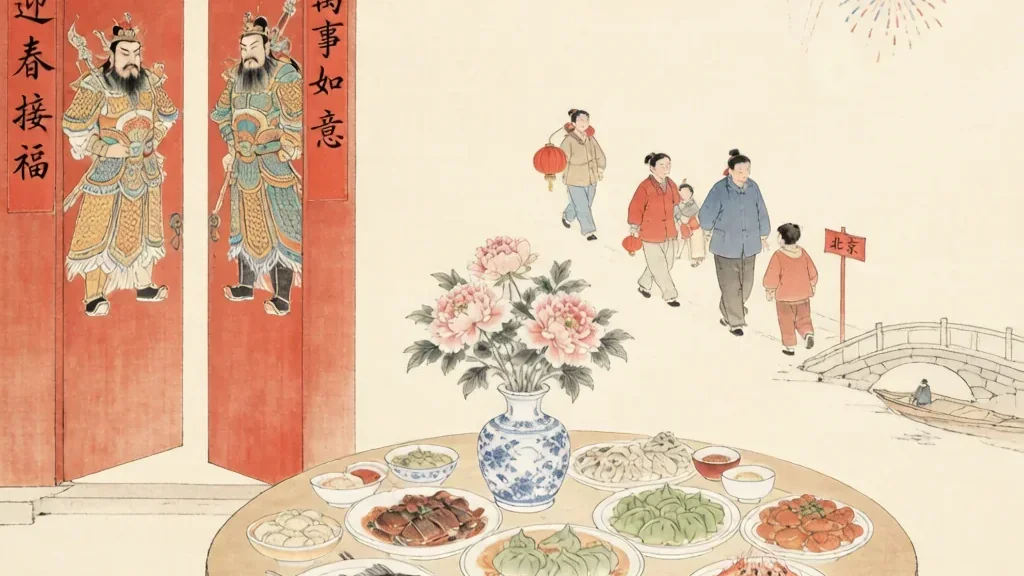
Every winter, as the lunar calendar turns toward its end, hundreds of millions of people across China begin the largest regular movement of human beings on the planet. This is 春节 (Chunjie), the Spring Festival, better known in the West as Chinese New Year. It is not merely a holiday but a civilizational event, a forty-day season in which families reunite, kitchens fill with the smell of dumplings, and the color red appears on every door. More than just a celebration of the new year, the Spring Festival is the emotional anchor of Chinese culture, the time when the pull of home proves stronger than any distance, cost, or difficulty. To understand China, one must first understand this festival.
The Long Road Home
The phrase "Chunyun" describes the Spring Festival travel rush, a period when an estimated three billion trips are taken across the country in roughly forty days. Migrant workers who have spent the year in coastal factories, students studying far from home, and office employees in distant cities all turn their faces toward the towns and villages where they grew up. Trains, buses, and planes run at capacity, and standing-room tickets on overnight trains have become the stuff of legend. The migration is so vast that it has been called the greatest annual human movement in history.
What drives this movement is not convenience but duty and love. In a culture shaped by Confucianism (儒家), with its stress on filial devotion, returning home to honor parents and grandparents is a moral act as much as a personal one. The reunion dinner, eaten on the eve of the new year, is the destination of this journey. Missing it is felt as a small tear in the fabric of family. For many families, the Spring Festival is the single week each year when scattered members stand in the same room together.
Red, Firecrackers, and the Beast Nian
The dominant visual language of the festival is red. Doorways are framed with red couplets bearing poetic wishes written in black or gold ink. Windows are cut into red paper patterns, and children receive red envelopes filled with money. The color is no accident: an old legend tells of a monster called Nian that emerged each new year to devour villagers. The people discovered that the beast feared three things: the color red, bright light, and loud noise. So they pasted red paper on their doors, hung lanterns, and set off firecrackers to drive it away. The word for the monster and the word for "year" became the same, and the ritual of warding it off became the festival itself.
Firecrackers once meant strings of exploding paper shells that filled the night with smoke and sound. In many modern cities, environmental and safety rules have limited their use, replaced by recorded booms or silent light shows. Yet the symbolism remains. The loudest moment of the old year is meant to clear away misfortune and announce, to the heavens and to the neighbors, that a fresh start has begun.
The Reunion Dinner
The centerpiece of New Year's Eve is the reunion dinner, known as the reunion meal. In northern China, the table almost always holds dumplings, shaped like ancient gold ingots and sometimes hiding a coin or sweet filling for luck. In the south, a sticky rice cake called niangao is favored, its name a pun on "higher year," suggesting rising fortune and status. Fish is served but often left partly uneaten, because the word for fish, yu, sounds like the word for surplus, and keeping some means abundance will carry into the next year.
The meal is also a performance of care. Grandmothers wake before dawn to knead dough; uncles argue good-naturedly over the best filling; cousins who rarely cook attempt a dish and are applauded anyway. Food here is not fuel but a language of belonging. To be fed by one's family at this table is to be, for a few hours, exactly where one is supposed to be.
The Twelve Animals of the Zodiac
Each Spring Festival marks the start of a new year in the cycle of twelve animals: rat, ox, tiger, rabbit, dragon, snake, horse, goat, monkey, rooster, dog, and pig. A person's birth year animal is believed to shape temperament and fate, and the year one is born in is thought to be a year of challenge, when extra caution is wise. The story of how these animals earned their order is one of the best-loved tales in Chinese folklore, the legend of the great zodiac race, in which the Jade Emperor summoned the creatures to a river crossing.
When a new animal year arrives, the country changes its decorations accordingly. Dragon years bring particularly grand celebrations, since the dragon is the only mythical creature in the cycle and a symbol of imperial and national power. People born in a given year receive gifts marked with "their" animal, and greetings cards announce the creature now taking the throne of the calendar.
Fifteen Days of Celebration
The Spring Festival is not a single night but a season. Traditionally the observances run for fifteen days, closing only with the Lantern Festival, when families hang glowing lanterns and eat sweet rice balls. In between, each day carries its own custom: visiting the wife's family, welcoming the God of Wealth, or simply resting at home. The first days are reserved for close family; later days open to friends and neighbors. The rhythm moves from intimacy outward to the wider community.
Modern China grants an official public holiday of about a week, but many workplaces extend leave, and the spirit of the season easily spills past the official boundary. Shops close, cities empty of their migrant populations, and the great metropolises grow quiet and strangely peaceful. Then, almost all at once, everyone returns, rested and refed, to begin the year's labor anew.
Old Customs in a New China
The festival has absorbed the modern world without losing its core. Red envelopes now travel digitally through phone payments, sent with a tap and a festive animation. New Year's Eve television, the Spring Festival Gala, draws audiences in the hundreds of millions, a variety show that has become its own tradition since the 1980s. Yet the oldest gestures persist: the bow to elders, the sweeping of the house before the new year to cast out the old, the avoidance of unlucky words on the first morning.
What endures is the meaning beneath the customs. The Spring Festival answers a question every society asks, how to mark the turning of time, with an answer built on family, gratitude, and hope. It tells each person that no matter how far they have gone, there is a door with their name on it, and a meal waiting, once a year, without fail.
The Custom of Spring Couplets
Among the most visible Spring Festival decorations are chun lian, the poetic couplets brushed in black or gold ink onto narrow red strips and pasted on either side of the doorframe, often with a fourth phrase across the lintel. The tradition grew from the ancient practice of hanging peach-wood charms to ward off evil, and during the Tang Dynasty the charms evolved into written verses. A well-matched couplet balances meaning and sound, wishing the household health, harvest, and harmony. Today cities sell printed sets by the million, yet many families still prefer a few lines written by hand, believing the personal wish carries more luck than the mass-produced one.
Regional Foods and Family Variations
Although the reunion dinner is shared everywhere, its centerpiece changes with geography. In northern China dumplings dominate, their crescent shape likened to gold ingots and sometimes hiding a coin for the lucky eater, while the south favors the sticky rice cake called nian gao, whose name puns on rising fortune. Coastal families add whole fish for surplus, and wheat-growing regions serve noodles for long life. These differences are not mere taste: they encode local crops and climate, so that the same festival plates a different harvest in every province. The variety shows how one national holiday adapts to countless local tables without losing its central meaning of togetherness.
❓ Frequently Asked Questions
📝 Chinese Vocabulary
春节 — : Spring Festival, the Chinese New Year.
年 — : Year, and also the name of the monster of legend.
团圆饭 — : The reunion dinner eaten on New Year's Eve.
红包 — : Red envelope containing lucky money.
年糕 — : A sticky rice cake whose name means "year high."
春联 — : Spring Festival couplets: paired poetic phrases written on red paper and pasted on doorways for good fortune.
守岁 — : The custom of staying up late on New Year's Eve to welcome the arriving year together as a family.
饺子 — : Dumplings shaped like ancient gold ingots, the centerpiece of the northern reunion dinner.
🎉 Fun Facts
- The Spring Festival travel rush moves an estimated three billion trips, making it the largest annual human migration on Earth.
- Sweeping the floor on New Year's Day is traditionally avoided, for fear of sweeping away the good luck that just arrived.
- The character for fortune is often pasted upside down because "upside down" sounds like "arrive" — fortune arrives.
- A year's supply of red envelopes and decorations can be found in nearly every household weeks before the festival begins.
- Many families paste a new door-god image or a paper-cut of the fortune character on the front door, a custom with roots stretching back over a thousand years to the Tang Dynasty.
- It is considered unlucky to break a dish during the festival, yet if one does, people quickly say 'sui sui ping an' so that the accident becomes a blessing by punning on the word for 'break'.