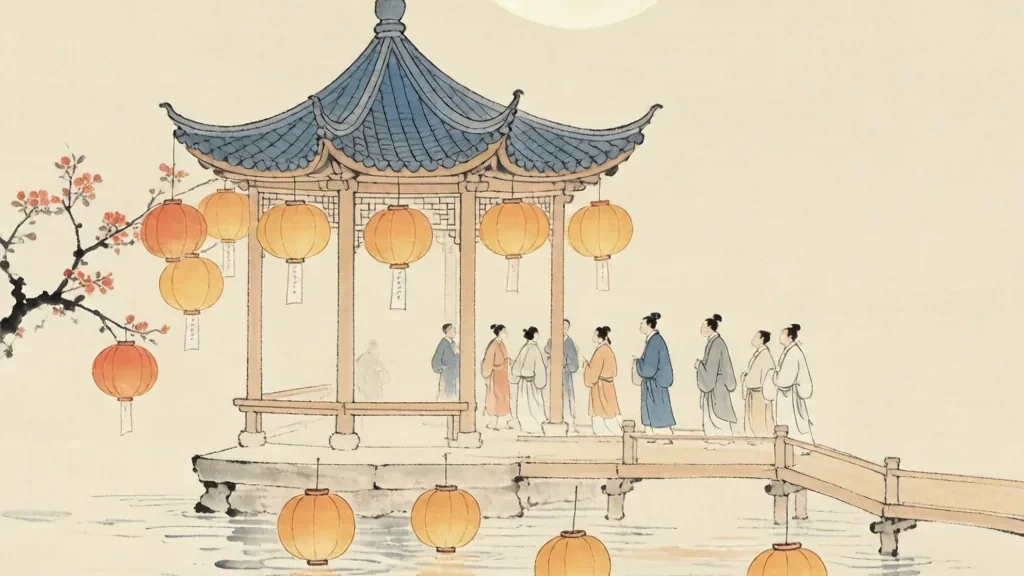
Fifteen days after the Spring Festival, when the first full moon of the lunar year rises, the streets of China fill with light. This is 元宵 (Yuanxiao), the Lantern Festival, the bright closing of the New Year season. After weeks of family dinners and quiet visits, the festival spills outdoors: lanterns of every shape swing from eaves and wires, riddles are pinned beneath them for passersby to guess, and everyone eats a bowl of sweet glutinous balls. It is the most openly joyful night of the Chinese year, when the private warmth of home becomes a public sea of glowing paper.
The First Full Moon of the Year
The festival takes its date from the calendar: the fifteenth day of the first lunar month is, by definition, the night of the first full moon. The characters yuanxiao can be read as "first night," pointing to this opening full moon of the year. Where the Spring Festival centered on the family hearth, the Lantern Festival turns outward to the community and the open sky.
The full moon matters because it is a symbol of completeness and reunion. To gaze up at it together, after the separated travels of the new year, is to feel the circle close. The lanterns below mirror the moon above, so that earth and heaven share one round, glowing shape on this one night.
Lanterns of Every Shape
The heart of the festival is the lantern itself. Traditional lanterns are framed in bamboo and covered in paper or silk, painted with scenes of flowers, animals, or characters from The Monkey King (孙悟空) and other beloved tales. They range from small handheld rounds to towering floats carried through the streets, some shaped like dragons, rabbits, or boats. In earlier times they were lit by candles; today many glow with safe electric light.
Lantern fairs fill parks and old town squares, where thousands of lanterns are hung in coordinated displays. The effect, after dark, is of a second sky turned upside down, a city of soft stars at eye level. Children carry their own small lanterns, and the simple act of walking with a light in the hand links the youngest to a ritual older than any memory they hold.
Riddles Written on the Light
A favorite custom is guessing lantern riddles. Written couplets or single clever lines are pasted on the lanterns, and those who think they know the answer call it out to claim a small prize. The riddles play on puns, homophones, and the shapes of characters, so solving one is a little feat of wordplay as much as knowledge.
This game turns the festival into a shared mental sport. Strangers gather under a lantern, debate a clue, and laugh when the answer is revealed. It is a gentle, inclusive kind of contest, where the prize matters less than the pleasure of the cleverness, and where even a child can outwit an elder with a lucky guess.
The Sweet Balls of the Night
No Lantern Festival passes without tangyuan or yuanxiao, round dumplings of glutinous rice flour stuffed with sweet fillings, sesame, peanut, red bean, or mashed date, and boiled in a light broth. Their round shape echoes the full moon and the ideal of family unity, and the word for them sounds like "reunion." A warm bowl at night, after walking among the lanterns, is the festival's comfort made edible.
In the north the balls are sometimes made by rolling the filling in dry flour, while in the south they are wrapped like small dumplings; the two methods give slightly different textures but the same meaning. However they are made, the sweet roundness is the taste of the first full moon, and of a year hoped to come full and whole.
Love and Freedom in the Dark
In imperial times, when women were mostly confined to the home, the Lantern Festival was one of the rare nights they could walk freely through the streets to see the lanterns. This made it, quietly, a night of meeting and courtship, a chance for young people to see and be seen outside the walls. Many old stories and operas place a fateful first meeting on this evening, under the swinging lights.
That layer of romantic possibility still clings to the festival. To walk out together on the fifteenth night, beneath a full moon and a thousand lanterns, carries a faint echo of those earlier freedoms. The light itself seems to grant permission to look up, look out, and look at one another.
The Closing of the New Year
With the Lantern Festival, the long New Year season ends. The decorations come down, the travel rush completes its second half as people return to work, and ordinary time resumes. But the festival leaves behind its glow, a reminder that the year began not only with duty to family but with joy shared in the open air. To light a lantern on the first full moon is to send the new year forward bright, hopeful, and round as the moon itself.
Legends Behind the Lanterns
One beloved tale says the Jade Emperor, angered by a mortal offense, planned to burn a village with heavenly troops. A kind-hearted official warned the people, who lit every lantern and set off firecrackers so the sky glowed as if already ablaze. Seeing his decree seemingly carried out, the emperor spared them. To mark their escape, villagers hung lanterns each year on the first full moon. Whether or not the story is history, it captures the festival's logic: light as protection, and community ingenuity turning a threat into a night of joy that everyone now shares outdoors. Another version blames a village of swallows, and yet another credits the emperor's daughter who leaked the plan, but each retelling keeps the same moral: ordinary people, with lanterns and courage, can outwit even heaven's wrath.
Lantern Fairs Today
The Lantern Festival has grown into a spectacle of civic scale. In Sichuan, the Zigong lantern fair builds towering, mechanical displays of dragons, palaces, and scenes from legend that draw visitors from across the country. City parks from Beijing to Guangzhou string thousands of lanterns into coordinated rivers of light, and television broadcasts feature regional competitions of design and craft. Yet the heart remains local: families still walk the fair, still guess the riddles pinned to the paper, and still eat a warm bowl of round rice balls beneath the moon. The festival proves that an ancient custom can expand without losing its intimate, glowing core. In many towns the lanterns are released onto rivers at the close of the night, so the lights drift away carrying wishes, a quiet benediction sent downstream into the new year.
❓ Frequently Asked Questions
📝 Chinese Vocabulary
元宵 — : The Lantern Festival, and also the sweet rice balls.
汤圆 — : Glutinous rice balls eaten on the night.
猜灯谜 — : Guessing lantern riddles.
花灯 — : Decorative floral lanterns.
满月 — : The full moon marking the festival date.
上元 — : The Upper Prime, another traditional name for the Lantern Festival, the first of the three prime nights.
灯会 — : A lantern fair, the public gathering where thousands of lanterns are displayed and viewed at night.
走百病 — : Walking away a hundred illnesses, the custom of strolling in the moonlight on the festival to ward off disease.
🎉 Fun Facts
- The Lantern Festival is celebrated on the very night of the first full moon of the lunar year.
- Lantern riddles can play on the shapes and sounds of Chinese characters, making them a word game as much as a quiz.
- In the past the festival was one of the few nights women could leave the home, so it became linked with romance.
- Some lantern fairs display thousands of lanterns shaped like dragons, rabbits, and scenes from legend.
- On the night, an old custom called walking away a hundred illnesses had people, especially women, stroll across bridges and walk in the moonlight to ward off disease in the coming year.
- Beyond the nighttime lantern viewing, many places also hold daytime folk performances on the festival, such as stilt walking, land-boat dances, and lively group dances, so the celebration spills into the whole day.