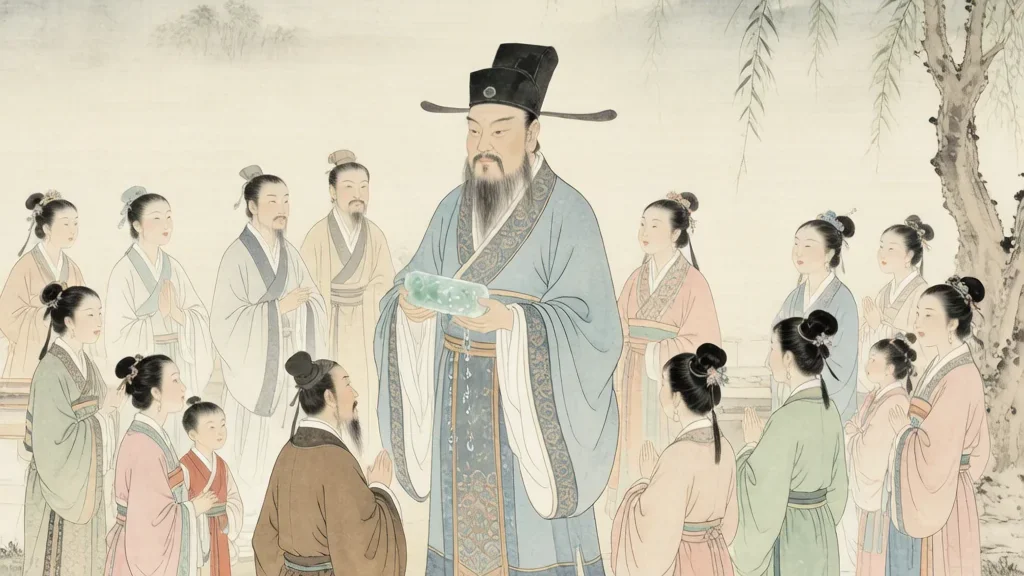
The Xiayuan Festival (下元节, Xiàyuán Jié) falls on the fifteenth day of the tenth lunar month and honors the Water Official (水官, Shuǐguān), the lowest of Taoism's Three Officials. On this cool autumn night, as the harvest is stored and the rivers run low, devotees gather at temples and riversides to confess their faults, release misfortune, and pray for protection from floods, drought, and the uncertainties of the year ahead. It is the third and final of the Sanyuan festivals, arriving as autumn gives way to winter, and it has been kept continuously for well over a thousand years in one form or another. Though quieter than its famous siblings, it carries one of the oldest Chinese ideas about water: that the same currents which can destroy us may also wash us clean.
The Three Officials and the Sanyuan Cycle
The Chinese liturgical year is framed by the Sanyuan (三元, "Three Primes"), three festivals that fall on the fifteenth day of the first, seventh, and tenth lunar months. Each is governed by one of the Three Officials: the Heaven Official (天官, Tiānguān) grants blessing at Shangyuan, the Earth Official (地官, Dìguān) pardons sin at Zhongyuan, and the Water Official (水官, Shuǐguān) relieves calamity at Xiayuan. Together the three days form a single moral arc spread across the turning year.
Seen as a whole, the three days describe a complete moral cosmos — heaven that bestows, earth that judges, and water that cleanses. Xiayuan closes the cycle in late autumn, when the harvest is gathered and the waters turn cold. Historically it was the quietest of the three, observed most faithfully inside Taoist communities rather than as a mass folk holiday, yet it remained the day when ordinary people could ask the waters themselves for mercy.
Who Is the Water Official?
In Taoist belief the Water Official is Shuiguan Dadi (水官大帝, "Great Emperor of the Waters"), one of three celestial administrators who record human deeds and dispense fortune according to a vast heavenly bureaucracy. Popular tradition identifies him with Yu the Great (大禹, Dà Yǔ), the semilegendary ruler who tamed the great floods of antiquity by dredging rivers and guiding the waters down to the sea. As Yu, he is remembered less as a distant god than as a tireless worker who walked the land for years on end, and this earthy, laborious image made him especially dear to peasants and boatmen.
This linkage explains the festival's deep preoccupation with water: the Water Official governs rivers, lakes, seas, rains, and the shadowy boundary between the living and the drowned. To win his favor was to secure safe voyages, good catches, and immunity from drowning, drought, and waterborne disease — concerns that weighed heavily on farming and fishing communities alike.
Origins and Taoist Scripture
Xiayuan's theological roots lie in the Lingbao (灵宝) scriptures of early medieval Taoism, which systematized the cult of the Three Officials as cosmic judges. The "Sutra of the Three Officials" taught that each official presided over a court that audited human conduct and could absolve wrongdoing through sincere, repeated repentance offered on the correct day.
By the Tang dynasty (618–907) the three Sanyuan days were established imperial and popular observances, marked by closures of markets and courts. The tenth-month festival was specifically linked to the Water Official's power to "dissolve adversity" (解厄, jiě è), and Taoist clergy began holding formal redemption rites on the fifteenth of the tenth month to lift the troubles of the faithful.
Historical Development Through the Dynasties
Imperial patronage peaked under the Tang and Song, when the Sanyuan days were public holidays and Taoist ordinations and community rites clustered around them. The Water Official's day drew fishermen, boatmen, and riverside households who depended on calm water for their livelihood, their trade, and often their very survival through the winter.
From the Ming and Qing onward Xiayuan steadily receded. The lively lantern culture of Shangyuan and the ghost offerings of Zhongyuan overshadowed it, and the tenth-month festival survived mainly in temple liturgy. Local gazetteers note that by the late imperial period only devout households and clergy marked the day with special seriousness, while most commoners let it pass unnoticed.
Rituals of Repentance and Release
At the heart of Xiayuan is the repentance rite (忏, chàn). Worshippers present a "register of faults" (罪籍, zuì jí) listing their transgressions, which the priest ceremonially burns or casts into flowing water so the Water Official may wash the sins away and lift the impending misfortune recorded against them.
Temples intone the Water Official's precious scroll, offer vegetarian feasts, and issue talismans (符, fú) of protection to the faithful. Laypeople may also perform a "release of life" (放生, fàng shēng), freeing captive fish or turtles into rivers as a merit-making act that mirrors the official's own release of human suffering and binds the giver to gentleness. The rite is usually performed at dusk, when lamps are lit along the water's edge and the names of the living are read aloud so the official may know whose burdens to lift.
Folk Practices and Water Lanterns
Beyond the temple, families once floated paper boats and water lanterns (水灯, shuǐ dēng) on ponds and streams, each carrying a written worry or the name of a departed relative. The drifting light was thought to draw misfortune downstream and out to sea, where the Water Official could dissolve it for good.
Household altars received fruit, wine, and vegetarian dishes, while riverside communities staged small processions of decorated boats. In fishing towns the day doubled as a blessing of the fleet: nets were mended, hulls repainted, and the Water Official asked to guard voyagers through the winter storms ahead and bring them home safely.
Foods and Offerings of the Day
Unlike Shangyuan's sweet rice balls or Zhongyuan's ghost meals, Xiayuan keeps a plainly vegetarian table. Devotees prepare simple dishes — steamed buns, plain rice, seasonal greens, and fresh fruit — because the Water Official's rites stress purity and the careful avoidance of slaughtered flesh on a day given over to repentance.
Household offerings are arranged on a clean altar beside a written petition, then either shared by the family or, in riverside custom, set afloat on a paper boat. The absence of meat is itself symbolic: by refusing to take life on the Water Official's day, the faithful mirror the mercy they hope to receive from the waters above.
Regional and Local Variations
In the Yangtze delta and along the southeast coast, Xiayuan blended with local river and sea cults, producing boat-blessing ceremonies unique to each port and each deity of the waters. In parts of Shanxi and Shaanxi the day was kept as a quiet household fast rather than a public event open to the neighborhood.
Some southern communities tied the festival to ancestor veneration, combining the Water Official's absolution with offerings to the family dead. These variations show how a single Taoist calendar date could be localized, absorbing indigenous water worship while keeping its core theme of cleansing, protection, and the renewal of bonds between the living and the departed.
Xiayuan in the Modern Era
Today Xiayuan is the least visible of the Three Primes, yet it has not vanished. Major Taoist centers — Beijing's White Cloud Temple and the courts of the Wudang and Longhu Mountains — still hold public Water Official rites that draw curious visitors as well as faithful devotees each tenth month.
Cultural heritage campaigns and a broader revival of traditional festivals have given Xiayuan a second life as a "water lantern" event in several cities, recast as an ecological and contemplative occasion. What was once a solemn confession of sin is increasingly a seasonal moment to release anxiety, set down one's burdens, and honor the rivers that quietly sustain life.
Cultural and Social Meaning
Seen broadly, Xiayuan is a festival of accountability and renewal. Its central act — naming one's faults and consigning them to water — is an ancient technology of conscience, a structured chance to admit error and begin again before the long, cold winter sets in.
As the closing movement of the Sanyuan triad, it reminds communities that cosmic order depends on balance among heaven, earth, and water. In an age of floods, pollution, and climate anxiety, the Water Official's promise to relieve calamity speaks to a very old human hope: that the waters which threaten us may also, in the end, wash us clean. For Taoist households the day is also a gentle annual audit, a moment to settle debts — both moral and worldly — before the year turns, so that one may face winter clear-eyed and at peace.
❓ Frequently Asked Questions
📝 Chinese Vocabulary
下元节 — : Lower Prime Festival; the Water Official's day.
水官 — : Water Official; Taoist cosmic administrator of waters.
三元 — : Three Primes; the Shangyuan, Zhongyuan, Xiayuan trilogy.
上元 — : Upper Prime; the Lantern Festival (15th of first month).
中元 — : Middle Prime; the Ghost Festival (15th of seventh month).
解厄 — : to dissolve or relieve adversity and misfortune.
水灯 — : water lantern; a floating light released on rivers.
放生 — : release of life; freeing captive animals as merit.
忏 — : repentance; the confession rite at Xiayuan.
禹 — : Yu the Great; the flood-taming sage linked to the Water Official.
🎉 Fun Facts
- Xiayuan is the least observed of the Three Prime festivals, mostly kept inside Taoist temples.
- The Water Official is popularly identified with Yu the Great, the legendary tamer of China's floods.
- Xiayuan closes the Sanyuan cycle on the fifteenth of the tenth lunar month, in late autumn.
- Floating paper boats during Xiayuan resembles water-lantern rites found in other Asian cultures.
- In imperial times the Sanyuan days were official public holidays under the Tang and Song.
- "Release of life" — freeing fish or turtles — is a traditional Xiayuan merit-making act.