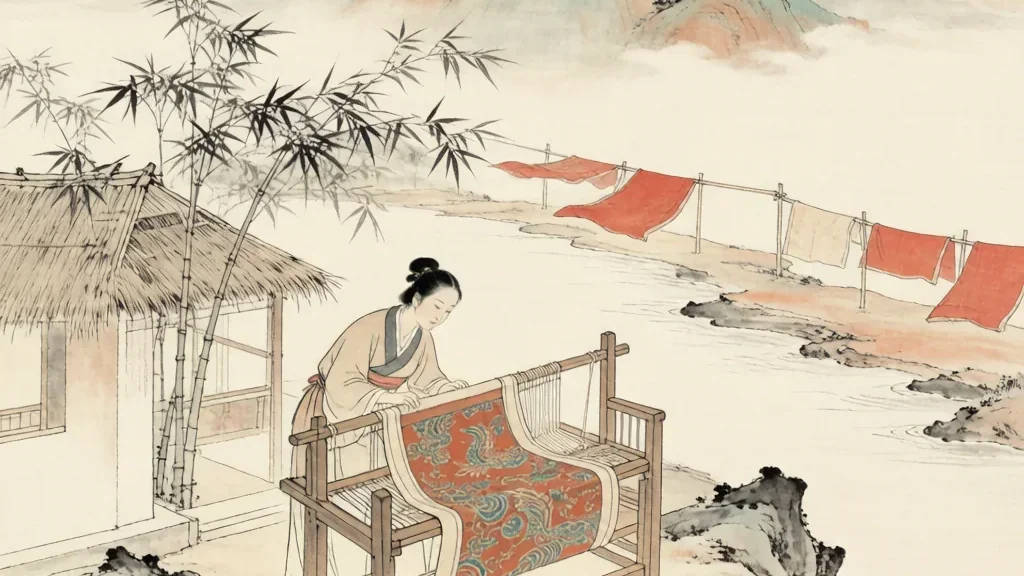
Tucked in the fertile Sichuan basin, ringed by mountains that long separated it from the central plains, lies a capital whose name is synonymous with ease and abundance. Chengdu (成都, chéng dū) — the "Brocade City" of Shu (蜀, Shǔ) — was the seat of an ancient southwestern civilization, the stage of the romantic Shu-Han kingdom of the Three Kingdoms, and a workshop of silk whose fame reached the Silk Road. If the northern capitals spoke of power, Chengdu spoke of plenty.
Founding and the Kingdom of Shu
Chengdu's plain was home to a distinctive culture long before it joined the Chinese world. The peoples of Shu left haunting bronzes — the standing figures and the "sacrificial pits" of Sanxingdui (三星堆), and the later vessels of Jinsha (金沙) — that show a civilization as sophisticated as any in the Yellow River valley, yet with its own strange gods and art. The city of Chengdu itself was founded, according to tradition, in the fourth century BCE by the rulers of Shu, and in 316 BCE the Qin conquered Shu and made it a commandery, building Chengdu as its administrative capital.
The basin's wealth came from the Dujiangyan (都江堰) irrigation system, engineered by Li Bing in the third century BCE, which tamed the Min River without a dam and turned the plain into a perennial granary. "Heaven sends down grain; the land of Shu stores it" ran an old saying, and Chengdu's security rested on that engineered abundance.
The Role of a Southernwestern Capital
Chengdu's great historical moment came with the collapse of the Han. As the empire fractured into the Three Kingdoms, Liu Bei (刘备) founded Shu-Han (蜀汉, Shǔ Hàn, 221–263 CE) at Chengdu, with the statesman Zhuge Liang as his chancellor. Though the smallest of the three powers, Shu-Han became, through the novel Romance of the Three Kingdoms (三国演义), the romantic hero of the age — the loyalist claimant to the Han mandate holding out in the southwest.
Chengdu also served as capital for later short-lived states: the Former Shu and Later Shu of the tenth-century Five Dynasties period, both famous for their arts and for the printing of the Buddhist canon. Throughout, the city's role was that of a sheltered, wealthy regional capital — rich enough to fund independence, remote enough to survive the storms that wrecked the north.
Landmarks and Cultural Life
The city's signature landmark is the Wuhou Shrine (武侯祠, wǔ hóu cí), dedicated to Zhuge Liang and, by extension, to Liu Bei and the Shu-Han court — a place of pilgrimage for anyone raised on the Three Kingdoms tales. Nearby, the Thatched Cottage of Du Fu (杜甫草堂, dù fǔ cǎo táng) commemorates the great Tang poet's refuge in Chengdu, where he wrote some of his calmest nature poetry beside the Huanhua Stream.
Chengdu's economic landmarks were its workshops. The imperial Brocade Office (锦官, jǐn guān) gave the city its nickname "Brocade City," and the trade in Shu silk, lacquer, and the prized Shu embroidery flowed out along the Shu Roads and the southwest passages toward India. The Jinli (锦里) street and the old city walls trace a commercial culture that prized leisure — teahouses, storytelling, and the famous Sichuan cuisine — as much as industry.
Why Chengdu Mattered
Chengdu mattered because it preserved a regional civilization within the Chinese whole. The ancient Shu culture of Sanxingdui and Jinsha shows that "China" was never a single river valley but a convergence of distinct traditions; Chengdu is where the southwestern strand entered the recorded story. Its irrigation, its brocade, and its cuisine made the basin a self-sufficient world that could flourish on its own terms.
It mattered, too, as the stage of the Shu-Han ideal. The loyalty of Zhuge Liang, who "devoted all his energy until his death" (鞠躬尽瘁,死而后已), became a Confucian model of devoted service, and the Wuhou Shrine keeps that ideal alive. Among China's capitals, Chengdu is the one that proves a city need not be the largest or the most central to matter most in the imagination — a brocade city of mountains and memory, where the romance of loyalty outshone the logic of power.
A Capital That Endured
After Shu-Han fell to the Wei in 263 CE, Chengdu remained the great city of the southwest, and it rose again as a royal capital in the tenth century, when the Former Shu and Later Shu kingdoms of the Five Dynasties period ruled from it. Those short-lived courts were famous patrons of art and printing: the Later Shu produced the first woodblock edition of the Confucian classics and an early printed Buddhist canon, and the city's wealth drew scholars and monks from across a divided realm. Even when not a capital, Chengdu was the economic anchor of Sichuan, its granaries and brocade sustaining the region through wars that raged elsewhere.
The city's continuity is its distinction. Unlike Anyang or Kaifeng, Chengdu was never buried or abandoned; it has been a major urban center for more than two millennia, and the Tang poet Du Fu's thatched cottage, the Han-era irrigation of Dujiangyan, and the Wuhou Shrine all survive within a living metropolis. The Sichuan basin's natural defenses — the mountains that long walled it off from the plains — let Chengdu preserve a distinctive speech, cuisine, and temperament. Among China's capitals, Chengdu is the one that best shows how a regional seat could be both a stage of empire and, more lastingly, a home — a brocade city whose abundance outlived every throne that claimed it.
Chengdu's place among the capitals is also a reminder that China was never one river valley but many. The ancient Shu culture of Sanxingdui, with its alien-eyed bronzes, shows a civilization that developed on its own terms until it joined the wider Chinese world. Chengdu's later role — as Shu-Han's loyal stronghold and as the wealthy refuge of southwestern dynasties — kept that distinct identity alive. To study the Brocade City is to see how the periphery enriched the center, and how a city could matter not by commanding the realm but by cultivating, behind its mountains, a way of life worth defending.