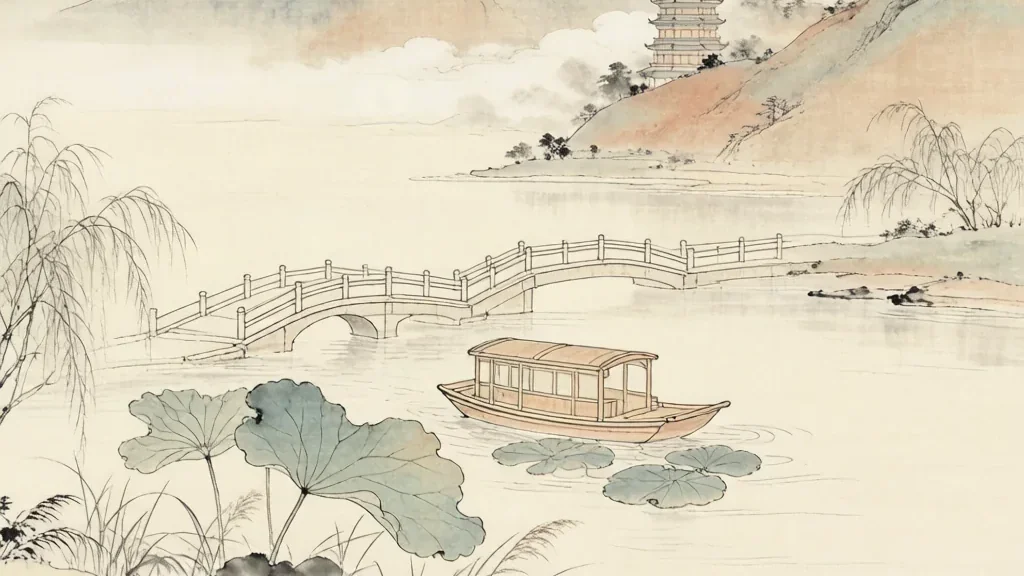
Among the great capitals of China, one is remembered not for walls or power but for beauty. Hangzhou (杭州, háng zhōu) sits at the head of a misty bay on the southeast coast, cradled by hills and a placid lake, and for centuries it has been called — in a phrase every Chinese schoolchild knows — "Paradise on Earth." As the Southern Song capital it was the empire's cultural mirror, where poetry, gardens, and tea defined what it meant to live well.
Founding and the Southern Song Court
Hangzhou's fortune turned on catastrophe. When the Jurchen Jin captured Kaifeng in 1127, the surviving Song prince re-established the court in the south, first at several sites and then, in 1129, at Hangzhou, which it renamed Lin'an (临安, lín ān), "Temporary Peace." The name was wishful: the city remained the Southern Song capital until the Mongols took it in 1276. Before that, in the tenth century, Hangzhou had been the capital of the regional Kingdom of Wuyue (吴越), whose rulers drained marshes and built the seawalls that made the land habitable.
The move south transformed a pleasant provincial town into a metropolis. The court, the aristocracy, and the artisans of the lost north poured into Hangzhou, and the city swelled with refugees who became its new elite. For a century and a half it was the true center of Chinese high culture, even as the dynasty formally hoped to return north.
The Role of a Refined Capital
Hangzhou's role differed from that of the northern capitals. It was not a ritual grid but a garden city, its life organized around West Lake, the canals, and the Qiantang River trade. The Southern Song court built palaces on the lake's edge and patronized the arts with extraordinary lavishness. The Imperial Painting Academy flourished, ci lyric poetry reached new heights in the hands of Xin Qiji and Li Qingzhao's successors, and the city's teahouses and pleasure boats became the setting for a sophisticated urban culture.
Economically, Hangzhou was the hub of the richest region of the realm — the Yangtze delta rice bowl, linked by the Grand Canal to the north and by sea to foreign trade. Its markets sold silk, lacquer, and the celebrated Longjing tea (龙井, lóng jǐng) grown on the surrounding hills. The population likely exceeded a million, making it, like Kaifeng before it, one of the world's largest cities.
Landmarks and Cultural Life
The soul of Hangzhou is West Lake (西湖, xī hú), a shallow lake landscaped over centuries into causeways, islands, and framed vistas. The poet-surayat Su Shi and the statesman Bai Juyi each served as local governor and dredged the lake, building the causeways still named for them. Around its shores stand the Leifeng Pagoda, the Lingyin Temple (灵隐寺, líng yǐn sì) — a great Chan Buddhist monastery in the hills — and the myriad pavilions that inspired the "Ten Scenes of West Lake" (西湖十景), a set of named views that became a template for garden design across East Asia.
Hangzhou also became a city of print and learning. The Southern Song established one of the empire's great publishing centers here, producing fine editions of the classics and histories. The philosopher Zhu Xi's Neo-Confucian synthesis spread from southern academies, and the city's culture of connoisseurship shaped taste for centuries.
Why Hangzhou Mattered
Hangzhou mattered because it redefined the capital as a place of civilization rather than merely command. Where Chang'an projected imperial authority and Kaifeng commercial energy, Hangzhou projected refinement — proving that a court could legitimize itself through beauty, letters, and the good life. The Southern Song's achievement was to keep Chinese high culture alive and brilliant precisely when the realm was halved, and Hangzhou was the stage for that survival.
The city's fame crossed the world. Marco Polo, visiting just after the Mongol conquest, called Hangzhou the finest city on earth, and his tale fixed its reputation in Europe. Today the saying "Above is heaven, below are Suzhou and Hangzhou" (上有天堂,下有苏杭) still caps the city's charm. Among China's ancient capitals, Hangzhou is the one you visit not to feel power, but to understand why a people came to see a well-tended lake as a kind of earthly heaven.
From Imperial Lake to Enduring Ideal
After the Mongol conquest of 1276, Hangzhou lost its throne but kept its charm. The Yuan made it a provincial center, and Marco Polo's account of its splendor helped preserve its fame abroad. Under the Ming and Qing it remained the wealthiest city of the Yangtze delta, its West Lake tended by successive rulers who dredged it, rebuilt its causeways, and added pavilions. The Qing emperor Qianlong visited six times and inscribed his praise on stone tablets that still stand by the lake, treating the scenery as a possession of the state as much as of the locals.
Hangzhou's later history shows how a capital can survive the loss of power by becoming a symbol. Stripped of its court, it became the archetype of the good Chinese city — refined, green, and leisurely — a reputation that modern tourism has only amplified. The "Ten Scenes of West Lake" were codified and reprinted for centuries, and the city's tea, silk, and cuisine became exports of a different, softer kind of influence. Among China's capitals, Hangzhou is unique in that its greatest monument is not a palace or a wall but a lake, tended for a thousand years as a work of art — proof that beauty, too, can be a form of rule.
The Southern Song court that made Hangzhou a capital also left it a gift of temperament. Exiled from the north, the literati turned their longing into an art of small pleasures — tea, chess, garden stones, and the careful naming of views — and Hangzhou became the capital where Chinese aesthetic life reached its most refined pitch. That temperament survived the loss of the throne and explains why, centuries later, the city is still praised in the same breath as paradise. Hangzhou taught China that a capital's true monument could be not power but taste.