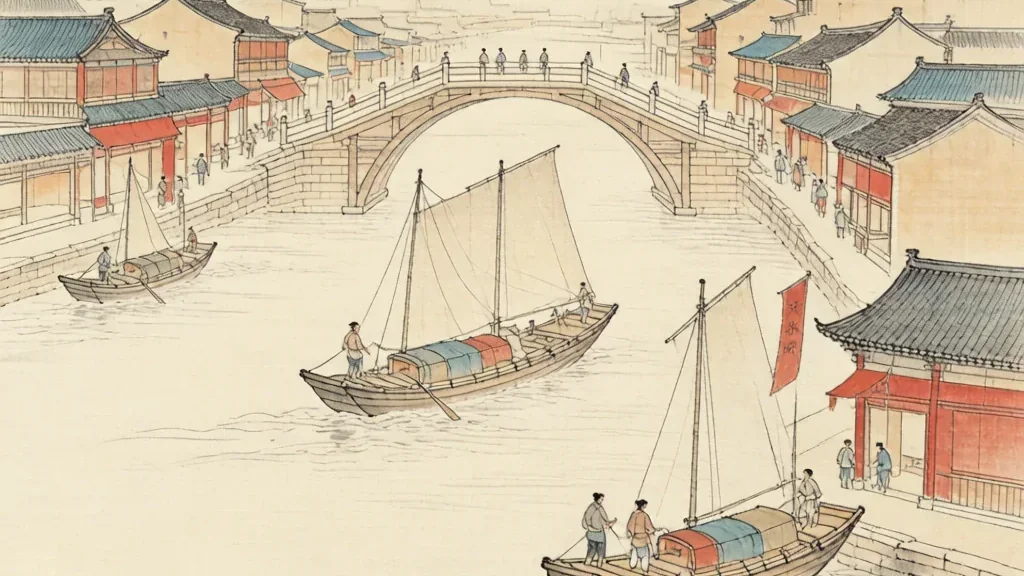
Of all China's ancient capitals, none captures the energy of everyday urban life like Kaifeng (开封, kāi fēng). Under the Northern Song (北宋, Běi Sòng, 960–1127 CE) it was known as Bianjing (汴京, biàn jīng), and it was the first great city in world history where commerce, not ceremony, set the rhythm of the streets. Open markets ran day and night, restaurants advertised their menus on boards, and a painted scroll preserves its crowds for us still. Kaifeng was the capital that proved a Chinese city could be, above all, a place to live, trade, and be entertained.
From Prefecture to Imperial Metropolis
Kaifeng's rise was a matter of water. The city sat astride the Bian River (汴河, Biàn Hé), a channel that linked the Yellow River system to the Grand Canal and thus to the rice-rich south. Whoever held Kaifeng could feed an army and tax the grain traffic. The Tang had governed it as a modest prefecture, but the warlord regimes of the Five Dynasties (907–960) made it their capital for precisely this logistical reason. When the Song founder Zhao Kuangyin seized the throne in 960, he kept Bianjing as his seat, and the city exploded in size and wealth.
Unlike Chang'an or Luoyang, Kaifeng was never a strictly planned ritual grid. It grew as a commercial organism, its walls expanded to enclose new suburbs, its streets shaped by the flow of trade rather than the dictates of cosmology. That very messiness is what makes it feel modern to us.
The Role of a Commercial Capital
The Northern Song broke with a thousand years of urban tradition by abolishing the ward system and the night curfew that had locked citizens indoors after dark. In Bianjing, shops lined the main avenues, taverns stayed open past midnight, and the famous night markets (夜市, yè shì) sold everything from mutton broths to imported perfume. The historian Meng Yuanlao, writing after the city's fall, recalled streets "competing in splendor" and a populace that "never tired of the bustle."
This was also a city of institutions. The Song founded the Imperial College, expanded the civil-service examination, and ran a vast bureaucracy whose offices clustered near the palace. Papermoney — the jiaozi (交子) note — first circulated here as a convenience for merchants, an early step toward the paper currency we use today. Kaifeng's population, probably over a million, made it the largest city of its time and a blueprint for the commercial cities of later China.
Landmarks and Cultural Life
The most precious landmark of Kaifeng is not a building but a painting. Along the River During the Qingming Festival (清明上河图, qīng míng shàng hé tú), by the court artist Zhang Zeduan, unrolls more than five meters to show the city's Rainbow Bridge, its river boats, its wine shops and sedan chairs, and hundreds of finely observed figures. It is the closest thing we have to a photograph of a medieval Chinese capital, and it has been copied, expanded, and animated for a thousand years.
The city also held the impressive Xiangguo Temple (相国寺), a great Buddhist monastery that doubled as a market and entertainment ground, and the tower where the astronomer Su Song later built his remarkable clock-driven armillary sphere. Theatrical forms flourished in Kaifeng's pleasure quarters, feeding the storytelling and drama traditions that would flower in the south after the court's flight.
Why Kaifeng Mattered
Kaifeng mattered because it marked the shift from the ceremonial capital to the commercial city. The Tang ideal, perfected at Chang'an, subordinated the street to the throne; the Song ideal, realized at Kaifeng, let the city belong to its merchants, cooks, and crowds. In doing so it anticipated the urban character of the Yangtze delta and, ultimately, of the modern world. The very problems Kaifeng faced — speculative prices, crowded suburbs, the fragility of a food supply dependent on distant canals — are the problems of cities ever since.
The city's fall in 1127, when the Jurchen Jin captured the emperor and hauled the court north, became a wound in the Chinese memory. Poets and painters of the Southern Song never stopped longing for "the eastern capital" they had lost, and the painting of the Qingming scroll itself became a nostalgic relic of a golden age. Kaifeng thus matters twice over: as the most vivid capital of medieval daily life, and as the lost paradise that taught later China how much a city could mean.
A Capital Buried by Rivers
After the Southern Song court fled south, Kaifeng's glory dimmed but did not end. The Ming rebuilt it as a provincial seat, and for a time it recovered some of its commercial bustle. Yet its fortune was tied to the Yellow River, whose course shifted restlessly across the plain. Repeated breaches drowned the fields and, in 1642, a desperate Ming general deliberately broke the dikes to drown a rebel army, inundating Kaifeng and killing the great majority of its inhabitants. The old Song city sank beneath silt, and later builders simply raised a new town on top — so that modern Kaifeng is, in a real sense, a city built upon a city, with the foundations of Bianjing lying meters below the streets.
Kaifeng's cultural afterlife has been as rich as its physical fate was harsh. The Qingming scroll became a perpetual bestseller in imitation: the Ming and Qing produced enlarged, crowded copies, and the Qing emperor Qianlong had a version made for his own southern tours. The city's Jewish community, present from the Song or Yuan, left stone inscriptions that fascinated early Western visitors. And the very name Bianjing passed into longing — a synonym for the lost golden age of urban ease. Kaifeng thus survives less as ruins than as a story: the capital that taught China what a city could be, and that later ages could only recreate on silk.
What Kaifeng gave the world, beyond its vanished streets, was a new idea of the city as a theater of ordinary life. The Song broke the ancient spell that a capital must be a walled ritual machine and let it become a marketplace, a kitchen, and a stage. Later Chinese cities — from Ming Nanjing to Qing Suzhou — inherited that commercial, pleasure-loving temper far more than they inherited Chang'an's grid. Kaifeng thus marks the moment China discovered urban leisure, and its silence today, buried under the silt of the Yellow River, only sharpens the vividness of the painted scroll that remembers it.