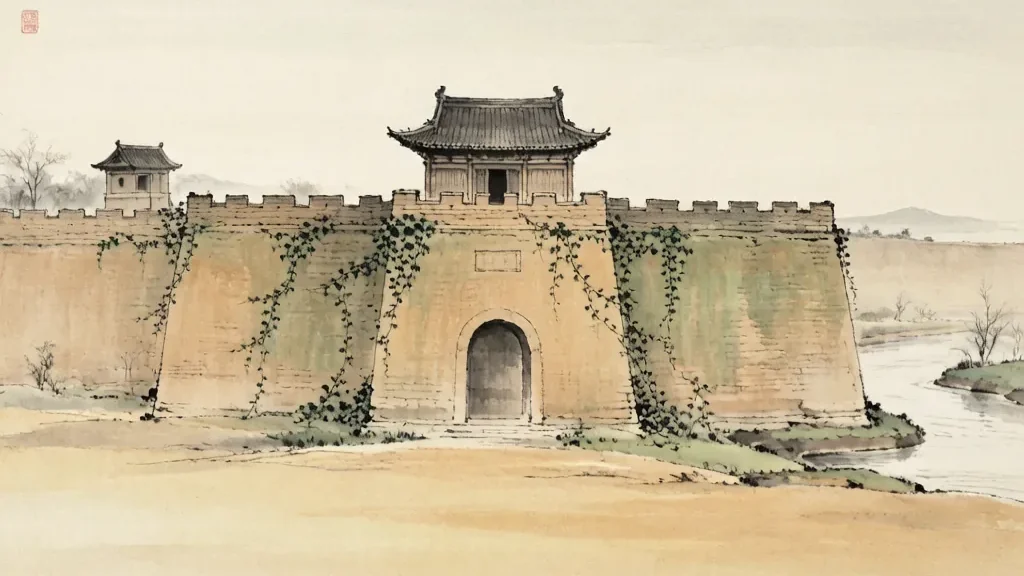
Zhengzhou, the capital of Henan province, sits atop one of the most important archaeological sites in China: the remains of a great walled city of the Shang dynasty, among the earliest and largest urban foundations in East Asia. More than three and a half thousand years ago, the Shang people built a rectangular capital here enclosed by massive rammed-earth walls, and they operated bronze foundries, bone workshops, and pottery kilns on a royal scale. The discovery of this city in the mid-twentieth century transformed the understanding of early Chinese civilization, confirming the historical reality of the Shang beyond the later written records. Today the earthen walls still rise above the modern streets, a tangible link between the Bronze Age and the contemporary provincial capital. Zhengzhou thus claims a double identity: a busy rail and industrial hub, and the seat of a kingdom that helped invent urban China.
The Shang Dynasty in the Bronze Age
The Shang is the earliest Chinese dynasty for which both written evidence and archaeological remains are abundant. Ruling roughly from the sixteenth to the eleventh century BCE, the Shang were masters of bronze casting, literacy, and ancestral ritual, and their kings commanded a network of cities across the North China plain. The dynasty is known from later histories, from the oracle-bone inscriptions of the late Shang, and from the cities and tombs unearthed by archaeologists.
Shang society was hierarchical and ritualized, centered on a king who communicated with ancestors and deities through divination and sacrifice. Bronze vessels cast for these ceremonies display a level of technical and artistic achievement unmatched in the contemporary world, and the control of bronze was a source of royal power.
The heart of the realm shifted among several capitals over the dynasty's long span, and Zhengzhou preserves one of the earliest and most monumental of these seats, a city that belonged to the formative centuries of the Shang state.
The Discovery of the Shang City
For most of history the Shang capital at Zhengzhou was buried and forgotten, known only through a vague tradition that a place called Ao had been an early Shang seat. The truth emerged in the 1950s, when systematic survey and excavation revealed a vast rectangular enclosure defined by enormous earthen walls, along with workshops, foundations, and rich finds.
The walls were built by pounding layers of earth in wooden frames, the ancient technique of hangtu, and they reached a formidable height and thickness. Their scale announced a state capable of mobilizing huge labor for public works, a hallmark of civilization. The city's plan, with a palace area and industrial zones, showed advanced urban design.
The confirmation of a major Shang capital at Zhengzhou forced scholars to push the horizon of Chinese urban history further back and to take the early texts more seriously. The site became a benchmark for understanding the Erligang phase, the culture of the early and middle Shang.
The Rammed-Earth Walls
The most striking survival at Zhengzhou is the wall itself. Constructed of compressed earth in successive lifts, the ramparts formed a rectangle enclosing the elite core of the city, with gates and a grid of streets. Though eroded by millennia of weather and building, sections still stand several meters high and run for long stretches through the modern urban fabric.
The engineering behind the walls reveals planning and organization. The earth had to be sourced, tempered, carried, and pounded in measured courses, then faced and maintained. Such labor implied a central authority able to tax, conscript, and direct the workforce, the very definition of a state.
For the visitor, to stand on the Zhengzhou wall is to stand on the oldest city wall in China still traceable above ground. It is a monument not of stone but of earth, yet it has outlasted empires of marble.
Bronze Workshops and Royal Industry
Within and around the Shang city, archaeologists found the traces of state industry on a grand scale. Bronze-casting workshops produced the ritual vessels and weapons that defined Shang kingship, using clay piece-molds and a mastery of high-temperature metallurgy. The scale of the slag, the molds, and the debris shows continuous, organized production.
Bone-working shops turned the shoulder blades of cattle and sheep into implements and into the plaques later inscribed for divination, while pottery kilns supplied the daily and ceremonial wares of the court. The concentration of these crafts inside the capital reveals a planned economic core serving the palace.
The presence of such industry confirms that Zhengzhou was not a ritual enclosure alone but a working metropolis, a place where raw material from the hinterland was transformed into the symbols and tools of power. The city was, in effect, the factory of the early kingdom.
The Palace and the Elite Core
At the center of the walled enclosure lay the palace quarter, where the rulers lived and conducted ceremony. Excavations have exposed foundation trenches, courtyards, and the sort of large timber buildings raised on packed-earth platforms that became the template for Chinese palaces for millennia.
Around the palace were the dwellings and graves of the elite, supplied in death with bronzes, jades, and vessels. The contrast between the rich burials and the simpler quarters of craftsmen speaks to the steep hierarchy of Shang society and to the court's monopoly on precious goods.
This spatial logic, elite core within a great wall, workshops at the edges, ancestors honored in ritual, would be repeated in every Chinese capital that followed. Zhengzhou is thus a prototype, the original draft of the imperial city.
Erligang and the Wider Culture
The culture of the Zhengzhou Shang city is classified by archaeologists as Erligang, named for a nearby locality, and it marks a phase of expansion in which Shang-style bronzes, walls, and rites spread across a broad region. Erligang sites appear far from Zhengzhou, testifying to the reach of the early state's model of urban life.
This diffusion suggests that Zhengzhou was not an isolated capital but the hub of a networked world, its practices copied or imposed from the plains to the Yangtze. The uniformity of bronzes across this zone implies shared religion and authority, the cultural glue of the Shang realm.
Studying Erligang therefore means studying the birth of a civilization's form: the walled, bronze-using, ancestor-worshipping city that would define China's heartland for a thousand years.
Zhengzhou and Nearby Anyang
The later Shang capital, famous from the oracle bones, lay at Anyang to the north, and its discovery in the twentieth century first proved the dynasty historically. Zhengzhou belongs to an earlier stage, the era when the Shang were consolidating their power before the move to Anyang.
The two sites together tell a single story of growth and shift. Zhengzhou shows the Shang at the height of their early urban ambition; Anyang shows the mature kingdom of the late Bronze Age with its written records. The capitals moved, but the culture endured.
For travelers interested in the deepest roots of Chinese civilization, the pair of Zhengzhou and Anyang forms a natural itinerary, a journey from the walled prototype to the inscribed court.
From Ancient Capital to Modern Hub
In the centuries after the Shang, Zhengzhou remained a local center but lost its imperial status, overshadowed by Luoyang and Kaifeng nearby. It revived as a railway junction in the modern era, when lines across the plain made it a major transport and industrial city, and it became a provincial capital in the mid-twentieth century.
The modern city grew over and around the ancient one, so that the Bronze Age wall now threads through districts of concrete and steel. Preservation efforts protect the remaining ramparts and present them as a park and monument, a conscious bridge between past and present.
The result is a city where a commuter may pass a Shang wall on the way to work, an everyday coexistence of three thousand years that few places on earth can match.
Why Zhengzhou's Shang Past Matters
The Shang city matters because it is foundational. It demonstrates that complex urban society in China arose earlier and at a larger scale than once supposed, and it anchors the long continuum of Chinese civilization in measurable earth and bronze.
It also matters for method. The union of excavated walls, inscribed bones, and transmitted histories at Zhengzhou and Anyang created the model by which early China is studied, a discipline built on matching spade and text.
For the visitor, finally, Zhengzhou offers the chance to touch the oldest city wall in China and to stand where a Bronze Age king once ruled, a direct physical link to the invention of the Chinese city.
❓ Frequently Asked Questions
What is the Zhengzhou Shang city?
It is the walled capital of the early Shang dynasty, built more than three thousand years ago and confirmed by mid-twentieth-century excavation as a major Bronze Age urban center.
How were the walls built?
They were made by pounding layers of earth in wooden frames, the rammed-earth technique, and they still stand above ground in places after millennia.
What was made in the city?
Royal workshops cast bronzes, worked bone for divination plaques, and fired pottery on an organized, state-run scale for the palace and ritual.
What does Erligang mean?
Erligang is the name archaeologists give to the early and middle Shang culture centered on Zhengzhou, whose style spread widely across the region.
How does Zhengzhou relate to Anyang?
Anyang was the later Shang capital known from oracle bones, while Zhengzhou represents an earlier stage, together mapping the dynasty's growth.
Why is the site important?
It confirms the historical reality of the Shang and shows that Chinese urban civilization began earlier and larger than previously thought.