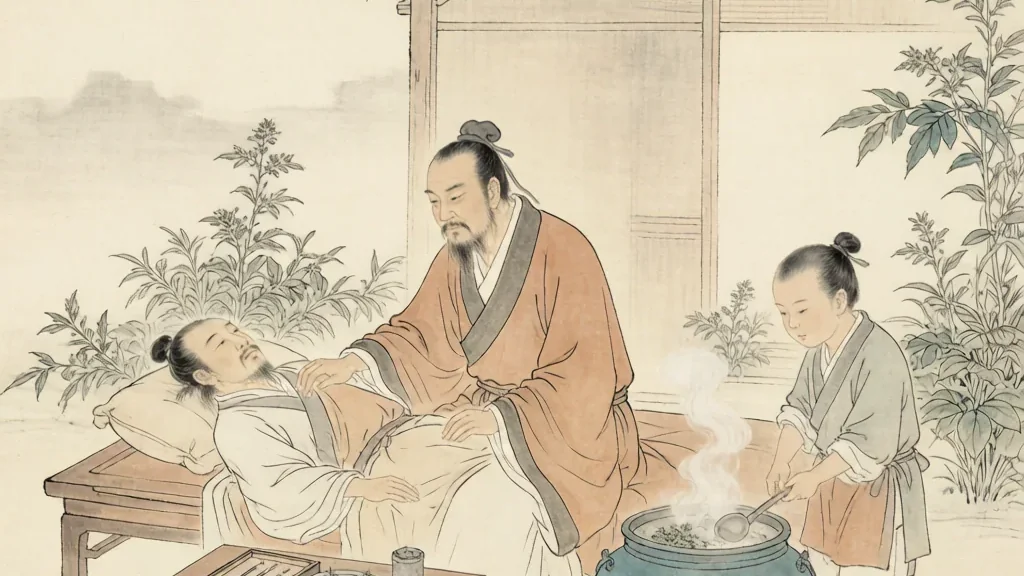
Long before European surgeons dared to cut open a living body, a wandering physician in the waning years of China's Han dynasty was already putting patients to sleep with an herbal brew and operating on their insides. His name was Hua Tuo, written 华佗 and pronounced . To readers in the English-speaking world, Hua Tuo is often described as the "Chinese surgeon of a thousand years too soon," a man whose techniques—anesthesia, abdominal surgery, and a exercise system still practiced today—anticipated modern medicine by more than a millennium. This article tells the story of a healer who refused high office, traveled among the poor, and whose only book was burned, leaving his genius to survive mostly as legend.
A Life Spent on the Roads
Hua Tuo was born around 145 CE in the state of Pei, in what is now Anhui province. Unlike many scholars of his age who pursued the civil service examinations to win a government post, Hua Tuo chose medicine as a lifelong calling. He traveled constantly from village to village, carrying little, treating farmers and soldiers and the families of obscure towns alongside the occasional general. Contemporary records describe him as plain in dress, indifferent to wealth, and fiercely independent in temperament.
What set him apart was his refusal to be confined to a court. Several regional warlords invited him to serve as a personal physician, and at one point he was summoned to the capital to attend Cao Cao, the powerful warlord who would become the founder of the Wei kingdom. Hua Tuo accepted, but he grew restless and fearful under the constant demands of a single patron. When he asked to return home on the pretext of fetching medicine for his wife, he did not come back. Cao Cao, suspicious and known for his cruelty to those who crossed him, had Hua Tuo arrested and executed around 208 CE.
The tragedy of Hua Tuo's death is that it cost China his written knowledge. According to the histories, he had compiled a medical treatise, but as he lay in prison he entrusted the manuscript to a jailer, who—afraid of punishment—destroyed it. Whether or not the story is literal fact, it captures a real loss: almost nothing of Hua Tuo's own writing survives, and we know him chiefly through the accounts of later historians such as Chen Shou in the Records of the Three Kingdoms.
The First Surgical Anesthetic
Hua Tuo's most astonishing contribution was a general anesthetic he called mafeisan, the "powder of boiled numbness." He would mix it with wine and have the patient drink it before an operation. Once insensible, the patient could be cut open, diseased organs removed or abscesses drained, and then sewn up, awakening only later in pain that Hua Tuo would treat with herbal poultices. For the ancient world, where surgery was normally limited to the surface of the body and performed in agony, this was extraordinary.
The exact recipe of mafeisan is lost, which is hardly surprising given that his book was destroyed. Later Chinese medical writers speculated that it may have contained preparations of plants such as datura, cannabis, or aconite, all of which were known in early Chinese pharmacology for their numbing or sedative effects. Whatever the ingredients, the principle was clear and modern: render the patient unconscious, operate, then manage recovery with care. It would be many centuries before surgeons elsewhere in the world adopted inhaled or ingested anesthetics on a comparable scale.
Hua Tuo is also credited with performing what amounts to an early form of abdominal surgery, including the removal of intestinal masses and the treatment of gastrointestinal disease. The histories recount a case in which he advised a patient that only opening the abdomen would cure him, and that the patient would live for years afterward. Such accounts, while shaped by admiration, reflect a genuine reputation for invasive procedures that no other physician of the era is said to have matched.
Master of Herbs and the Pulse
Outside the operating theater, Hua Tuo was a brilliant diagnostician. He placed great faith in feeling the pulse and observing the whole person rather than only the symptom. He is said to have diagnosed illnesses accurately from a single consultation and to have prescribed precise herbal formulas that restored health where others had failed. His pharmacology favored simplicity, using a small number of well-chosen drugs rather than enormous compound prescriptions.
He also understood the body as something to be kept healthy rather than only repaired when broken. Hua Tuo taught that the lungs and limbs must be moved to keep the blood flowing and to prevent illness from taking root. This conviction led him to design a set of calisthenics modeled on the movements of animals, a system that became one of his most enduring legacies.
The Five-Animals Exercise
Hua Tuo created a regimen he called the wuqinxi, the "play of the five animals": the tiger, the deer, the bear, the ape, and the bird. Each movement was meant to stretch a different part of the body and tone a corresponding organ system. The tiger posture built strength in the limbs, the deer舒展 the neck and spine, the bear steadied the waist, the ape loosened the joints, and the bird opened the chest to improve breathing.
Unlike the brutal training of soldiers, the five-animals play was gentle and could be performed by the elderly and the sick. Hua Tuo prescribed it as preventive medicine, claiming that a person who practiced it daily would digest food well, circulate blood smoothly, and rarely fall ill. The tradition survived the loss of his book: the wuqinxi was transmitted through later physicians andDaoist practitioners and is still taught today as a form of qigong, a living echo of a doctor who died nearly two thousand years ago.
Legend, Martyrdom, and Memory
Hua Tuo's execution by Cao Cao became one of the great cautionary tales of Chinese history, a story of a genius destroyed by the suspicion of a tyrant. The irony was sharp: Cao Cao himself suffered from a severe headache, and it was Hua Tuo who proposed trepanning the skull to relieve the pressure—a procedure Cao Cao, paranoid that it was an assassination, refused, sealing his own physician's fate and perhaps his own suffering. Popular memory transformed Hua Tuo into a near-saint of medicine, and even today the phrase "a second Hua Tuo" is a compliment paid to a skilled doctor.
In temples and folk religion he was honored as a healing deity, and his image joined those of other patron figures of the medical arts. The gap between the historical man and the legend is wide, but both rest on a real foundation: Hua Tuo was a physician of genuinely original practice, far ahead of his time in surgery, anesthesia, and preventive care. His lost book is a wound in the history of medicine, but his name endures as a symbol of compassion, independence, and scientific daring.
Why Hua Tuo Matters Today
Hua Tuo matters because he shows that the impulse behind modern surgery—to relieve suffering through precise, reasoned intervention—was not the property of any one civilization or era. His story challenges the familiar narrative that anesthesia and abdominal surgery were European inventions of the nineteenth century. It reminds us that knowledge can be lost as well as gained, and that a single life of devotion to the sick can outlast empires. For readers curious about the global roots of medicine, Hua Tuo is an essential figure: a doctor who anesthetized a thousand years too soon, and who still teaches us through the slow animal movements of his exercise.
Hua Tuo in Folklore and Deity Cult
Beyond the histories, Hua Tuo grew into a figure of popular religion. Healing temples placed his image among the patron deities of medicine, and devotees prayed to him for recovery and to sons who would become doctors. Folk stories multiplied his miracles, from raising the seemingly dead to diagnosing illness at a glance, and opera staged his confrontation with Cao Cao as a clash of healer and tyrant. This deification reflects a real esteem for physicians who served the poor, and it turned a historical doctor into a symbol of compassion. The gap between the man and the saint is wide, but both rest on the same foundation: a practitioner whose care for the sick outweighed his own safety.
The Lost Knowledge of Hua Tuo
The deepest loss tied to Hua Tuo is not his life but his book. According to the histories, he compiled a treatise and entrusted it to a jailer as he faced execution, but the jailer, fearing punishment, destroyed it. Whether literal or not, the story marks a genuine hole in medical history, for nearly all we know of Hua Tuo comes secondhand from later writers such as Chen Shou. His anesthetic recipe, his surgical method, and his herbal lore survived only as rumor and fragment. The destroyed Green Bag Book became a wound in Chinese medicine, a reminder that knowledge guarded by a single person can vanish with them, and that transmission, not genius alone, is what preserves a craft.
❓ Frequently Asked Questions
📝 Chinese Vocabulary
华佗 — : Hua Tuo, the Han-dynasty physician and surgeon.
麻沸散 — : "powder of boiled numbness," Hua Tuo's general anesthetic.
五禽戏 — : the five-animals exercise, his preventive-medicine calisthenics.
东汉 — : the Eastern Han dynasty, the era in which he lived.
神医 — : "divine physician," a title later given to great doctors like Hua Tuo.
青囊书 — : The Green Bag Book, the medical treatise Hua Tuo is said to have written and lost.
剖腹术 — : Abdominal surgery, which Hua Tuo is credited with performing after anesthesia.
脉诊 — : Pulse diagnosis, the method by which Hua Tuo read a patient's whole condition.
🎉 Fun Facts
- Hua Tuo is said to have kept a pet goat that he used to demonstrate pulse diagnosis to students.
- The phrase "a second Hua Tuo" is still used in Chinese to praise a brilliant doctor.
- He proposed drilling into Cao Cao's skull to cure a headache—an early idea of neurosurgery.
- The five-animals exercise he invented is still taught in parks across China each morning.
- Hua Tuo is said to have treated common soldiers and farmers without charge, turning down high office to remain among ordinary people.
- His name is still invoked in schools of traditional Chinese medicine as the model of the compassionate, independent physician.