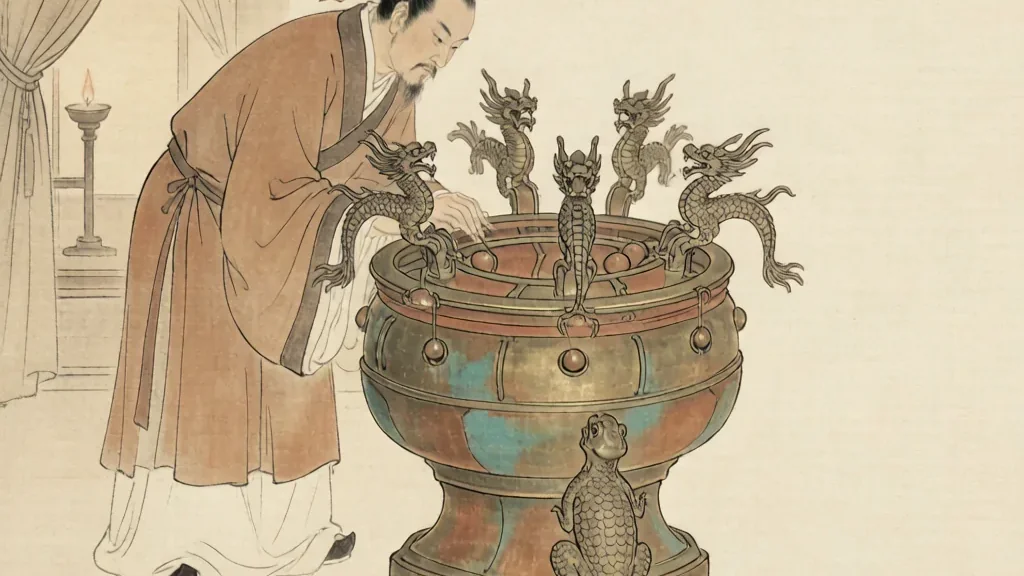
Almost two thousand years ago, in the court of the Han dynasty, a scholar built a bronze urn studded with dragons and toads that could tell, from the capital, exactly which direction an earthquake had struck hundreds of miles away. The inventor was Zhang Heng, written 张衡 and pronounced . An astronomer, mathematician, engineer, poet, and painter, Zhang is best remembered for the world's first seismoscope, but his mind ranged across the whole of learning. For English readers, Zhang Heng is proof that the so-called "Renaissance man" was not a European monopoly. This article surveys a life of astonishing breadth.
A Scholar of the Eastern Han
Zhang Heng was born in 78 CE in Nanyang, in present-day Henan province, during the stable and prosperous Eastern Han dynasty. He came from a family of modest official standing and showed early promise in writing and learning. Like many talented youths, he traveled to the capital, Luoyang, to study the classics, but he was known for a quiet, studious nature rather than a taste for fame or office.
He held several government posts, including a long tenure in the astronomical bureau, where he was responsible for keeping the calendar and observing the heavens. Colleagues respected his integrity and his reluctance to flatter powerful patrons. Although he could have pursued a more lucrative political career, Zhang preferred the company of books and instruments, and he used his official position chiefly as a base for research and writing.
The Seismoscope
Zhang Heng's most celebrated invention, completed around 132 CE, was the houfeng didong yi, often called the earthquake weathervane or seismoscope. It was a large bronze vessel crowned with a central column and surrounded by eight dragon heads, each holding a bronze ball in its mouth. Beneath each dragon crouched a bronze toad with its mouth open. When an earthquake occurred, the mechanism inside dropped the ball from the dragon facing the quake's direction into the toad's mouth, announcing the event with a ringing sound.
According to the histories, the device once released a ball when no tremor was felt in the capital, and skeptical officials mocked it—until a messenger arrived days later reporting a quake in the northwest at exactly the place the instrument had indicated. The story may be embellished, but it captures the real achievement: a machine that detected distant earthquakes through ground vibration, something unknown elsewhere for more than a thousand years. Modern replicas built from historical descriptions have shown that the principle is sound.
Astronomy and the Armillary Sphere
Zhang Heng was a leading astronomer who argued that the earth and heavens were spherical, comparing the cosmos to the yolk inside an egg. He improved the armillary sphere, a model of the celestial circles, and built a water-powered version that turned in step with the sky, an early astronomical clock. His writings described the moon's light as reflected sunlight and correctly explained eclipses as the shadow of the earth or moon.
He also produced star catalogs and refined the calendar. His cosmological views placed China within a vast, ordered universe governed by natural principle rather than by constant divine intervention, a perspective that fit the rational spirit of Han science. Through his instruments and texts, Zhang helped fix the basic framework of Chinese astronomy for centuries.
Mathematics and Cartography
Beyond the heavens, Zhang Heng contributed to mathematics. He offered improved approximations of pi, proposing values that, while not as precise as Zu Chongzhi's later result, were more accurate than the old "three times the diameter" used in everyday reckoning. He also wrote on the geometry of spheres and is credited with an early interest in calculating volumes.
He applied measurement to the earth as well as the sky. Historical sources say he drew an accurate map of the empire's regions, and his work in cartography reflected the same quantitative habits he brought to astronomy. Though the maps themselves are lost, the record of his engagement shows a mind that refused to treat any field as separate from the others.
The Literate Polymath
What makes Zhang Heng unusual is that he was also a fine man of letters. He wrote fu, the elaborate rhapsody poetry prized in the Han courts, including famous pieces on the two capitals and on the void. His prose was admired for its learning and elegance, and he served on commissions to compile official histories. This combination of scientist and poet is rare in any civilization and marks him as a truly rounded intellect.
His literary side also helped preserve his scientific ideas, because his writings carried his cosmological arguments to later readers. In Zhang Heng, the split between the "two cultures" of science and humanities had not yet been made, and his example invites us to imagine a scholar who measured the stars and sang of them in the same life.
Why Zhang Heng Endures
Zhang Heng endures because he embodies the ideal of the complete scholar and because his inventions solved real problems. The seismoscope addressed a practical need in a land frequently shaken by quakes, giving rulers early warning of disasters far away. His astronomical instruments advanced the human picture of the cosmos. And his career shows that curiosity across many fields can reinforce itself rather than dilute talent.
For the English-speaking world, Zhang Heng is a corrective to the notion that systematic science began in the West. His bronze dragon-and-toad machine and his turning armillary sphere belong to the same lineage as the telescope and the seismograph of modern times. He is a reminder that the urge to understand and to measure is common to humanity, and that some of its earliest triumphs rose on the plains of Han China.
Zhang Heng's Cosmological Writings
Beyond his instruments, Zhang Heng set down his picture of the universe in a treatise called the Spiritual Constitution of the Universe. In it he described the heavens as a sphere with the earth at the center, the stars fixed to an outer shell, and the seven luminaries moving within. He discussed the causes of eclipses, the phases of the moon, and the relative distances of the planets in terms of his age's knowledge. The work is important not for perfect accuracy but for its method: it treated the cosmos as orderly and knowable, governed by principle rather than whim. Lost in parts, it survives through later quotations that let scholars trace how Han astronomers reasoned. As both author and maker, Zhang Heng linked the written word and the machine, so his theories and his devices explained each other.
The Water-Powered Sky
One of Zhang Heng's cleverest devices was a water-driven armillary sphere that turned in step with the real sky. By regulating the flow of water through a tank and a series of wheels, he made a bronze model of the celestial circles rotate once roughly every twenty-four hours, so a viewer in his observatory could watch the heavens move indoors. This was an early astronomical clock, a piece of precision engineering that joined his love of mechanics to his study of the stars. The idea of powering a model of the cosmos with flowing water influenced later Chinese horologists, who built ever more accurate clock-driven spheres. Zhang Heng's machine is a reminder that his science was not only observational but practical, turning abstract cosmology into a working instrument that anyone could read.
❓ Frequently Asked Questions
📝 Chinese Vocabulary
张衡 — : Zhang Heng, the Han polymath and inventor.
地动仪 — : the seismoscope, his earthquake-detecting instrument.
东汉 — : the Eastern Han dynasty, his era.
浑天仪 — : the armillary sphere, his model of the heavens.
科学家 — : scientist, a modern word for what Zhang embodied.
灵宪 — : The Spiritual Constitution of the Universe, Zhang Heng's astronomical treatise.
圆周率 — : The ratio pi, which Zhang Heng estimated more accurately than the old value of three.
归田赋 — : Rhapsody on Returning to the Fields, one of Zhang Heng's famous literary works.
🎉 Fun Facts
- Zhang Heng's seismoscope reportedly detected a quake in a distant province that no one in the capital had felt.
- He compared the cosmos to the yolk inside an egg, an early spherical model of earth and heaven.
- He was both a government astronomer and a famous poet of the Han rhapsody form.
- A lunar crater and an asteroid are named in his honor.
- Zhang Heng's estimate of pi was about 3.162, an improvement over the traditional value of 3 then in common use, though later bettered by Zu Chongzhi.
- He served as an official in the astronomical bureau for years and was known for refusing flattery of powerful patrons, which limited his political climb.