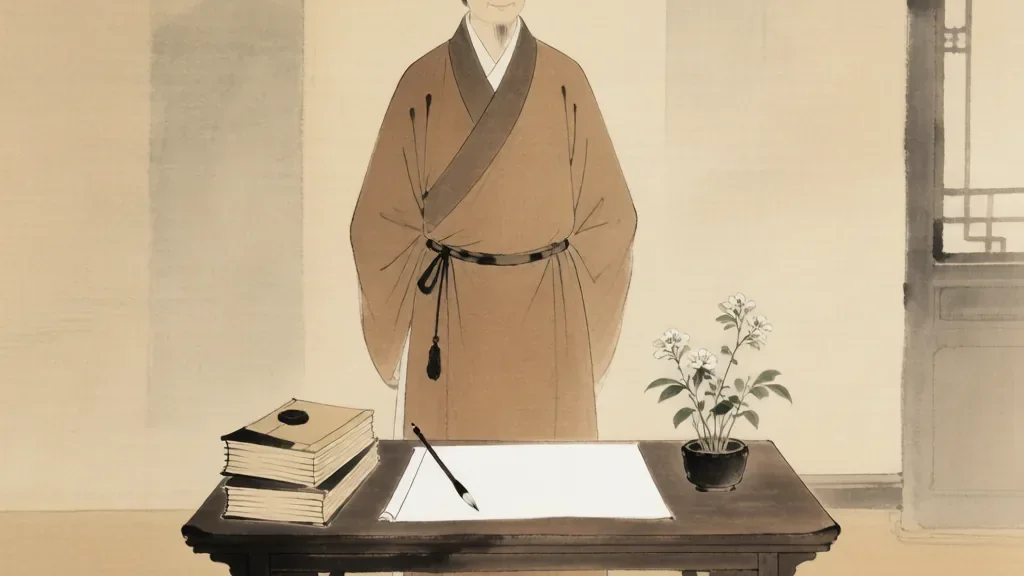
In the long history of medicine, few books have been as ambitious as the one a Ming-dynasty physician named Li Shizhen spent nearly thirty years writing. His Chinese name is 李时珍, pronounced , and his masterwork, the Bencao Gangmu or "Compendium of Materia Medica," catalogued nearly two thousand drugs drawn from plants, animals, and minerals. For English readers, Li Shizhen stands as one of the great naturalists of the pre-modern world—a man who combined field observation, careful classification, and skeptical testing in a way that feels strikingly modern. This article explores his life, his monumental book, and the reason his work still matters.
A Family of Doctors
Li Shizhen was born in 1518 in Qizhou, in present-day Hubei province, into a family that had practiced medicine for generations. His father was a local physician, a respected but modest profession in an age when the highest social prestige belonged to scholars who passed the civil service exams. As a dutiful son, Li Shizhen first tried to follow the orthodox path, sitting the county examinations as a young man. He passed the lowest level but then fell seriously ill, and the experience, together with his evident talent for medicine, turned him toward the family calling.
He never regretted the choice. Li Shizhen came to believe that medicine was a higher service than office-seeking, because it relieved real suffering. He studied widely, read the classical pharmacopeias, and soon built a reputation that reached the imperial court. At one point he served as an official in the Imperial Academy of Medicine in the capital, but he remained restless and independent, more interested in research than in bureaucratic routine. Within a few years he left to travel, observe, and write.
Why He Wrote the Compendium
The immediate spark for his life's work was dissatisfaction with the medical literature of his day. Earlier materia medica were riddled with errors: drugs were misidentified, entries were copied without checking, and folk names were confused with scholarly ones. Li Shizhen found that he could not trust the books on which physicians relied. He resolved to produce a corrected, systematic catalog of every substance used as medicine in China.
He began the project around 1552 and did not finish until about 1578. The scale was enormous. He consulted more than eight hundred earlier texts, from agricultural treatises to travel accounts, and he added his own findings from years of wandering through mountains and markets. He interviewed farmers, hunters, and herbalists, examined specimens himself, and discarded claims he could not verify. The result was a work of unusual intellectual honesty for its time.
The Bencao Gangmu
The Bencao Gangmu, or "Compendium of Materia Medica," was organized with a rigor that anticipated modern taxonomy. Li Shizhen grouped his entries into sixteen large categories—such as grasses, cereals, vegetables, fruits, domestic animals, and minerals—and within them arranged roughly 1,892 principal drugs, with thousands more mentioned in notes. Each entry gave the drug's names, a description of the plant or substance, its habitat, methods of preparation, and its supposed therapeutic uses.
What makes the book remarkable is not only its size but its method. Li Shizhen insisted on seeing the actual organism whenever possible, and he corrected the mistakes of predecessors who had described imaginary or conflated species. He distinguished true ginseng from look-alikes, clarified which animals yielded which medicines, and warned against toxic substitutions. Modern botanists still consult the Gangmu for its observations on Chinese flora and fauna, and it is rightly counted among the great encyclopedic works of the world.
Science Before Its Time
Li Shizhen's approach had a scientific character long before the word entered Chinese usage. He tested folk remedies against his own judgment, rejected superstition when evidence failed, and prized direct observation over authority. He noted, for example, that some widely used "medicines" were useless or dangerous, and he tried to separate genuine efficacy from tradition. His sections on diet, hygiene, and the effects of environment on health read like early public-health writing.
He was also a careful recorder of the natural world beyond medicine. The compendium contains descriptions of animals and plants that are valuable to historians of biology, and his classification—beginning with inorganic minerals and moving toward more complex living things—shows an intuitive sense of nature's order. Though he worked within a framework of traditional Chinese theory about energies and humors, his empirical habit of mind was the same one that would later define science.
Recognition and Spread
Li Shizhen completed the great work near the end of his life and died in 1593, not long after. The Bencao Gangmu was finally printed in 1596 with imperial support, and it quickly became the standard reference for Chinese medicine. Editions multiplied, and the book spread across East Asia. In the seventeenth century it reached Japan, where it shaped Japanese pharmacology, and by the eighteenth century it had been translated into several European languages through the work of Jesuit and other scholars.
European naturalists, including figures of the Enlightenment, read the Gangmu with admiration for its breadth. It entered Western libraries as one of the most detailed descriptions of Asian nature then available. Today it is preserved as a treasure of Chinese printing and learning, and Li Shizhen is memorialized in museums, on postage stamps, and in the names of research institutes.
Legacy for a Modern World
More than four centuries after his death, Li Shizhen speaks to anyone who values careful inquiry and respect for the natural world. His compendium bridged medicine and natural history at a time when such fields were not yet separate, and his insistence on checking facts against reality remains the core of good science. For readers in the English-speaking world, he is an inviting entry point into Chinese medicine, not as a bundle of exotic cures but as a tradition of serious observation. The physician who catalogued all of nature reminds us that curiosity, discipline, and a willingness to correct one's teachers are timeless virtues.
Theory Behind the Remedies
Underneath Li Shizhen's enormous list of drugs lay a coherent framework drawn from traditional Chinese medicine. He understood the body and its ills through paired forces such as yin and yang and through the circulation of qi, the vital energy said to animate life. Illness was explained as imbalance or blockage, and a remedy was chosen to restore equilibrium rather than merely to suppress a symptom. He also classified substances by their nature, hot or cold, and by their effects on particular organs. This theoretical lens is why the Gangmu reads as more than a catalogue: each entry places a plant, animal, or mineral within a living system of correspondences that guided how physicians actually prescribed.
Food and Prevention in the Gangmu
Li Shizhen gave unusual weight to diet and daily habit as the first line of medicine. Many entries in the Gangmu describe common foods, from grains and vegetables to fruits and teas, and explain how regular eating can prevent illness before it starts. He warned that indulgence and bad combinations of food could themselves become a source of disease, and he recorded simple household measures, such as using mung beans to counter certain poisons. This practical, preventive outlook distinguishes his work from books aimed only at treating the already sick. For modern readers it is a reminder that Chinese medicine long treated the kitchen and the pharmacy as neighboring arts, with the wise physician beginning at the table.
❓ Frequently Asked Questions
📝 Chinese Vocabulary
李时珍 — : Li Shizhen, the Ming-dynasty physician and naturalist.
本草纲目 — : the "Compendium of Materia Medica," his masterwork.
明朝 — : the Ming dynasty, the era in which he lived.
本草 — : "root and herb," the traditional term for materia medica or pharmacopeia.
药 — : medicine, drug, or remedy.
中医 — : Traditional Chinese medicine, the broad healing system within which Li Shizhen worked.
脉 — : The pulse, a central diagnostic signal Li Shizhen and other physicians read to assess the body.
针灸 — : Acupuncture and moxibustion, traditional therapies of needles and heat he described.
🎉 Fun Facts
- The Bencao Gangmu describes not only medicines but also curiosities like caffeine-containing tea and the use of mung beans to test for poisons.
- Li Shizhen interviewed herbalists, hunters, and farmers to verify his entries rather than trusting old books.
- The compendium was translated into Latin, French, and other European languages and read by Enlightenment scientists.
- He is featured on Chinese postage stamps and has a museum dedicated to him in his hometown.
- The Bencao Gangmu catalogs roughly eleven thousand prescriptions alongside its drug entries, which is why it is still consulted as a formulary and not only as a materia medica.
- The herb ma huang, or ephedra, described in the Gangmu, later yielded ephedrine, a compound used worldwide in modern medicine.