If Cao Cao is the cunning realist of the Three Kingdoms, Liu Bei (刘备, Liú Bèi) is its conscience. A man who claimed descent from a Han imperial prince yet made his living weaving straw sandals and mats, Liu Bei rose from obscurity through sheer perseverance, kindness, and loyalty to found the state of Shu-Han and briefly realize the dream of restoring the fallen Han. He is the hero of the novel Romance of the Three Kingdoms, beloved for weeping as readily as he fought, and for the brotherhood oath that has become China's ideal of loyalty. History shows a shrewder survivor than the weeping saint of fiction, but the ideal he represents — that virtue, not only force, can win a throne — is why his name still carries warmth.
Liu Bei lived from 161 to 223, through the collapse of the Han and the wars of the Three Kingdoms. This article follows his humble start, his friendships with Guan Yu and Zhang Fei, his long struggles, his patron Zhuge Liang, and the Shu state he built in the southwest. It also weighs the man against the legend, and asks what his enduring popularity really means.
Humble Beginnings
Liu Bei was born in Zhuo commandery (in modern Hebei) in 161, claiming a distant lineage from Emperor Jing of the Han. The connection was real but remote enough to confer no wealth; by his own account he was raised by his widowed mother and earned money making straw sandals and mats to sell. He was a tall, big-eared, composed youth who befriended older boys and showed early leadership among local youths.
When the Yellow Turban Rebellion broke out in 184, Liu Bei joined the government side with a small band of followers, beginning a military career marked less by early triumph than by extraordinary resilience. He attached himself to various patrons and warlords — Gongsun Zan, Cao Cao, Yuan Shao, Liu Biao — often losing everything and starting again. What he never lost was his reputation for personal honor and concern for his followers.
Contemporaries noted that soldiers and civilians alike trusted him; when he fled, people followed, and when he governed, he was beloved. This "virtue" (de) became his brand in an age when most warlords ruled by terror. It was a slow, fragile asset, but over decades it compounded into a kingdom.
The Oath of the Peach Garden
The most famous story about Liu Bei — the Oath of the Peach Garden — comes from the later novel rather than strict history, but it captures the spirit of his appeal. According to the tale, Liu Bei swore brotherhood with the warrior Guan Yu and the blunt giant Zhang Fei, pledging to live and die for the cause of the Han. The three became the model of loyal friendship in Chinese culture.
Historically, Guan Yu and Zhang Fei were indeed Liu Bei's closest companions from early days, and they accompanied him through every reversal. Guan Yu in particular became the most revered of the three, later deified as the God of War. The brotherhood ideal — that chosen bonds of loyalty outweigh blood and self-interest — resonated so deeply that it shaped the ethics of guilds, secret societies, and even modern business networks.
Liu Bei's ability to inspire such devotion was his true strategic asset. Where Cao Cao commanded through fear and system, Liu Bei commanded through love. That made his following smaller but ferociously loyal, the core around which Shu-Han was built.
The Long Road to a Kingdom
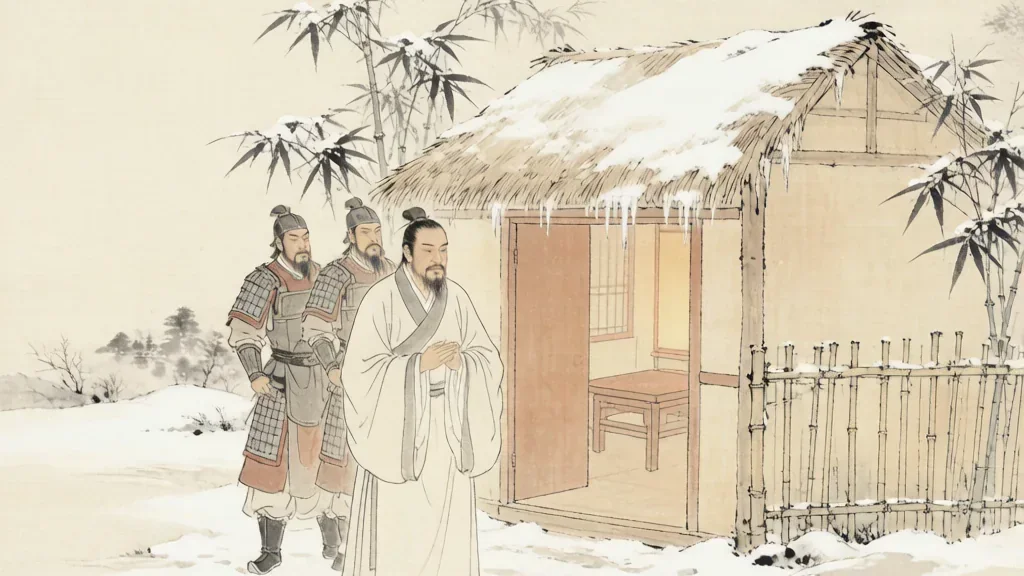
For decades Liu Bei was a wanderer. He served Cao Cao briefly, fled, and joined the campaign against Dong Zhuo's heirs; he was appointed to minor posts and lost them; he took refuge with Liu Biao in Jingzhou. The turning point came when he met Zhuge Liang, a brilliant young strategist, whom legend says he visited three times (the idiom "three visits to the thatched cottage") before winning his service.
With Zhuge Liang's counsel, Liu Bei adopted the plan to secure Jingzhou and then the rich province of Shu (Sichuan) as a base. After Liu Biao's death and Cao Cao's southern advance, Liu Bei's famous retreat through the burning lands of the south, carrying civilians who refused to leave him, cemented his reputation for humanity. In 214 he took Chengdu and established Shu-Han, declaring himself committed to restoring the Han line.
In 219, with Guan Yu holding Jingzhou and Liu Bei victorious in Hanzhong against Cao Cao, his fortunes peaked. But that same year Guan Yu was defeated and killed by Sun Quan's forces, and Jingzhou was lost — a blow from which Shu never fully recovered. Liu Bei's later life was shadowed by this grief.
The Founder of Shu-Han
In 221, after the Han emperor had been forced to abdicate to Cao Pi, Liu Bei proclaimed himself emperor of Han (historians call it Shu-Han) at Chengdu, presenting himself as the legitimate continuator of the dynasty. His reign was brief and troubled. Determined to avenge Guan Yu, he launched a campaign against Sun Quan in 222 but was crushed at the Battle of Yiling by the younger commander Lu Xun, who used fire against Shu's camps.
The defeat broke him. Liu Bei retreated to Baidicheng, fell ill, and in 223 entrusted his son and the state to Zhuge Liang in a famous deathbed charge, telling the minister that if the boy were incompetent he might take the throne himself — a gesture of trust Zhuge Liang repaid with a lifetime of loyal service. Liu Bei died later that year, having founded a state but not achieved restoration.
As a ruler he is remembered for clemency and for the quality of his court. Shu attracted able men disillusioned elsewhere, and under Zhuge Liang's regency it became a model of orderly, humane government in the southwest.
Historical Context: The Three Kingdoms
Liu Bei's career unfolded in the vacuum left by the Han's collapse. After the emperor became a puppet and Cao Cao ruled the north in his name, the south split between the Liu–Sun alliance and, after Red Cliffs, into the three polities of Wei (Cao), Shu (Liu), and Wu (Sun). The Three Kingdoms period (220–280) was a time of constant maneuver, shifting alliances, and regional state-building.
Liu Bei's project — restoring the Han — was as much a claim to legitimacy as a military goal. By stressing his imperial blood and his loyalty to the throne, he offered an alternative to Cao Cao's thinly veiled usurpation. Later Confucian historians, who detested Cao Cao's methods, elevated Liu Bei as the rightful claimant, and the novel cemented that view. The realpolitik was messier, but Liu Bei's narrative of virtuous resistance spoke to something the Chinese tradition needed.
Legacy: The Weeping Hero
Liu Bei's historical reputation was respectable; his legendary one is golden. In Romance of the Three Kingdoms he is the embodiment of benevolence (ren), weeping for his people and his brothers, never cruel, always wronged. Generations of readers rooted for him precisely because he wins by goodness rather than guile. Operas, paintings, and temples honored him, and the Shu court's cause became synonymous with legitimacy.
Modern historians note the gap: the real Liu Bei was a tough, adaptable warlord who made hard choices and sometimes acted from interest. But the gap does not lessen his interest; it shows how a culture projects its ideals onto a usable past. For many Chinese, Liu Bei answers a perennial question — can a good man succeed in a bad time? — with a qualified, touching "almost." That near-miss is exactly why he is loved.
Governing Shu-Han
Once established at Chengdu, Liu Bei set about building a working state in the southwest. He kept the local administration largely intact and drew able officials to his court, including many men disillusioned by the chaos elsewhere. Under Zhuge Liang's guidance, Shu became known for orderly, humane government: light taxes, careful appointments, and an emphasis on trust between ruler and people. The region's relative stability let Liu Bei present himself as the legitimate continuator of the Han, a claim given weight by his imperial ancestry and by the care he showed his subjects. Though his realm was the smallest of the three kingdoms, its reputation for justice long outlasted its short independent life, preserved in the memory of a gentle founder.
Liu Bei in Art and Memory
Across the centuries Liu Bei has been painted, staged, and worshipped as the benevolent lord. Operas show him with a gentle face and exaggerated large ears, visual shorthand for the destined yet merciful ruler, while temple art places him between his sworn brothers Guan Yu and Zhang Fei. The novel Romance of the Three Kingdoms fixed his image as the weeping, righteous uncle of the realm, the man who wins by goodness rather than guile. This artistic memory sometimes overshadows the historical warlord who made hard choices, but it captures what later culture needed: a leader whose power rested on love and loyalty. His enduring warmth shows how a people can remake a conqueror into a conscience.
❓ Frequently Asked Questions
📝 Chinese Vocabulary
刘备 — : The humble founder of Shu-Han and hero of the Three Kingdoms.
蜀汉 — : The Shu-Han state he founded in Sichuan.
三顾茅庐 — : "Three visits to the thatched cottage" to recruit Zhuge Liang.
桃园结义 — : The Oath of the Peach Garden brotherhood.
仁 — : Benevolence, the virtue Liu Bei embodies in legend.
诸葛亮 — : Zhuge Liang, Liu Bei's chief strategist and later regent of Shu-Han.
夷陵 — : Yiling, the site of Liu Bei's crushing defeat by Wu in 222.
白帝城 — : Baidicheng, the city where Liu Bei fell ill and died in 223.
🎉 Fun Facts
- Liu Bei allegedly made straw sandals and mats to support his widowed mother before his military career.
- He is said to have large ears, a traditional sign of a destined ruler.
- On his deathbed he told Zhuge Liang he could take the throne if the heir proved unfit — a gesture of total trust.
- The Oath of the Peach Garden shaped the loyalty ethics of guilds and secret societies for centuries.
- The Battle of Yiling, where Liu Bei was defeated by Lu Xun's fire attack, is still studied as a classic case of how overconfidence undid a strong army.
- Liu Bei's story spread far beyond China; in Korea and Japan the Three Kingdoms saga is a favorite subject of drama, games, and visual art.