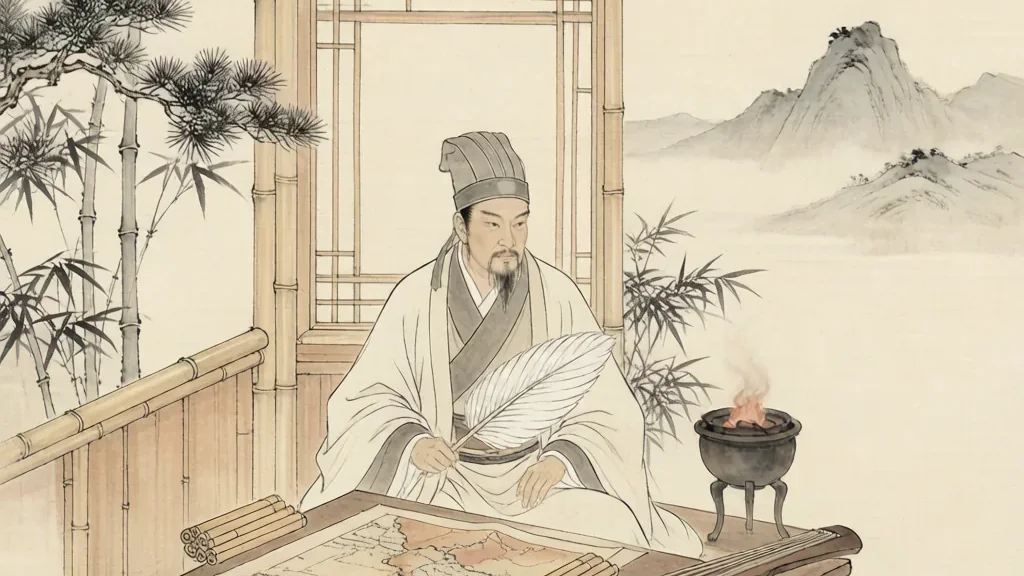
In the pantheon of Chinese heroes, no figure shines quite as brightly as Zhuge Liang. Known as the "Sleeping Dragon" for his hidden talents, he emerged from a quiet life of farming and scholarship to become the master strategist of the Shu Han kingdom during the turbulent Three Kingdoms period. His name has become synonymous with genius, foresight, and unwavering loyalty—a man whose intellect was matched only by his integrity, and whose tragic determination to fulfill an impossible mission has inspired generations.
Zhuge Liang lived during one of the most dramatic and romanticized periods in Chinese history. The fall of the Han Dynasty in 220 CE had shattered the empire into three competing states: Wei in the north, Wu in the southeast, and Shu in the southwest. It was an age of larger-than-life heroes, epic battles, and political intrigue that would later be immortalized in one of China's greatest literary works, the Romance of the Three Kingdoms. And at the center of this grand narrative stood a man whose brilliance seemed almost supernatural.
The Young Recluse
Zhuge Liang was born in 181 CE in what is now Shandong Province. His mother died when he was young, and his father passed away when he was eight, leaving him and his siblings orphaned. The family fled south to escape the chaos engulfing the north, eventually settling in the relative peace of Jing Province, where Zhuge Liang would spend his formative years.
Rather than seeking an official position in the crumbling Han bureaucracy, the young Zhuge Liang chose a life of rural simplicity. He farmed his land, studied the classics, and cultivated friendships with other young intellectuals who shared his interests. He was known to compare himself to ancient sages like Guan Zhong and Yue Yi—comparisons that most people dismissed as the arrogance of youth. But those who knew him well recognized something extraordinary in the quiet young man who spent his days reading, composing poetry, and contemplating the state of the world.
The nickname "Sleeping Dragon" came from his contemporaries who sensed the immense power lying dormant within him. A dragon in Chinese culture is not merely a fearsome creature but a symbol of transformative potential, capable of rising from the depths to soar through the heavens. The name captured both Zhuge Liang's hidden genius and the expectation that, when the right moment came, he would shake the world.
The Three Visits
That moment arrived through one of the most famous episodes in Chinese history: Liu Bei's three visits to the thatched cottage. Liu Bei, a distant relative of the Han imperial family, was a warlord of modest means but great ambition. He had heard of the Sleeping Dragon from his advisor Xu Shu and determined to recruit this extraordinary talent for his cause.
Liu Bei traveled to Zhuge Liang's humble home with his sworn brothers, Guan Yu and Zhang Fei, only to find the master absent. He left a message and returned a second time, braving a snowstorm, only to miss him again. Guan Yu and Zhang Fei grew impatient—why should their lord humble himself before a mere farmer? But Liu Bei persisted, and on his third visit, he finally found Zhuge Liang at home, sleeping. Rather than wake him, Liu Bei waited respectfully outside until the scholar stirred.
When they finally met, Zhuge Liang presented the Longzhong Plan, a strategic vision that outlined how Liu Bei could establish a viable kingdom in the west while waiting for the right moment to restore the Han Dynasty. The plan was breathtaking in its scope and precision. It recognized that the north, controlled by the powerful warlord Cao Cao, could not be challenged directly. Instead, Liu Bei should secure the fertile lands of Yi Province (modern Sichuan), ally with the southern state of Wu, and wait for the moment when internal strife in the north would create an opening.
Liu Bei was so moved by Zhuge Liang's vision that he declared finding him was "like a fish finding water." At the age of twenty-seven, Zhuge Liang left his quiet farm and embarked on a career that would define the age.
The Architect of Shu Han
Zhuge Liang quickly proved his worth. When Cao Cao's massive army threatened to crush Liu Bei's fledgling forces, Zhuge Liang traveled to the court of Sun Quan, the ruler of Wu, to negotiate an alliance. His diplomatic skill and strategic reasoning convinced the hesitant Sun Quan to join forces against their common enemy. The result was the Battle of Red Cliffs in 208 CE, one of the most famous engagements in Chinese history, where the combined forces of Liu Bei and Sun Quan destroyed Cao Cao's fleet with a devastating fire attack.
Following this victory, Zhuge Liang guided Liu Bei's expansion into Yi Province, exactly as the Longzhong Plan had envisioned. When Liu Bei declared himself emperor of Shu Han in 221 CE, Zhuge Liang was appointed chancellor—the highest civil position in the government. He served not only as the empire's chief strategist but as its chief administrator, managing everything from agricultural policy to legal reform to military logistics.
Zhuge Liang's governance was marked by fairness, efficiency, and a deep concern for the welfare of ordinary people. He reformed the tax system, promoted agriculture, standardized weights and measures, and ensured that officials were selected based on merit rather than connections. The remote and relatively poor region of Shu flourished under his administration, becoming stable and prosperous even as war raged across the rest of China.
The Southern Campaign
When Liu Bei died in 223 CE, he entrusted his young son and his kingdom to Zhuge Liang's care. "If my son proves worthy, assist him," Liu Bei said on his deathbed. "If he proves unworthy, you may take the throne yourself." Zhuge Liang, weeping, swore to serve the young emperor with every fiber of his being—a promise he would keep until his dying breath.
The new emperor was indeed weak, and the kingdom faced immediate threats. The southern tribes, sensing an opportunity, rose in rebellion. Before he could turn his attention northward to confront the rival state of Wei, Zhuge Liang needed to secure his rear. His Southern Campaign of 225 CE became legendary for its combination of military effectiveness and moral persuasion.
The most famous episode involved the tribal leader Meng Huo, whom Zhuge Liang captured and released seven times. After each release, Meng Huo raised a new army and returned to fight, only to be defeated again. Finally, after the seventh capture, Meng Huo refused to be released, acknowledging that Zhuge Liang's military genius was beyond challenge and his mercy beyond expectation. The southern tribes were pacified not through terror but through respect, and they would remain loyal to Shu for the rest of Zhuge Liang's life.
The Northern Expeditions
With the south pacified, Zhuge Liang turned to the task that would consume his final years: the Northern Expeditions against Wei. The Longzhong Plan had always envisioned an eventual offensive to restore the Han Dynasty, and Zhuge Liang believed that time was running out. Wei was growing stronger every year, consolidating its control over the wealthy northern plains. If Shu did not strike soon, it would never have another chance.
Between 228 and 234 CE, Zhuge Liang launched five major campaigns against Wei. Each was a masterpiece of logistics and maneuver, but each ultimately fell short of decisive victory. The challenges were immense: Shu's army had to cross the formidable Qinling Mountains, maintain supply lines through difficult terrain, and defeat a numerically superior enemy on its home ground. That Zhuge Liang came as close to success as he did is a testament to his genius; that he ultimately failed reflects the fundamental imbalance of power between the two states.
The campaigns produced some of the most dramatic episodes in the Three Kingdoms saga. At the Battle of Jieting, Zhuge Liang's trusted general Ma Su disobeyed orders and suffered a catastrophic defeat—a failure for which Zhuge Liang famously executed the man he had treated as a son, weeping as he gave the order. At the Battle of Wuzhang Plains, Zhuge Liang engaged in a prolonged stalemate with the Wei commander Sima Yi, each trying to outmaneuver the other in a deadly game of strategic chess.
Innovations and Inventions
Zhuge Liang was not merely a strategist and administrator—he was also a remarkable inventor. Tradition credits him with numerous innovations that reflect his practical genius. The most famous of these is the wooden ox and flowing horse, wheelbarrow-like devices designed to transport supplies over the rough mountain terrain of the Northern Expeditions. The exact design remains debated, but the concept was revolutionary: a one-man vehicle that could carry enough grain to feed several soldiers, freeing the army from dependence on vulnerable supply lines.
He is also credited with developing the repeating crossbow, a semi-automatic weapon that could fire multiple bolts before needing to be reloaded, and with improving the design of the sky lantern—a small hot air balloon used for military signaling that has evolved into the paper lanterns still released during festivals today. He wrote military manuals on strategy, logistics, and leadership that were studied for centuries, including the Thirty-Six Stratagems sometimes attributed to his genius.
Perhaps his most enduring contribution to Chinese culture is the steamed bun, or mantou. According to legend, after a military victory in the south, Zhuge Liang needed to cross a river that the locals believed was guarded by a deity demanding human sacrifices. Unwilling to sacrifice his soldiers, he ordered the army cooks to prepare steamed buns shaped like human heads and stuffed with meat, which were offered to the river instead. The deity was apparently satisfied, the army crossed safely, and mantou became a staple of Chinese cuisine.
Death at Wuzhang Plains
In 234 CE, during the fifth Northern Expedition, Zhuge Liang's health finally gave out. He had driven himself relentlessly for years, personally overseeing every detail of military and civil administration, often working late into the night and eating sparingly. His body, never robust, could no longer sustain the burden he had placed upon it.
The scene at Wuzhang Plains has become one of the most poignant in Chinese history. The dying chancellor, knowing his end was near, dictated his final wishes to the emperor, recommending his successor and apologizing for his failure to complete the great task of restoration. He gave detailed instructions for the army's orderly withdrawal, ensuring that even in death he would protect the soldiers who had followed him through so many campaigns.
According to the Romance of the Three Kingdoms, Zhuge Liang attempted to extend his life through a Daoist ritual, lighting seven lamps that needed to burn for seven days. But the Wei general Wei Yan burst into the tent on the final night, extinguishing the main lamp and sealing Zhuge Liang's fate. Whether historical or legendary, the story captures the tragic dimension of his character: a man who gave everything—even his life force—in service to a cause he knew might be impossible.
He died at the age of fifty-three. When the army withdrew, the Wei commander Sima Yi saw the abandoned camp and realized his great rival was gone. The scene is often depicted with Sima Yi standing before the empty encampment, awed by the order and discipline of the retreat—a final tribute to the man who had been his most formidable opponent.
The Sleeping Dragon's Legacy
After Zhuge Liang's death, Shu Han survived for another thirty years before falling to Wei. The Han Dynasty was never restored. In purely political terms, Zhuge Liang's life's work ended in failure. And yet, in Chinese cultural memory, he is remembered not as a failure but as the very embodiment of wisdom, loyalty, and dedication to principle.
His legacy rests on two pillars. The first is his intellect: the strategic genius who could predict his enemies' moves, the inventor whose creations advanced military technology, the administrator who built a prosperous state from limited resources. Chinese idioms still celebrate his cleverness—calling someone "as wise as Zhuge Liang" is the highest intellectual compliment.
The second, and perhaps more important, is his character. In an age of shifting alliances and broken oaths, Zhuge Liang's unwavering loyalty to Liu Bei and his son stood out as a moral beacon. He could have seized the throne for himself, as Liu Bei had invited him to do. He could have retired to a comfortable life when the odds turned against him. Instead, he exhausted himself in service to a cause he knew might fail—not because he was blind to reality, but because he believed that some commitments are worth honoring regardless of the outcome.
"Do your best and leave the rest to fate," he wrote in one of his memorials to the throne. It is a philosophy that acknowledges the limits of human agency while insisting on the dignity of the effort itself. The Sleeping Dragon never fulfilled his grand design. But in trying, he became immortal.
❓ Frequently Asked Questions
📝 Chinese Vocabulary
- 诸葛亮 (Zhūgě Liàng) — Zhuge Liang, the master strategist of the Three Kingdoms
- 卧龙 (Wòlóng) — "Sleeping Dragon," Zhuge Liang's nickname
- 三顾茅庐 (Sāngù Máolú) — "Three visits to the thatched cottage," the story of Liu Bei recruiting Zhuge Liang
- 鞠躬尽瘁 (Jūgōng Jìncuì) — "Spare no effort in the performance of one's duty," from Zhuge Liang's famous memorial
- 木牛流马 (Mùniú Liúmǎ) — "Wooden ox and flowing horse," Zhuge Liang's transport invention
🎉 Fun Facts
- Zhuge Liang is traditionally credited with inventing the steamed bun (mantou), which he created as a humane substitute for human sacrifices during a military campaign.
- He was known for carrying a white feather fan, which became his iconic symbol—legend says it was a gift from his wife, who was also a brilliant strategist.
- The idiom "three visits to the thatched cottage" is still used today to describe someone who sincerely and persistently seeks out talent.
- In the Empty Fort Strategy, Zhuge Liang is said to have calmly played the guqin on the open city wall, convincing a cautious enemy general that an ambush awaited inside and prompting a retreat.
- Zhuge Liang is honored as a patron deity in some Chinese temples, where worshippers seek his blessings for both wisdom in study and loyalty in service.
- The Eight Trigrams battle formation is attributed to him, a maze of flags and troops designed to confuse and trap opposing forces on the field.