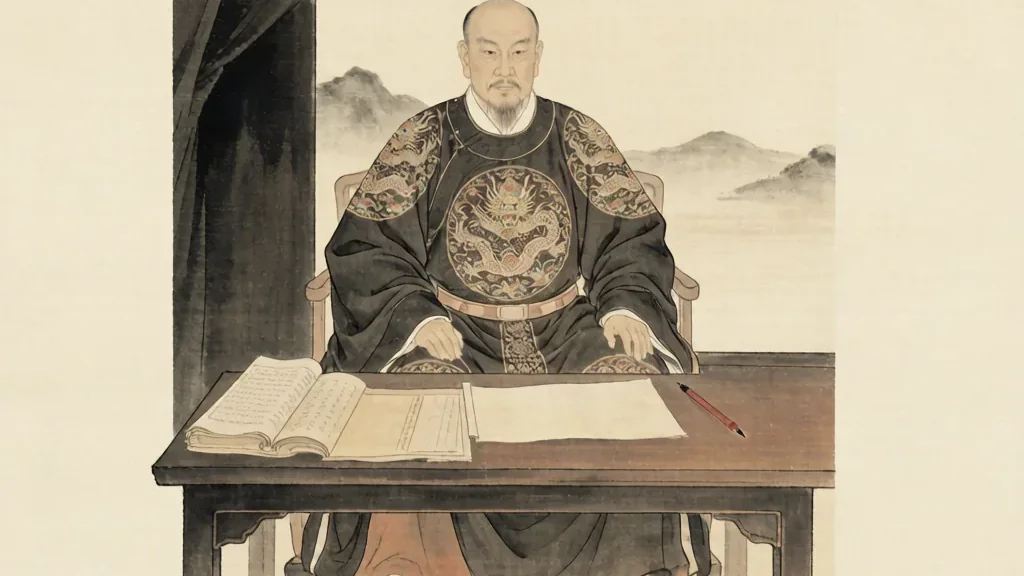
No rise in Chinese history is more improbable than that of Zhu Yuanzhang (朱元璋, Zhū Yuánzhāng). Born a desperately poor peasant in 1328, orphaned by plague, and forced to beg, he entered a Buddhist monastery to survive, then joined a rebel army against the Mongol Yuan dynasty. Within two decades he had conquered all rivals, expelled the Mongols, and founded the Ming dynasty, ruling as the Hongwu Emperor. He is the only person in Chinese history to rise from penniless commoner to founding emperor. His reign was brilliant in restoring native rule and disastrous in its terror — a study in how suffering can forge both a unifier and a tyrant. To know Zhu is to know the raw, violent energy of China's last native dynasty.
This article traces the beggar monk's path to the dragon throne, his nation-building, his paranoid purges, his reforms, and a legacy as contradictory as the man himself. Few founders loved the people more in theory and feared them more in practice.
From Beggar to Monk
Zhu Yuanzhang was born in 1328 in Huizhou (in modern Anhui), to a family of landless peasants. The 1340s brought famine and plague that killed his parents and brothers; the teenage Zhu was alone. He took refuge in a local monastery as a lay novice, but when the monastery's lands failed he was sent out to beg — a humiliation that scarred him and, he later said, taught him the people's misery.
The collapsing Yuan dynasty, ruled by Mongols who had lost touch with China's needs, faced wave after wave of peasant rebellions. In 1352 Zhu joined the Red Turban movement, a millenarian uprising wrapped in Buddhist and messianic imagery. He proved a capable organizer and fighter, rising quickly from soldier to commander through discipline and luck.
His early experience of hunger and contempt for the elite shaped his lifelong attitudes: a genuine sympathy for peasants paired with a burning suspicion of officials and rivals. The monastery and the battlefield together made the man who would rule.
The Road to the Throne
Zhu's genius was strategic patience. Based in Nanjing, he built a stable base in the wealthy Yangzi region while other rebel leaders exhausted themselves. He cultivated talent — scholars to govern, generals to fight — and presented himself as a restorer of Han Chinese order rather than a mere bandit. Step by step he eliminated competitors: first rival Red Turban chiefs, then the powerful warlord Chen Youliang, then Zhang Shicheng in the south.
In 1368 his armies marched north and took the Yuan capital Dadu (Beijing); the last Yuan emperor fled to the steppe, ending nearly a century of Mongol rule over China. Zhu proclaimed the Ming ("Brilliant") dynasty and took the reign name Hongwu, "Vast Martial." He was the first commoner to found a dynasty in a thousand years, and the achievement stunned contemporaries.
His victory was not just military but political: he offered order, native rule, and relief from Yuan corruption. For many Chinese, the Ming's founding felt like the world righting itself after a long disorder.
The Nation-Builder
As emperor, Hongwu worked tirelessly to rebuild the state. He restored the examination system, recruited Confucian scholars, revived agriculture through land surveys and irrigation, and promoted settlement of war-devastated regions. He moved the capital to Nanjing and built a formidable administration. The Ming would last nearly three hundred years, and its institutions — the civil service, the garrison system, the legal code — were largely his creation.
He also asserted Chinese power abroad, sending fleets (later expanded under his son, the Yongle Emperor) and demanding tribute from neighbors. Domestically he emphasized frugality and the peasant ideal, banning luxury at court and urging farmers to return to the land. In his self-image he was the farmer-emperor, the opposite of the decadent Mongol elite he had replaced.
Yet his building was authoritarian. He concentrated power in his own hands, abolished the post of chief councillor (prime minister) after executing his own ministers, and ruled as a personal autocrat. Efficiency and terror, in Hongwu's hands, were the same instrument.
The Paranoid Purges
Hongwu's reign is darkened by horrific bloodletting. Having come from nothing, he trusted no one once on the throne. He launched successive purges of officials, generals, and alleged plotters, most notoriously the cases of Hu Weiyong and Lan Yu, in which tens of thousands were executed. Entire families of meritorious founders were wiped out on suspicion of treason.
The emperor's secret police and harsh laws made the court a place of terror. His own edicts confess anxiety about betrayal, and the very men who helped him win the throne often died at his order. This pathology — the founder who consumes his companions — is one of history's recurring tragedies, and Zhu enacted it on a vast scale.
Modern historians debate his motives: real conspiracies, genuine insecurity, or the cold logic of a usurper eliminating future usurpers. Whatever the cause, the purges left the early Ming both secure and traumatized, its elite cowed into obedience.
Historical Context: The Fall of the Yuan
Zhu rose against the Yuan dynasty (1271–1368), founded by Kublai Khan and the Mongols. By the fourteenth century the Yuan had decayed: inflated currencies, floods (including the Yellow River's shifts), famine, and ethnic tensions between Mongol rulers and Chinese subjects fueled revolt. The Red Turban and other movements expressed both economic grievance and Han nationalist feeling.
The Ming's founding restored ethnic Chinese rule and reasserted Confucian statecraft after foreign domination. It also turned China somewhat inward, less engaged with the Mongol-led Eurasian world and more focused on its own order. Hongwu's suspicion of trade and outsiders prefigured the later Ming retreat from maritime expansion.
Legacy of the Farmer Emperor
Zhu Yuanzhang died in 1398, having transformed China and himself beyond recognition. He is remembered with awe and dread: the peasant who became emperor, the restorer of Han rule, and the tyrant who slaughtered tens of thousands. The Ming he founded would build the Great Wall anew, sail the treasure fleets, and endure until 1644.
His contradictions define his interest. He never forgot the hungry boy he had been, yet he ruled by fear; he loved the common people in the abstract and crushed the officials who served them. For the modern reader, Zhu Yuanzhang is a stark lesson in how oppression and liberation can share one throne — and how a single life can contain both the best and worst of an age.
Hongwu's Legal and Administrative System
Zhu Yuanzhang was as much an institution-builder as a conqueror. He restored the civil service examination system to recruit Confucian talent, surveyed arable land, and promoted irrigation to revive agriculture after decades of war. His Great Ming Code, the Da Ming Lu, became the dynasty's legal backbone and influenced law in later East Asian states. He organized a hereditary military household system to defend the frontiers and settled refugees on abandoned fields. Crucially, he concentrated authority in his own hands, abolishing the post of chief councillor so that no minister could rival the throne. The structures he erected, from the bureaucracy to the legal code, proved durable enough to govern China for nearly three hundred years, making the Ming one of the best-institutionalized regimes of the age.
The Ming Turn Inward
Hongwu's suspicion of merchants and outsiders helped set the Ming on a more inward course. Having risen against the Mongol Yuan, he distrusted long-distance trade and the private wealth it created, preferring a peasant economy under tight state control. He demanded tribute from neighbors but limited unofficial commerce, a posture that prefigured the later Ming retreat from the sea. Although his son Yongle would launch Zheng He's treasure fleets, the dynasty's underlying wariness of maritime engagement grew after Yongle's death. Hongwu's emphasis on agrarian self-sufficiency and centralized autocracy thus shaped Ming foreign policy for generations. The farmer-emperor who reunited China left a state powerful at home yet cautious toward the wider world, a contradiction that would define the dynasty's long encounter with an arriving age of global maritime expansion.
❓ Frequently Asked Questions
📝 Chinese Vocabulary
朱元璋 — : The peasant-founder of the Ming dynasty.
明朝 — : The Ming dynasty he founded in 1368.
洪武 — : His reign name, "Vast Martial."
红巾军 — : The Red Turban rebel army he joined.
元朝 — : The Mongol dynasty he overthrew.
南京 — : Nanjing; the southern capital Zhu built as the seat of the early Ming
大明律 — : The Great Ming Code; the legal code Hongwu promulgated and enforced
锦衣卫 — : The Embroidered Uniform Guard; Hongwu's secret police that enforced his terror
🎉 Fun Facts
- Zhu Yuanzhang was orphaned by plague as a teen and survived by begging as a monastery novice.
- He is the only Chinese emperor to rise from a common beggar to dynasty founder.
- He abolished the post of prime minister after executing his ministers, ruling as a personal autocrat.
- His purges of the Hu Weiyong and Lan Yu cases cost tens of thousands of lives.
- Zhu rebuilt Nanjing as his capital and was buried there in the Ming Xiaoling mausoleum, which still stands on the city's eastern hills.
- Though emperor, Hongwu styled himself the farmer-emperor, banning luxury at court and urging peasants back to the land as a rebuke to the decadent Mongols he had overthrown.