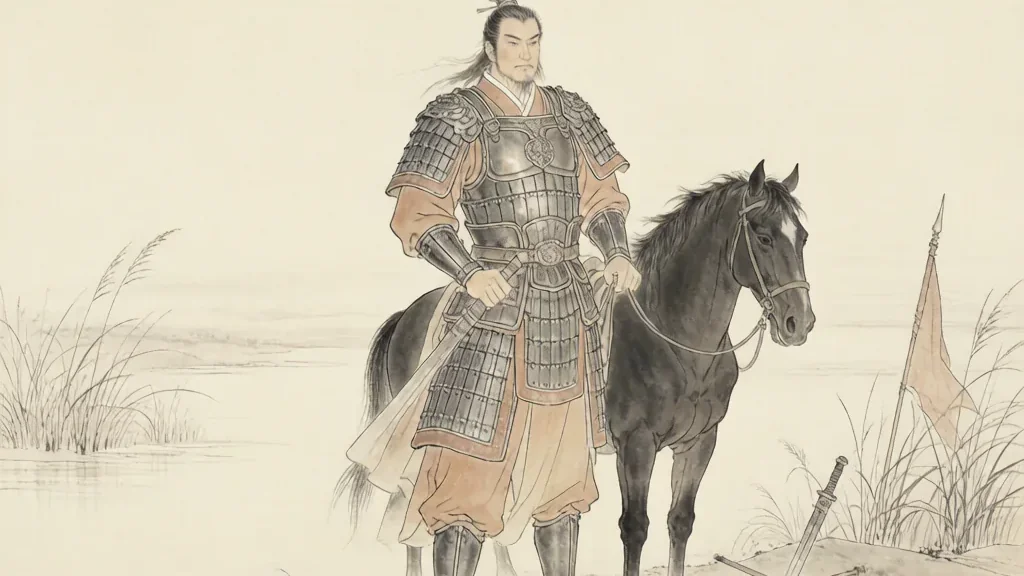
No defeat in Chinese history is more romanticized than that of Xiang Yu, written 项羽 and pronounced . A scion of the aristocracy of Chu, he was the mightiest warrior of the rebellions that toppled the Qin, a general of legendary strength who at last lost the empire to the tavern-keeper Liu Bang. Rather than flee in disgrace, he died by his own hand, crying that heaven itself had destroyed him, not his own fault. For English readers, Xiang Yu is the tragic hero—the conqueror who could win every battle and still lose the war. This article recounts his rise and his fall.
A Youth of Immense Strength
Xiang Yu was born around 232 BCE into a family of Chu generals, in the waning years of the Qin dynasty that had destroyed his homeland. Legends credit him with superhuman strength and a refusal to learn either writing or single skills, saying he would learn only enough to fight ten thousand men. As a young man he reportedly watched Qin Shi Huang's procession and declared that he would like to "take his place," a boast that nearly cost him his life.
When the Qin collapsed into revolt in 209 BCE, Xiang Yu rose with his uncle Xiang Liang, quickly becoming the military engine of the anti-Qin coalition. His shock tactics and personal valor made him feared across the realm. At the Battle of Julu he famously ordered his troops to sink their boats and break their cooking pots after crossing a river, so that they must win or die—a tactic of "burning the boats" that entered military lore.
The Destroyer of Qin
Xiang Yu's greatest feat was the crushing of the main Qin army at Julu, after which the Qin never recovered. He then entered the former Qin heartland and, in a notorious act, put the surrendered Qin capital and its palaces to the sword and flame, killing the last prince and looting the treasures. This savagery won terror but lost the people's hearts, a contrast with Liu Bang's restraint at Xianyang.
After the Qin fell, Xiang Yu styled himself "Hegemon-King of Western Chu" and divided the conquered lands among the rebel lords, making Liu Bang king of the distant Han. His aristocratic pride and harsh justice bred resentment among the very allies he needed. The stage was set for a contest between the noble warrior and the canny commoner.
The Chu–Han War
The struggle between Chu and Han raged for about four years. Xiang Yu won battle after battle, often inflicting heavy losses on Liu Bang's armies, yet he could not translate victory into control of the realm. Liu Bang, better at holding alliances and listening to strategists like Zhang Liang, kept returning no matter how many times he was beaten.
A famous episode has Liu Bang's family captured by Xiang Yu, who threatened to boil them alive; Liu Bang coolly replied that, as sworn brothers, Xiang Yu would then be boiling his own uncle's kin—an answer that forced Xiang Yu to back down. The war of wits and wills showed Xiang Yu's martial supremacy and his political blind spot: he fought like a hero and governed like a conqueror, not a statesman.
The Last Stand at Gaixia
The end came at Gaixia in 202 BCE. Surrounded by Liu Bang's armies, Xiang Yu heard, in the night, songs of Chu rising from the enemy camp—a trick meant to suggest that his homeland had already fallen. His men lost heart, believing Chu was lost. That night he drank with his beloved concubine Yu Ji, sang a song of regret, and she is said to have taken her life so as not to burden him.
Breaking out with a small band, Xiang Yu reached the banks of the Wu River. Offered a boat to escape and rebuild in his eastern homeland, he refused, saying he could not face the fathers of the Chu men who had died for him. He turned, fought a last stand cutting down hundreds, and then took his own life. His death sealed Liu Bang's empire and turned failure into legend.
Why Xiang Yu Is Remembered
Xiang Yu is remembered not for winning but for how he lost. Chinese culture has always had a soft spot for the noble defeated, and his end—proud, loving, and fatalistic—fits the ideal of the tragic hero. Poets from Li Bai to modern writers have mourned Yu Ji and the Hegemon who would not flee. He embodies a virtue the calculating Liu Bang lacked: an unbending sense of personal honor.
Historians note the irony that his very greatness as a warrior blinded him to statecraft. He could inspire men to die but not to govern, and he mistook terror for loyalty. Yet the sympathy he commands shows what a civilization values: not only success but the courage to meet ruin with dignity.
Xiang Yu in Culture
Beyond history, Xiang Yu lives in opera, poetry, and the novel Romance of the Three Kingdoms' predecessor tales of the Qin–Han transition. The "songs of Chu on every side" (simian chuge) became an idiom for encirclement and despair. His bond with Yu Ji is a staple of tragedy, painted and staged for centuries as the lover's farewell at the river.
For English readers, Xiang Yu is the Eastern echo of figures like Hector or Napoleon—greater in the field than in the cabinet, undone by the logic of politics he disdained. The conqueror who could not bear to lose still rides, in story, across the Wu River he refused to cross, a permanent question about what victory is worth.
Strengths and Fatal Flaws of a Leader
Xiang Yu's career exposes the gap between military genius and statecraft. On the battlefield he was fearless and magnetic, inspiring men to follow him to death, and his Julu campaign broke the Qin for good. But the same pride that made him a hero undermined him as a ruler. He rewarded loyalty with terror, massacred the surrendered Qin capital, and scattered the allies he needed, while Liu Bang kept his coalition intact through patience and counsel. Xiang Yu mistook fear for loyalty and victory for governance. He could take a throne but not build one. The tragedy is that his virtues, courage and honor, were real, yet they pointed outward at the enemy and not inward at the art of ruling. His fall teaches that winning wars and holding a realm are different skills, and he had only the first.
Xiang Yu and Liu Bang: Two Models of Power
Chinese memory preserves Xiang Yu and Liu Bang as a paired contrast. Liu Bang was a minor official and tavern-keeper, blunt and unscrupulous, who listened to advisors, kept his allies, and governed for the long term; Xiang Yu was the aristocratic prodigy who fought like a god but trusted almost no one. The Chu-Han war thus became a contest between the calculating founder and the honor-bound warrior. Liu Bang won because he treated rule as administration, Xiang Yu as conquest. Yet sympathy has always tilted toward the loser, for he kept his word to himself if not to others, and met ruin with dignity. The pairing lets later writers weigh what power requires: Liu Bang shows the price of success, Xiang Yu the cost of honor. Together they frame a permanent Chinese question about whether greatness lies in the crown or in the manner of losing it.
❓ Frequently Asked Questions
📝 Chinese Vocabulary
项羽 — : Xiang Yu, the Hegemon-King of Western Chu.
楚 — : the state of Chu, his homeland and banner.
西楚霸王 — : Hegemon-King of Western Chu, his title.
四面楚歌 — : "songs of Chu on every side," encirclement and doom.
垓下 — : Gaixia, the site of his final defeat.
刘邦 — : Liu Bang, the former tavern-keeper who became Xiang Yu's rival and founded the Han dynasty after defeating him.
巨鹿 — : Julu, the site of Xiang Yu's decisive blow against the main Qin army by the burning the boats tactic.
乌江 — : The Wu River, whose near bank Xiang Yu reached in his last flight and where he refused a boat to escape.
🎉 Fun Facts
- Xiang Yu supposedly sank his boats and smashed his pots to force his troops to fight to the death at Julu.
- His concubine Yu Ji's farewell at the river is one of China's great tragic-love stories.
- He refused a boat to escape, saying he could not face the fathers of the Chu men who died for him.
- "Songs of Chu on every side" became a Chinese idiom for being surrounded with no hope.
- As a youth he declared he would learn only enough to fight ten thousand men, scorning book learning in favor of martial arts.
- He once watched Qin Shi Huang's procession and boldly said he would like to take his place, a remark that nearly cost him his life.