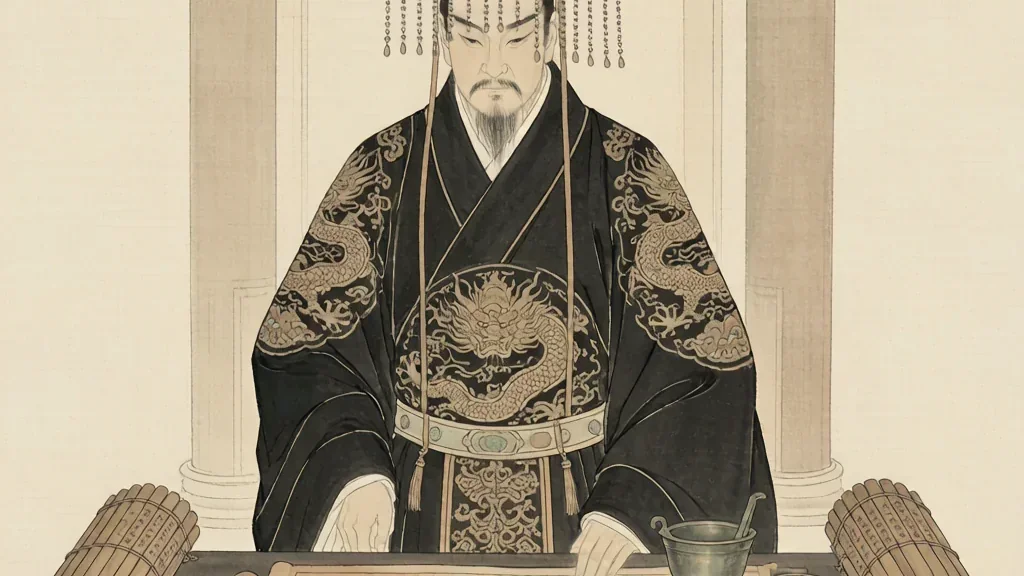
Few rulers in history have left a mark as deep and as controversial as Qin Shi Huang, the First Emperor of China. In a reign that lasted just over a decade as emperor—though built on centuries of Qin statecraft—he transformed a fractured collection of warring kingdoms into a unified empire, standardized its writing, its currency, its measurements, and its laws, and launched construction projects so ambitious that they continue to awe the world more than two thousand years later. He was a visionary, a tyrant, a builder, a destroyer, and the man who gave China its name.
Born in 259 BCE as Ying Zheng, the prince of the western state of Qin, he ascended the throne at the age of thirteen and began a campaign of conquest that would consume the other six major states of the Warring States period. By 221 BCE, at the age of thirty-eight, he had done what no ruler before him had accomplished: he had united all of China under a single sovereign. It was a moment that would define Chinese civilization for the next two millennia.
The Rise of Qin
The state of Qin was not always the most powerful of the warring kingdoms. Located in the western frontier, it was considered semi-barbaric by the more cultured states of the central plains. But Qin had advantages that would prove decisive. Its harsh environment produced tough, disciplined soldiers. Its geography, protected by mountains and the Yellow River, made it difficult to invade. And most importantly, it embraced the philosophy of Legalism—a ruthlessly pragmatic system of government that prioritized state power above all else.
Legalism, as developed by thinkers like Shang Yang and Han Feizi, held that human beings are fundamentally selfish and can only be controlled through a system of strict laws, clear rewards, and severe punishments. Under Legalist policies, Qin transformed its society: nobles lost their hereditary privileges, farmers were organized for maximum productivity, soldiers were promoted based on the number of enemy heads they collected, and every aspect of life was regulated to serve the state. The result was a military and economic machine of terrifying efficiency.
When Ying Zheng came of age and took personal control of the government, he inherited this formidable apparatus and applied it with relentless focus. One by one, the other states fell: Han in 230 BCE, Zhao in 228, Wei in 225, Chu in 223, Yan in 222, and finally Qi in 221. The Warring States period, which had lasted over two centuries and cost countless lives, was over. China was one.
Inventing an Empire
Conquest was only the beginning. The real challenge was creating a unified empire from a patchwork of former kingdoms, each with its own language, customs, laws, and loyalties. Qin Shi Huang approached this task with characteristic thoroughness and brutality. He would not merely rule China—he would remake it.
His reforms were sweeping. He standardized the writing system across the entire empire, replacing the diverse regional scripts with a single small seal script that ensured government documents could be read everywhere. He standardized weights and measures, so a pound of grain in one province weighed the same as a pound in another. He standardized the width of cart axles, so that roads built anywhere in the empire could accommodate traffic from anywhere else. He even standardized the currency, replacing the various knife-shaped and spade-shaped coins of the old states with a single round coin with a square hole.
These reforms may sound merely administrative, but they were revolutionary. For the first time, a merchant could travel from the northern frontier to the southern coast and conduct business using the same money, the same measurements, and the same written language. A scholar from the former state of Chu could read books written in the former state of Qi. The psychological unity created by these shared systems was as important as the political unity enforced by Qin's armies.
The emperor also reorganized the empire's administration, abolishing the old feudal system and replacing it with a centralized bureaucracy. The empire was divided into thirty-six commanderies, each governed by officials appointed directly by the emperor—not by hereditary nobles with independent power bases. This system, with modifications, would remain the basic model of Chinese governance for two thousand years.
The Dark Side of Unification
Qin Shi Huang's achievements came at a staggering human cost. To prevent rebellion, he ordered the confiscation of weapons from across the empire and had them melted down to cast giant bronze statues. He forcibly relocated thousands of noble families from the conquered states to the capital, severing their local connections. He burned books that contradicted Legalist orthodoxy and, according to the historical record, buried alive scholars who criticized his rule.
The book burning was particularly devastating. The emperor's chief minister, Li Si, argued that the old texts—particularly the Confucian classics that celebrated the Zhou Dynasty's decentralized feudal system—undermined the new imperial order. By destroying these works, the Qin hoped to erase the memory of the old world and ensure that future generations would know only the Qin way. The cultural loss was immense, though some texts survived through dedicated scholars who hid copies at great personal risk.
The emperor also imposed crushing burdens on the population through his construction projects. Hundreds of thousands of laborers were conscripted to build roads, canals, palaces, and fortifications. The death toll from these projects was enormous, and popular resentment simmered beneath the surface of Qin's iron control. The Legalist system, which had been so effective at mobilizing resources for war, proved less suited to the challenges of peacetime governance—or perhaps it simply exhausted the people it was meant to govern.
The Great Wall and Imperial Highways
Among Qin Shi Huang's most enduring construction projects was the beginning of the Great Wall. The northern frontier had long been threatened by nomadic tribes, particularly the Xiongnu, whose cavalry raids terrorized settled communities. Earlier states had built defensive walls along their northern borders, but these were disconnected and incomplete. The First Emperor ordered them linked together and extended into a continuous barrier stretching thousands of miles.
It is important to understand that the Qin Great Wall was not the stone-and-brick structure that tourists visit today—that version was built by the Ming Dynasty nearly two thousand years later. The Qin wall was constructed primarily of rammed earth, a technique in which layers of soil and gravel were compacted between wooden frames to create hard, durable walls. Though less visually impressive than its later counterpart, it served its purpose, channeling nomadic movements and providing early warning of invasions.
The emperor also constructed an extensive network of imperial highways radiating outward from the capital. These roads, some of which were fifty paces wide, facilitated the rapid movement of troops and officials, the collection of taxes, and the integration of the empire's economy. The most famous was the "Straight Road," running eight hundred kilometers from the capital to the northern frontier—an engineering marvel that remains visible in satellite images today.
The Search for Immortality
For all his power, the First Emperor could not escape the fear of death. As he aged, he became increasingly obsessed with finding the secret of immortality. Alchemists and magicians flocked to his court, promising elixirs of eternal life. The most famous of these quests involved a expedition led by Xu Fu, a court sorcerer who claimed that the islands of the eastern sea were home to immortals who possessed the herb of everlasting life.
The emperor outfitted Xu Fu with a fleet of ships, thousands of young men and women, and enough supplies for a long voyage. According to some legends, Xu Fu never returned—perhaps because he found the islands (some identify them with Japan) and established a colony there, or perhaps because he simply realized that returning empty-handed to a ruler known for executing those who disappointed him would be unwise. Whatever the truth, the quest for immortality consumed enormous resources and yielded nothing.
In a grim irony, it may have been the very elixirs meant to extend his life that ended it. Some historical sources suggest that the First Emperor died from ingesting mercury compounds prescribed by his alchemists—substances that were thought to confer longevity but are in fact highly toxic. He died in 210 BCE, at the age of forty-nine, during a tour of the eastern provinces. His death was kept secret for weeks as his chief minister Li Si and the eunuch Zhao Gao conspired to place a pliable successor on the throne.
The Terracotta Army
If Qin Shi Huang could not achieve immortality in life, he was determined to achieve it in death. His tomb, begun when he was still a young king and expanded throughout his reign, was designed to be an underground palace where he could continue to rule in the afterlife. Ancient accounts describe a vast complex with rivers of mercury, ceilings painted with the constellations, and elaborate traps to deter grave robbers.
The most famous feature of the tomb was discovered by accident in 1974, when farmers digging a well near Xi'an unearthed fragments of pottery that turned out to be parts of life-sized terracotta soldiers. Archaeological excavation revealed an army of thousands of clay warriors—infantry, cavalry, archers, charioteers, and officers—each with unique facial features, arranged in battle formation and facing east, toward the former kingdoms the emperor had conquered.
The Terracotta Army is one of the most remarkable archaeological discoveries in human history. The level of detail is extraordinary: the soldiers' hairstyles, armor, and weapons are rendered with precision, and no two faces are exactly alike. The sheer scale of the project—an estimated seven hundred thousand laborers worked on the tomb complex over decades—testifies to the resources and organizational capacity of the Qin state.
The tomb mound itself, a massive earthen pyramid, has never been excavated. Ancient records claim it contains a model of the empire with flowing mercury rivers, and modern soil tests have detected abnormally high mercury levels in the area, lending credibility to these accounts. Whether the tomb will ever be opened remains an open question, complicated by the technical challenges of preserving its contents and by cultural sensitivities about disturbing the emperor's final resting place.
Legacy of the First Emperor
The Qin Dynasty collapsed just four years after the First Emperor's death. His son, manipulated by the scheming eunuch Zhao Gao, proved utterly incapable of maintaining the empire. Rebellions erupted across the land, and by 206 BCE, the Qin capital had fallen. The dynasty that was supposed to last ten thousand generations had lasted barely fifteen years.
And yet, the First Emperor's legacy endured. The succeeding Han Dynasty adopted and refined his administrative systems rather than returning to the old feudal model. The standardization of writing, currency, and measurements became permanent features of Chinese civilization. The idea of a unified China, ruled by a single emperor through a centralized bureaucracy, became so deeply ingrained that even periods of disunity were always seen as temporary aberrations from the natural order.
Chinese historians have debated Qin Shi Huang's legacy for centuries. Traditional Confucian scholarship condemned him as a tyrant whose cruelty doomed his dynasty. Modern assessments are more nuanced, recognizing both his extraordinary achievements and the terrible cost at which they were achieved. He was, in many ways, the essential founder of imperial China—the man who took the raw material of a divided civilization and forged it into something that would endure for millennia.
Perhaps the most fitting symbol of his legacy is the very name "China." The English word derives from "Qin" (pronounced "Chin"), the name of his state and dynasty. Every time we speak of China, we invoke the memory of the First Emperor—a man whose ambition was so vast that it reshaped a civilization and whose name echoes through the ages.
The First Emperor's Tours and Steles
To bind his new empire together, the First Emperor traveled repeatedly through the conquered lands, from the eastern sea to the southern hills. These were not idle journeys but acts of state: at key sites he erected tall stone steles inscribed with his achievements, the unity of the realm, and the virtue of his laws. The steles were written in the uniform small seal script he had imposed, so they physically embodied his policy of one writing for all. They also served as propaganda aimed at local populations long used to their own rulers. Though the Qin itself vanished quickly, several of these monuments survived, and they remain among our earliest witnesses to the standardized script that made a single Chinese written culture possible.
❓ Frequently Asked Questions
📝 Chinese Vocabulary
- 秦始皇 (Qín Shǐ Huáng) — Qin Shi Huang, literally "First Emperor of Qin"
- 兵马俑 (Bīngmǎyǒng) — Terracotta Army, literally "soldier and horse funerary statues"
- 长城 (Chángchéng) — The Great Wall, literally "Long Wall"
- 法家 (Fǎjiā) — Legalism, the philosophy of strict laws and punishments
- 焚书坑儒 (Fénshū Kēngrú) — "Burning books and burying scholars," the Qin persecution of intellectuals
🎉 Fun Facts
- The First Emperor survived at least three assassination attempts, including one by the famous assassin Jing Ke, whose story is one of the most dramatic tales in Chinese history.
- The emperor's actual burial chamber has never been opened. Ancient texts describe booby traps including crossbows rigged to fire at intruders.
- The English word "China" and the prefix "Sino-" both derive from "Qin," the name of the First Emperor's dynasty.
- The round coin with a square hole he standardized remained the basic shape of Chinese money for more than two thousand years.
- On his inspection tours he had stone steles carved and erected across the realm to proclaim the unity and virtue of his rule.
- His son Huhai, placed on the throne by Zhao Gao and Li Si, reigned as the Second Qin Emperor for only a few years before the dynasty collapsed.