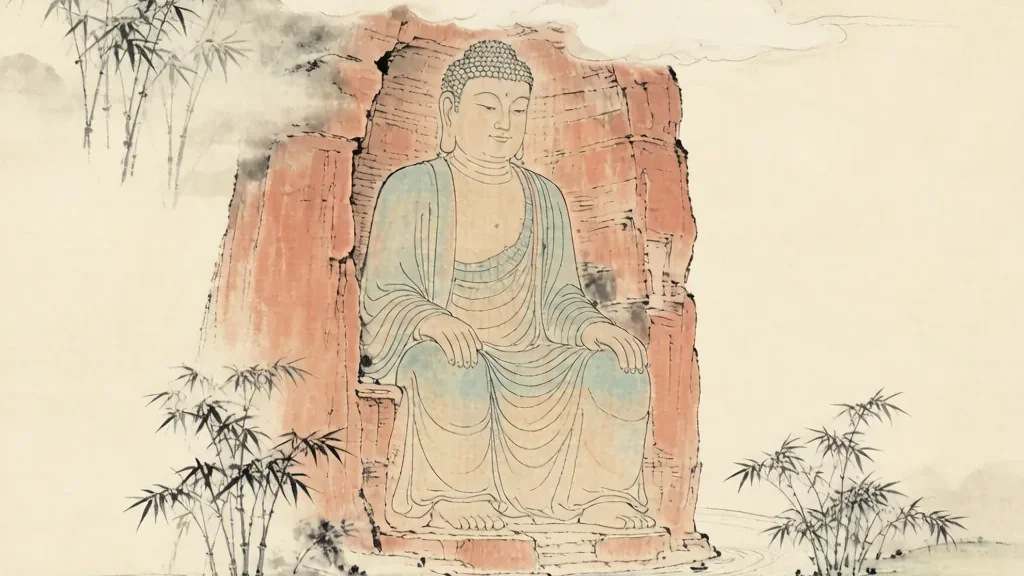
The Leshan Giant Buddha (乐山大佛, Lèshān Dàfó) is the largest stone Buddha statue in the world and one of the most awe-inspiring achievements of human craftsmanship — a colossal seated figure of Maitreya Buddha (the Buddha of the Future) carved directly into a red sandstone cliff face at the confluence of the Min River, Dadu River, and Qingyi River near the city of Leshan in Sichuan Province. Standing 71 meters (233 feet) tall, the Buddha is so vast that its shoulders span 28 meters, its head is 14.7 meters high, its ears — carved from wood and covered with clay — measure 7 meters in length, and its smallest toenail is large enough to seat a person. Construction began in 713 CE during the reign of Emperor Xuanzong of the Tang Dynasty, initiated by the Buddhist monk Haitong (海通和尚), and continued for an astonishing 90 years, completed in 803 CE under the sponsorship of regional military governors. Designated a UNESCO World Heritage Site in 1996 alongside Mount Emei, the Leshan Giant Buddha represents not only a triumph of religious devotion and artistic vision but also an extraordinary feat of hydraulic engineering — the statue was carved specifically to calm the treacherous waters at the confluence of the three rivers, where countless boats and their crews had perished in the swirling currents, and the massive quantity of stone removed from the cliff face was deposited into the river, altering the water flow and making navigation significantly safer.
The Monk Haitong: A Vision Born of Compassion
The story of the Leshan Giant Buddha begins with the Tang Dynasty monk Haitong (海通, Hǎitōng), whose name literally means 'Sea-Penetrating' — a name that would prove prophetic, as his project would tame the waters at the confluence of three great rivers. According to historical accounts and local legend, Haitong was a wandering Buddhist monk who arrived at the Lingyun Temple on the cliffs above the river confluence in the early 8th century. He was horrified by the constant loss of life on the waters below: the meeting of the Min, Dadu, and Qingyi rivers created violent whirlpools and unpredictable currents that capsized boats and drowned their crews with terrible regularity. In the Buddhist worldview of Tang China, such natural disasters were not random events but manifestations of spiritual forces — the turbulent waters were the domain of water demons and restless spirits, and only an act of profound religious merit could pacify them. Haitong conceived an audacious plan: to carve an immense statue of Maitreya Buddha from the cliff face overlooking the confluence, believing that the Buddha's presence would subdue the dangerous waters and protect those who traveled upon them. He spent years traveling throughout the region collecting donations, begging for alms, and recruiting skilled stone carvers — an effort that required not only religious devotion but extraordinary organizational and persuasive abilities. Legend holds that when local officials attempted to extort the funds Haitong had collected, he gouged out his own eyes to demonstrate that he would rather be blind than surrender the money dedicated to the Buddha — a story that, whether historically true or apocryphal, captures the intensity of the devotion that this project inspired.
Engineering the Colossus: 90 Years of Construction
The construction of the Leshan Giant Buddha was one of the most ambitious engineering projects of the Tang Dynasty, spanning nearly a century and requiring the labor of thousands of craftsmen across three generations. The initial phase, overseen by Haitong himself, focused on preparing the site: clearing vegetation from the cliff face, establishing scaffolding and work platforms, and beginning the rough shaping of the Buddha's head and shoulders. When Haitong died around 730 CE, the project was far from complete, but his disciples carried on the work. Construction halted entirely around 740 CE when Haitong's chief disciple, unable to secure continued funding, was forced to abandon the project. For nearly 40 years, the half-finished Buddha stood as a ghostly silhouette on the cliff face — a colossal head and shoulders emerging from the rock, the rest still imprisoned within the mountain. The project was revived around 780 CE by Wei Gao (韦皋), the military governor of the region, who contributed his personal wealth and mobilized government resources to complete the carving. Under Wei Gao's patronage, the Buddha's body, arms, legs, and the elaborate drapery of his robes were carved, and the statue was completed in 803 CE — exactly 90 years after Haitong had first conceived the project. The completed Buddha was originally covered with a 13-story wooden pavilion known as the Great Image Pavilion (大像阁, Dàxiàng Gé), which protected the statue from the elements and allowed worshippers to view it from multiple levels. This pavilion was destroyed during the wars at the end of the Tang Dynasty, but traces of its beam sockets are still visible in the cliff face on either side of the Buddha, and its absence has exposed the statue to centuries of weathering that have softened its features but also endowed it with the serene, time-worn dignity that visitors find so moving today.
The Hidden Drainage System: Ancient Engineering Brilliance
One of the most remarkable aspects of the Leshan Giant Buddha — and a key reason it has survived over 1,200 years of exposure to Sichuan's humid, rainy climate — is the sophisticated internal drainage system that the Tang Dynasty engineers incorporated into the statue. Rainwater and groundwater penetration are the primary threats to any stone monument, causing erosion, cracking, and the growth of moss and lichen. The builders of the Leshan Buddha anticipated this challenge and created an ingenious system of hidden channels and gutters that directs water away from vulnerable areas of the statue. The Buddha's head features 1,021 coiled hair buns (螺髻, luójì), each individually carved and each functioning as a miniature drainage point — rainwater that falls on the head is channeled between the buns and directed through hidden conduits behind the ears and neck, flowing harmlessly down the back of the statue rather than across its face. Additional drainage channels are concealed within the folds of the Buddha's robes, along the arms, and through the body of the statue, creating a comprehensive water management system that has functioned continuously for over a millennium. This drainage system was not a later addition but an integral part of the original design — evidence that the Tang Dynasty builders understood the principles of stone conservation with a sophistication that modern engineers still admire. Recent laser scanning and photogrammetric surveys have mapped the entire drainage network in three dimensions, revealing a level of planning and execution that suggests the statue was designed not just as a work of art but as a permanent structure intended to endure for centuries.
Artistic and Religious Significance: Maitreya and the Tang Buddhist World
The Leshan Giant Buddha is a representation of Maitreya (弥勒佛, Mílè Fó), the Buddha of the Future, whose cult was enormously popular during the Tang Dynasty. In Buddhist eschatology, Maitreya is the successor to the historical Buddha Shakyamuni, who will appear on Earth in the distant future to renew the dharma (Buddhist teachings) and lead all sentient beings to enlightenment. During the Tang period, belief in Maitreya was associated with millenarian hopes for a coming golden age of peace and prosperity — hopes that resonated powerfully in a century marked by the An Lushan Rebellion (755–763 CE), which devastated the Tang Empire and killed millions. The Leshan Buddha's serene expression — eyes slightly downcast, lips curved in a faint, compassionate smile — embodies the Mahayana Buddhist ideal of the bodhisattva who postpones his own enlightenment to work for the salvation of all beings. The statue's posture, with hands resting on the knees in the 'earth-touching' mudra (触地印, chùdì yìn), symbolizes the Buddha's triumph over the forces of illusion and his calling of the Earth to witness his enlightenment — a gesture that resonated with the statue's original purpose of subduing the demonic forces believed to inhabit the turbulent river waters. The scale of the Buddha is itself a religious statement: the colossal size was intended to overwhelm the viewer with a sense of the Buddha's transcendent power while simultaneously conveying the infinite compassion of a being who would manifest in such a vast form for the protection of ordinary people. For the boatmen and fishermen who plied the dangerous waters of the river confluence, the Buddha looming on the cliff above was not an abstract theological concept but a tangible, visible presence — a protector whose gaze calmed the waters and whose merit shielded them from harm.
Modern Conservation and the Challenge of Preservation
The preservation of the Leshan Giant Buddha in the modern era presents challenges that Haitong and his fellow builders could never have anticipated. The same red sandstone that made the cliff face relatively easy to carve also makes it vulnerable to erosion, and the loss of the protective wooden pavilion centuries ago has exposed the statue to the full force of Sichuan's subtropical climate — heavy monsoon rains, high humidity, and temperature fluctuations that cause the stone to expand and contract, creating cracks and fissures. Industrial pollution in the late 20th century caused acid rain damage to the Buddha's surface, darkening the stone and accelerating erosion. The growth of tourism — the site now receives over 3 million visitors annually — has introduced new pressures, including vibrations from tourist boats and the physical wear caused by millions of feet on the narrow staircases carved into the cliff beside the Buddha. Since the 1990s, Chinese and international conservation teams have undertaken a series of major restoration projects: cleaning the statue's surface with gentle chemical treatments, injecting consolidants into cracks to prevent further splitting, installing monitoring equipment to track the statue's structural health in real time, and constructing new visitor pathways that reduce direct contact with the statue. In 2001, a controversial restoration project repaired damage to the Buddha's face and chest, sparking debate among heritage professionals about the appropriate degree of intervention — whether to preserve the weathered appearance that had become part of the statue's character or to restore it closer to its original Tang Dynasty appearance. The 2008 Sichuan earthquake, whose epicenter was less than 150 kilometers from Leshan, caused alarm worldwide but, remarkably, did not damage the Buddha — a testament to the structural integrity of its design. The Leshan Giant Buddha continues to fulfill its original purpose, drawing millions of pilgrims and tourists who come to marvel at a work of devotion so vast that it required 90 years to complete and has endured for more than 12 centuries — a seated figure of compassion that has watched over the meeting of three rivers for over 1,200 years.