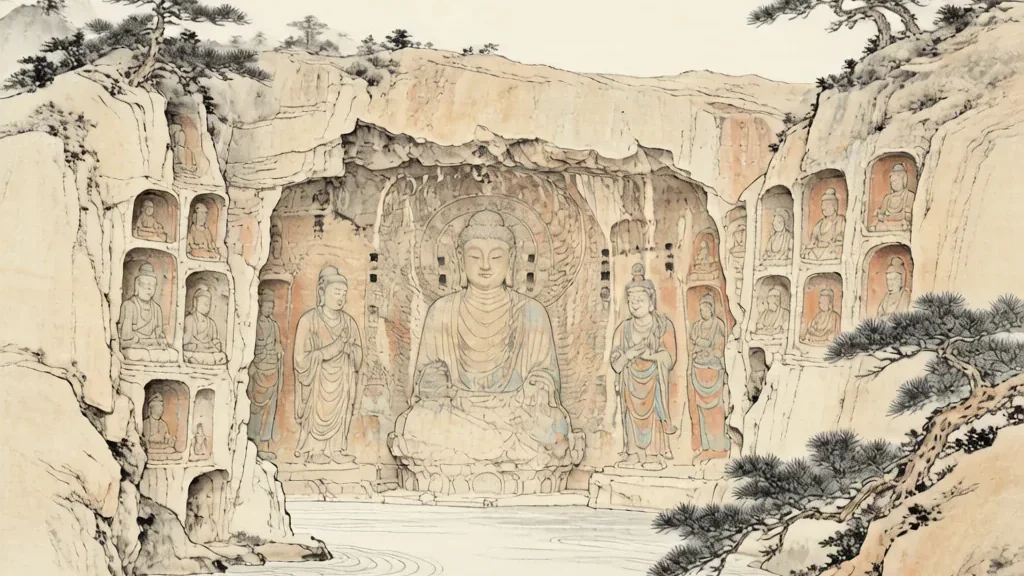
The Longmen Grottoes (龙门石窟, Lóngmén Shíkū), carved into the limestone cliffs along the Yi River (伊河) approximately 12 kilometers south of Luoyang in Henan Province, represent the zenith of Chinese Buddhist cave art — a monumental complex of 2,345 caves and niches containing over 100,000 statues, 2,800 inscribed stone tablets, and 60 Buddhist pagodas, created over a period of more than 400 years from the late 5th to the early 10th century CE. The name 'Longmen' means 'Dragon Gate,' a reference to the two hills between which the Yi River flows — West Hill (西山) and East Hill (东山) — which were said to resemble a gateway fit for dragons. The Longmen Grottoes, inscribed as a UNESCO World Heritage Site in 2000, are considered alongside Yungang, Mogao, and Maijishan as one of China's 'Four Great Grottoes,' but Longmen is distinguished by the extraordinary refinement of its carving, the intimate integration of sculpture with the natural landscape, and the unparalleled historical value of its inscriptions, which provide precise dates and donors for many of the caves.
The Move from Yungang to Longmen: A Tale of Two Dynasties
The creation of the Longmen Grottoes is directly connected to one of the most consequential political decisions in Chinese history: the transfer of the Northern Wei capital from Pingcheng (modern Datong) to Luoyang in 494 CE by Emperor Xiaowen (r. 471–499). This move, part of Emperor Xiaowen's comprehensive program of sinicization, brought the imperial court — and its patronage of Buddhist art — from the sandstone cliffs of Yungang to the limestone cliffs of Longmen. The earlier Yungang style, with its robust, powerful figures showing strong Central Asian and Gandharan influences, evolved at Longmen into a distinctly Chinese aesthetic: figures became more slender and graceful, with flowing robes that cling to the body in the 'wet drapery' style, faces became more oval with gentler, more introspective expressions, and the overall composition achieved a harmony and elegance that represents the full maturation of Chinese Buddhist sculpture. The Northern Wei period at Longmen (494-534 CE) produced some of the site's most exquisite carvings, including the Central Binyang Cave (宾阳中洞), commissioned by Emperor Xuanwu in 500 CE to honor his father, Emperor Xiaowen, and his mother, Empress Wenzhao. The cave required 800,000 workdays over 24 years to complete — an expenditure that a contemporary official criticized as 'exhausting the resources of the empire for a single cave.'
The Fengxian Temple and the Grand Buddha
The undisputed masterpiece of Longmen — and arguably the greatest single achievement of Chinese Buddhist sculpture — is the Fengxian Temple (奉先寺, Fèngxiān Sì), an immense niche on West Hill created during the Tang Dynasty under the patronage of Emperor Gaozong (r. 649–683) and his consort, the future Empress Wu Zetian. The central figure is the Vairocana Buddha (卢舍那大佛), seated on a lotus throne and standing 17.14 meters tall — the largest Buddha at Longmen. The face of the Vairocana Buddha is legendary: with its serene, slightly downcast eyes, its gently smiling lips, and its expression of profound compassion and transcendent wisdom, it is considered the supreme embodiment of the Tang Dynasty ideal of beauty. Art historians have long noted that the face bears a striking resemblance to descriptions of Empress Wu Zetian, who personally contributed 20,000 strings of cash — a fortune equivalent to her annual cosmetics allowance — to the temple's construction. Whether or not the Buddha was intended as a portrait of the empress, the association is irresistible: Wu Zetian would go on to become the only female emperor in Chinese history, and the Buddha that bears her alleged likeness radiates an authority and compassion that perfectly captures the paradox of her reign. The Fengxian Temple complex includes colossal statues of the Buddha's disciples Ananda and Kasyapa, two bodhisattvas, and two guardian kings — a total of nine figures that together form a mandala-like arrangement representing the entire Buddhist cosmos.
The Ten Thousand Buddhas and the Inscriptions of Longmen
While the monumental statues of Longmen command the most attention, the site's thousands of smaller carvings are equally significant for what they reveal about the social history of Buddhism in medieval China. The 'Ten Thousand Buddhas Cave' (万佛洞, Wàn Fó Dòng), completed in 680 CE, features 15,000 tiny Buddha figures carved into its walls — each about 5 centimeters tall, each with a unique facial expression — creating a shimmering, kaleidoscopic effect that represents the Mahayana Buddhist concept of the infinite multiplication of Buddhas throughout the cosmos. Perhaps the most historically valuable features of Longmen are its inscriptions — over 2,800 carved texts that provide an unparalleled documentary record of medieval Chinese society. These inscriptions include the names, titles, and motivations of donors, who ranged from emperors and empresses to humble merchants, farmers, and even convicted criminals seeking to accumulate Buddhist merit. The famous 'Twenty Calligraphic Masterpieces of Longmen' (龙门二十品), a selection of Northern Wei inscriptions, are considered foundational texts in the history of Chinese calligraphy, documenting the transition from the formal clerical script (隶书) to the elegant regular script (楷书) that remains standard today. These inscriptions have been studied and copied by every serious calligrapher in China for the past 1,500 years.
Destruction, Preservation, and the Longmen of Today
The Longmen Grottoes have suffered extensive damage over their 1,500-year history, most grievously during the 20th century. The anti-Buddhist persecutions of the Tang Dynasty (841-845 CE) destroyed many of the site's wooden structures, leaving the stone carvings exposed to the elements. During the late Qing Dynasty and the Republican period (1912–1949), foreign collectors and dealers systematically looted Longmen, removing thousands of sculptures — particularly the heads, which were prized by Western museums and private collectors. Entire sculptural groups were sawn from the rock face and shipped abroad; today, fragments from Longmen can be found in the collections of the Metropolitan Museum of Art in New York, the British Museum in London, the Musée Guimet in Paris, and dozens of other institutions worldwide. Since the 1950s, the Chinese government has invested heavily in the preservation of Longmen, stabilizing the cliff faces, installing drainage systems, and constructing protective walkways and viewing platforms. In 2000, the site's UNESCO World Heritage inscription brought international recognition and resources for conservation. Digital technology has opened new frontiers: the Longmen Grottoes Research Academy has completed high-resolution 3D scans of the entire site, creating a permanent digital archive and enabling virtual tours that allow visitors worldwide to experience the grottoes in unprecedented detail. In 2020, the 'Cloud Longmen' digital platform was launched, offering virtual reality tours, online exhibitions, and interactive educational programs — a 21st-century extension of the grottoes' ancient mission to make the Buddha's teachings accessible to all.