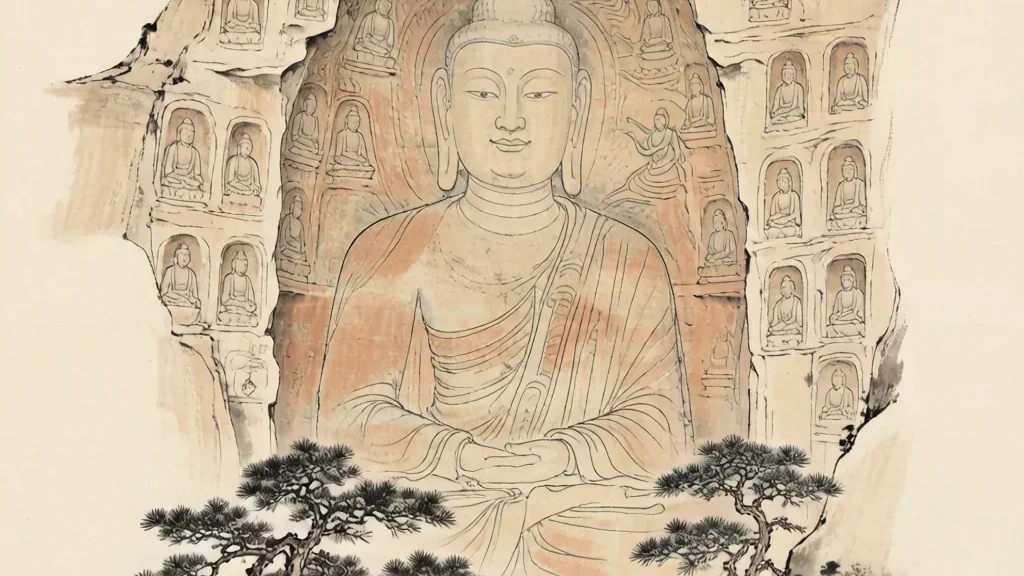
The Yungang Grottoes (云冈石窟, Yúngāng Shíkū), located 16 kilometers west of Datong in Shanxi Province, represent one of the greatest achievements of Buddhist art in world history — a monumental complex of 252 caves and niches carved into a 1-kilometer-long sandstone cliff face, containing over 51,000 Buddhist statues that range from just a few centimeters to a colossal 17 meters in height. Constructed primarily between 460 and 525 CE during the Northern Wei Dynasty (386–534 CE), the grottoes mark a pivotal moment in the history of Asian art: the first large-scale imperial-sponsored Buddhist cave complex in China, created when Buddhism was transforming from a foreign religion into a state ideology. Designated a UNESCO World Heritage Site in 2001, the Yungang Grottoes stand alongside the Mogao Caves of Dunhuang, the Longmen Grottoes of Luoyang, and the Maijishan Grottoes as one of China's 'Four Great Grottoes' — but Yungang is distinguished by its unified imperial patronage, the extraordinary quality of its carving, and its role as the direct artistic ancestor of all subsequent Chinese Buddhist cave temples.
Imperial Patronage: The Northern Wei Dynasty and the Sinicization of Buddhism
The creation of the Yungang Grottoes is inseparable from the political and religious ambitions of the Northern Wei Dynasty, founded by the Tuoba clan of the Xianbei people — nomadic warriors from the Mongolian steppe who conquered northern China in the 4th century CE. The project was initiated by Emperor Wencheng (r. 452–465) and his chief Buddhist advisor, the monk Tan Yao (昙曜), who oversaw the carving of the first five caves (Caves 16-20, known as the 'Tan Yao Caves'). Each of these five caves contains a colossal Buddha statue that scholars believe was modeled on a Northern Wei emperor — a deliberate fusion of political authority and religious devotion that declared the emperor to be the living Buddha, a concept known as 'the ruler is the Tathagata' (皇帝即如来). The five Buddhas range from 13.5 to 16.8 meters in height, and their faces bear distinct individual features, suggesting that they were indeed intended as portraits of specific rulers. The most famous of these is the seated Buddha in Cave 20, whose upper portion was exposed when the cave's front wall collapsed at some point in history, creating the iconic open-air Buddha that has become the symbol of Yungang. The Northern Wei's embrace of Buddhism was part of a broader strategy of sinicization — by adopting Chinese religion, language, and customs, the Xianbei rulers sought to legitimize their rule over the Han Chinese population. In 494 CE, Emperor Xiaowen moved the capital from Pingcheng (modern Datong) to Luoyang, initiating a similar cave-carving project at Longmen — but Yungang remains the purer expression of the Northern Wei's early Buddhist vision.
The Three Phases of Yungang's Construction
Archaeologists and art historians divide the construction of Yungang into three distinct phases, each reflecting different artistic influences and political circumstances. The first phase (460-465 CE), represented by the five Tan Yao Caves (16-20), is characterized by colossal Buddhas executed in a style that blends Indian Gandharan and Central Asian influences with emerging Chinese characteristics — the figures have the broad shoulders, elongated ears, and serene expressions of Gandharan Buddhas but are rendered with a linearity and frontality that reflects Chinese aesthetic preferences. The second phase (465-494 CE), comprising the twin caves (7-8, 9-10, 5-6, and 1-2), represents the zenith of Yungang's artistic achievement. These caves feature elaborate architectural frameworks — carved imitations of wooden buildings with bracket sets, tiled roofs, and decorated pillars — that are invaluable records of 5th-century Chinese architecture, of which no wooden structures survive. The interiors are covered from floor to ceiling with carved scenes from Buddhist scriptures: the life of the historical Buddha, jataka tales of his previous incarnations, processions of celestial musicians (飞天, fēitiān), and intricate geometric and floral patterns. The third phase (494-525 CE), after the capital moved to Luoyang, consists of smaller caves and niches carved by private donors — officials, merchants, and religious societies — rather than the imperial court. These later carvings show increasing sinicization, with figures becoming more slender and elegant, wearing Chinese-style robes rather than the foreign-inspired garments of the earlier phases.
Artistic Significance: The Meeting of Civilizations
The Yungang Grottoes represent an extraordinary synthesis of artistic traditions from across the ancient world. The site embodies the transmission of Buddhist art along the Silk Road — from its origins in India through Central Asia to China — and the transformation of that art into a distinctly Chinese idiom. Indian influences are visible in the lotus thrones, the curly hair of the Buddhas, and the depiction of stupa forms. Central Asian (particularly Kushan and Sogdian) elements appear in the flying celestials (apsaras), the ornate jewelry, and the treatment of drapery. Persian and Hellenistic motifs — palmettes, acanthus leaves, fluted columns — reached Yungang through the cosmopolitan culture of the Silk Road oasis cities. The famous 'Musician's Cave' (Cave 12), often called the 'Cave of Music,' features carved orchestras playing instruments from across Asia: Chinese zithers (qin), Indian veenas, Persian harps, Central Asian lutes, and Mongolian flutes — a stone encyclopedia of 5th-century musical instruments from three continents. The evolution visible across the three phases of Yungang — from the hybrid Indo-Central Asian style of the earliest caves to the fully sinicized elegance of the latest — provides an unparalleled record of cultural exchange and artistic transformation. The grottoes also preserve precious evidence of lost art forms: the polychrome painting that once covered every surface, now largely worn away by centuries of exposure, is still visible in protected areas, revealing that these stone carvings were originally as brilliantly colored as any Tibetan thangka or Indian miniature.
Preservation, Research, and Modern Significance
The preservation of the Yungang Grottoes presents formidable challenges. The sandstone into which the caves are carved is relatively soft and vulnerable to water erosion, wind abrasion, and the crystallization of soluble salts. Centuries of exposure to the elements, combined with the effects of coal mining and industrial pollution from nearby Datong — historically one of China's most polluted cities due to its coal industry — have caused significant deterioration. Since the 1960s, Chinese and international teams have undertaken extensive conservation efforts: reinforcing unstable rock faces, installing drainage systems to divert water away from the caves, applying chemical consolidants to fragile stone surfaces, and constructing protective roofing over the most exposed areas. The relocation of a major highway and the closure of nearby coal mines in the early 2000s dramatically improved the site's environmental conditions. Digital documentation projects, including high-resolution 3D laser scanning of every cave and statue, have created comprehensive records for future research and potential restoration. In recent years, Yungang has become a major tourist destination, attracting over 3 million visitors annually. A modern visitor center and museum, designed by Chinese architect Zhang Jinqiu and opened in 2010, provides interpretive exhibits on the grottoes' history and artistry. The site continues to be an active center of Buddhist scholarship and practice — monks from the adjacent Yungang Temple perform daily rituals, and international conferences on Buddhist art and Silk Road studies are regularly held at the site's research institute.