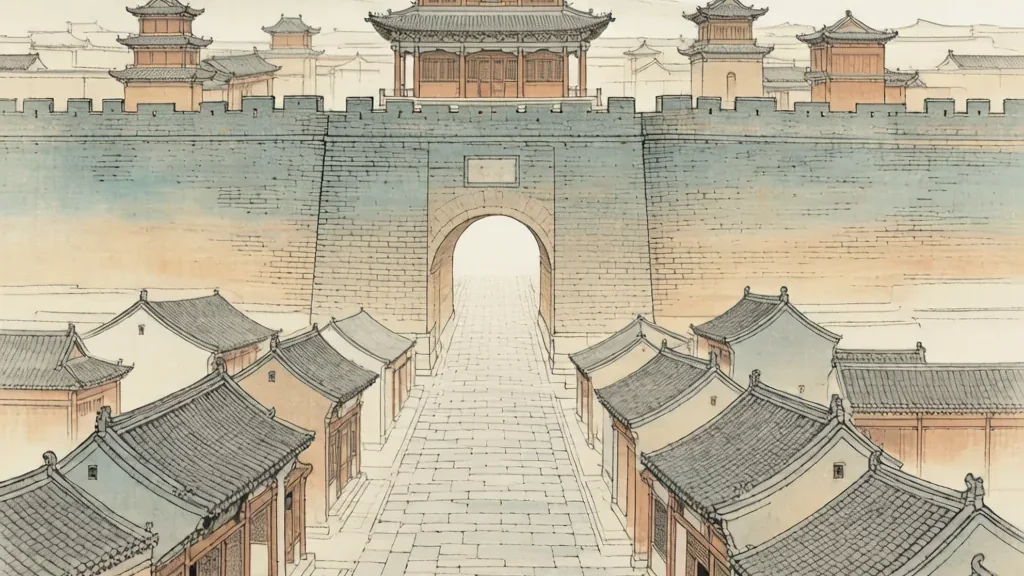
Pingyao Ancient City (平遥古城, Píngyáo Gǔchéng), located in central Shanxi Province approximately 100 kilometers south of Taiyuan, stands as the most complete and best-preserved walled city from the Ming (1368–1644) and Qing (1644–1912) dynasties in all of China — a living museum where over 40,000 residents still inhabit the same courtyards, walk the same cobblestone lanes, and conduct business in the same shopfronts that their ancestors did centuries ago. Founded during the Western Zhou Dynasty (1046–771 BCE) as a military garrison, Pingyao reached its golden age during the Ming and Qing periods when it became the undisputed financial capital of China — the Wall Street of imperial China — home to the headquarters of the nation's first piaohao (票号), or draft banks, which revolutionized Chinese commerce by inventing a nationwide system of paper remittance that eliminated the need to transport heavy silver bullion across vast distances. Designated a UNESCO World Heritage Site in 1997, Pingyao's 2.25-square-kilometer old city is encircled by a complete circuit of Ming Dynasty walls stretching 6.4 kilometers, punctuated by 72 watchtowers and six imposing gates, and contains within its walls over 4,000 traditional courtyard residences, 20 historic banking houses, and an urban layout that has remained essentially unchanged for over 600 years.
The Jin Merchants: Architects of China's First Financial Empire
The story of Pingyao is inseparable from the rise of the Jin merchants (晋商, Jìn Shāng), the legendary trading families of Shanxi Province who dominated Chinese commerce from the 14th through the early 20th centuries. Shanxi's geographical position — wedged between the agricultural heartland of the Central Plains and the nomadic territories of the Mongolian steppe — made its people natural intermediaries in the cross-border trade of tea, salt, grain, silk, and horses. By the Ming Dynasty, Shanxi merchants had established trading networks that stretched from Fujian in the south to Siberia in the north, from the Korean Peninsula in the east to Central Asia in the west. Their business model was built on a unique combination of family-based partnerships, strict codes of commercial ethics rooted in Confucian values, and sophisticated financial instruments that predated similar developments in Europe by centuries. Pingyao became the nerve center of this commercial empire not because of its size or political importance — it was never a provincial capital or imperial residence — but because its merchant families possessed the capital, the connections, and the institutional ingenuity to create China's first modern banking system. The city's rise to financial dominance was so complete that by the early 19th century, Pingyao-based banks controlled an estimated 80% of all inter-provincial remittances in China, with branch offices in every major city and even overseas in Japan, Southeast Asia, and Russia.
Rishengchang and the Invention of the Draft Bank
The defining innovation that made Pingyao's fortune was the piaohao (票号), or draft bank — a financial institution that allowed merchants to deposit silver in one city and withdraw an equivalent amount in another using a paper draft (银票, yínpiào), effectively creating China's first national remittance system. The first and most famous piaohao was Rishengchang (日升昌, 'Sunrise Prosperity'), founded in 1823 by Li Daquan, a former manager at a Pingyao dye shop who recognized that the existing system of armed silver convoys was slow, expensive, and vulnerable to banditry. Rishengchang's genius lay in its simplicity: a merchant would deposit silver at the Pingyao headquarters, receive a draft written in a complex code that included secret characters, hidden watermarks, and personal seals, and present that draft at a Rishengchang branch in another city to receive the equivalent sum. The bank's security measures were legendary — the codes changed regularly, multiple managers had to authorize large transactions, and any discrepancy between the draft and the branch's records would immediately flag a forgery. Rishengchang's success was meteoric: within a decade of its founding, it operated over 30 branches across China, and by the 1860s Pingyao was home to 22 competing piaohao with a combined network of more than 400 branch offices. The piaohao system was so reliable and efficient that it handled the remittance of tax revenues for the Qing government, financed the international tea and silk trades, and even issued short-term loans to provincial treasuries. The Rishengchang compound in Pingyao's West Street, now a museum, preserves the original counting rooms, vaults, and manager's quarters where these financial innovations were born — a physical testament to a time when a provincial city in Shanxi was the financial heart of the world's largest economy.
The City Walls and Urban Planning of Pingyao
Pingyao's city walls, rebuilt in 1370 during the reign of the Hongwu Emperor (the founder of the Ming Dynasty), are among the finest surviving examples of Ming military architecture and provide the defining visual identity of the ancient city. The walls rise 12 meters high and average 5 meters in thickness at the base, built from rammed earth faced with grey bricks — a construction method that combined the structural solidity of earthen fortifications with the weather resistance of brick cladding. The 72 watchtowers that punctuate the walls at regular intervals are said to represent the 72 disciples of Confucius, while the 3,000 battlements along the parapet symbolize his 3,000 students — a fusion of military function and Confucian symbolism that reflects the dual identity of Pingyao as both a fortress and a center of learning and commerce. The city's layout follows the classical Chinese urban planning principles codified in the Zhou Dynasty text Kaogong Ji (考工记): a square walled enclosure oriented to the cardinal directions, with a central north-south axis defined by South Street (南大街, Nán Dàjiē), the city's main commercial thoroughfare. The City Tower (市楼, Shì Lóu), a magnificent three-story wooden pavilion at the intersection of South Street and the east-west axis, served as both a landmark and a watchtower, and remains the symbolic heart of Pingyao. The city's drainage system, still functional after 600 years, channels rainwater through underground channels beneath the streets — an engineering achievement that has protected the city from the flooding that devastated many other historic Chinese cities.
Courtyard Architecture: The Ming-Qing Residential Landscape
The approximately 4,000 traditional courtyard residences (四合院, sìhéyuàn) within Pingyao's walls represent one of the world's largest concentrations of historic domestic architecture. Unlike the sprawling courtyard complexes of Beijing, Pingyao's siheyuan are typically narrower and deeper — a response to the dense urban fabric and the commercial character of the city, where every inch of street frontage was valuable retail space. The typical Pingyao residence follows a linear sequence: a shopfront facing the street, followed by a first courtyard for receiving business guests, a second courtyard for family life, and sometimes a third courtyard at the rear for storage or gardens. The buildings are constructed of grey brick with grey-tiled roofs, their facades ornamented with intricate brick carvings, wooden lattice windows, and stone door frames engraved with auspicious couplets. Particularly notable are the carved brick screen walls (影壁, yǐngbì) that stand just inside the entrance gate, serving both to block the view of the interior from the street (a feng shui principle) and as a surface for displaying the family's wealth and taste through elaborate carvings of flowers, animals, and mythological scenes. The courtyards themselves are paved with grey bricks arranged in geometric patterns, often with a central water vat that served both as a decorative feature and a reservoir for firefighting. Many of these residences are still inhabited by descendants of the original merchant families, and several of the most elaborate compounds — such as the former homes of the Hou, Qu, and Wang families — have been converted into museums that offer visitors a glimpse into the domestic life of China's commercial elite during the Qing Dynasty.
Living Heritage and Contemporary Preservation
What distinguishes Pingyao from many other UNESCO World Heritage sites is that it is not a museum frozen in time but a living, functioning city. The 40,000 residents who call the old city home continue to go about their daily lives — shopping at the morning market in front of the City Tower, sending their children to schools housed in converted courtyard compounds, celebrating the Lunar New Year with lanterns strung across the ancient streets — in a setting that has remained essentially unchanged for centuries. This living character presents both opportunities and challenges for heritage preservation. Since the UNESCO inscription in 1997, tourism has exploded: the city now receives over 10 million visitors annually, and the economic incentives of tourism have funded the restoration of hundreds of historic buildings that might otherwise have been demolished. However, the pressures of mass tourism have also transformed parts of the old city into a commercialized landscape of souvenir shops, boutique hotels, and tourist-oriented restaurants. The local government has responded with a series of preservation regulations: building heights in the old city are strictly limited, new construction must follow traditional forms and materials, and residents are offered subsidies to maintain their historic homes rather than replace them with modern structures. The annual Pingyao International Photography Festival, held each September since 2001, has brought global attention to the city's architectural heritage while creating a contemporary cultural identity that complements its historic one. Pingyao's challenge — shared by historic cities worldwide — is to balance the needs of its residents, the demands of tourism, and the imperative of preserving an irreplaceable cultural landscape for future generations.