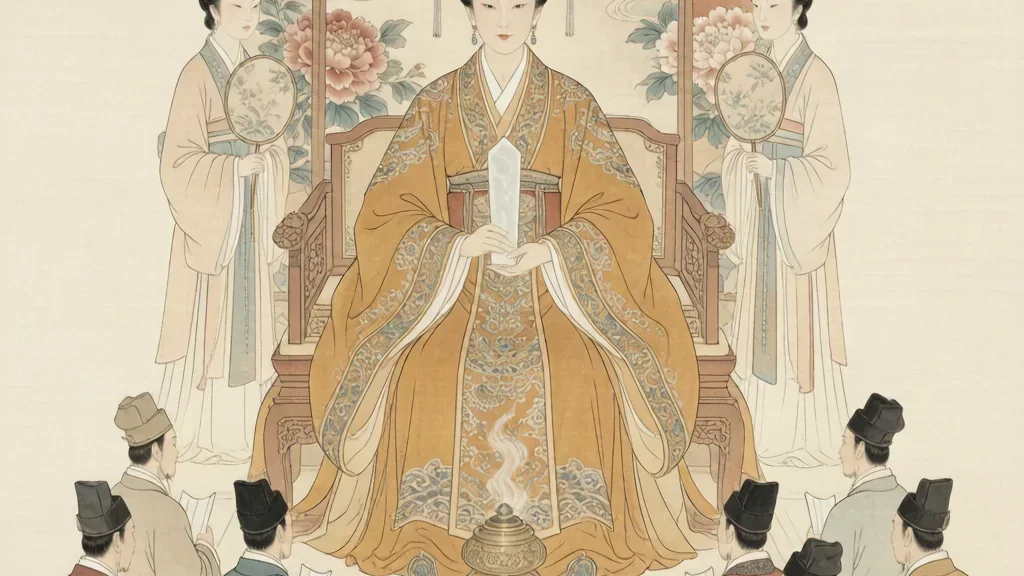
In the entire four-thousand-year sweep of Chinese imperial history—through dozens of dynasties and hundreds of emperors—only one woman ever ruled in her own name. Her path from a thirteen-year-old concubine to the supreme ruler of the world's most powerful empire is one of the most remarkable stories of political ascent ever told. Wu Zetian defied every expectation of her era, shattered every barrier that stood in her way, and left behind a legacy so complex that historians still argue about it more than thirteen centuries after her death.
Wu Zetian was born in 624 CE, during the early years of the Tang Dynasty—often considered the golden age of Chinese civilization. Her father was a wealthy merchant who had supported the Tang founder's rebellion against the previous Sui Dynasty, earning himself a position in the new imperial court. Her mother was a member of the powerful Yang family, descended from the Sui imperial line. From this comfortable but precarious position—wealthy but not truly aristocratic, well-connected but not secure—the young Wu Zhao, as she was originally named, began her extraordinary journey.
Entry into the Palace
At the age of thirteen, Wu Zhao was summoned to the imperial palace to become a low-ranking concubine of Emperor Taizong, one of China's greatest rulers. According to legend, her mother wept at the news, but the girl responded with remarkable composure: "To see the Son of Heaven—how do you know this is not good fortune? Why do you cry like a child?" This confidence, this refusal to see herself as a victim of circumstance, would define her entire life.
In Taizong's palace, Wu Zhao served as a "talented lady"—one of the lower ranks of the imperial harem. Her primary duties involved managing the imperial wardrobe and handling administrative tasks, which gave her exposure to the workings of government. She was literate, intelligent, and observant, and she used her position to learn everything she could about politics, administration, and the art of influence.
A famous story from this period illustrates both her boldness and her understanding of power. Emperor Taizong had a particularly spirited horse that no one could tame. Wu Zhao volunteered to handle it, requesting only three things: an iron whip, an iron hammer, and a dagger. "If the iron whip doesn't work, I'll use the iron hammer. If that doesn't work, I'll use the dagger." Taizong was reportedly impressed by her spirit, though whether he saw it as admirable or alarming is unclear. The story captures the essence of Wu Zhao's approach to obstacles: meet them with escalating force until they yield.
When Emperor Taizong died in 649 CE, Wu Zhao, like all of his childless concubines, was sent to a Buddhist nunnery to live out her days in religious seclusion. Her imperial career should have ended there. But Wu Zhao was not finished.
The Return to Power
The new emperor, Taizong's son Gaozong, had noticed Wu Zhao during visits to his father's palace. According to some accounts, they had begun a clandestine relationship while the old emperor was still alive. Whether or not this was true, Gaozong soon arranged for Wu Zhao to return from the nunnery and enter his own harem. This was a scandalous move—taking a former concubine of one's father violated fundamental Confucian proprieties—but Gaozong was apparently smitten.
Back in the palace, Wu Zhao demonstrated the political skills she had been developing for years. She cultivated allies among the palace staff, gathered information about her rivals, and positioned herself as indispensable to the emperor. She bore Gaozong several children, including sons who could inherit the throne. And she systematically eliminated her competition.
The most dramatic episode in her rise came in 654 CE, when Wu Zhao's infant daughter died suddenly. Wu Zhao accused the reigning Empress Wang of the murder, and though the evidence was circumstantial at best, the accusation served its purpose. Some historians have suggested that Wu Zhao herself may have been responsible for the child's death, using it as a means to destroy her rival—a charge that, if true, would represent one of the most cold-blooded acts in political history. The truth remains unknowable, but the result was clear: Empress Wang was deposed, and Wu Zhao took her place.
The Empress Behind the Throne
As empress, Wu Zetian was far more than a consort. Emperor Gaozong suffered from chronic illness—possibly a stroke or hypertension—that left him frequently incapacitated. Wu Zetian increasingly took charge of state affairs, reading memorials, issuing decrees, and making decisions in the emperor's name. She proved remarkably capable at governance, and Gaozong came to rely on her completely.
When Gaozong died in 683 CE, Wu Zetian faced a choice. Her son, the new Emperor Zhongzong, was weak and easily manipulated. Wu Zetian could have retired to the role of empress dowager, wielding influence from behind the scenes as many royal widows had done before her. Instead, she took a more radical path. Within months, she deposed her own son for showing signs of independence, replacing him with a more pliable younger brother. She was now the undisputed power behind the throne.
But even this was not enough. In 690 CE, at the age of sixty-five, Wu Zetian took the final, unprecedented step. She declared herself emperor—not empress, not regent, but Huangdi, the same title used by every male ruler who had ever sat on the Dragon Throne. She established a new dynasty, which she called the Zhou Dynasty (reviving the name of an ancient golden age), and ruled openly in her own name. No woman had done this before. No woman would do it again.
Ruling as Emperor
Wu Zetian's reign as emperor lasted fifteen years, from 690 to 705 CE. By most objective measures, it was a period of competent and even enlightened governance. She continued the Tang Dynasty's policies of territorial expansion, strengthening China's control over Central Asia and the Korean Peninsula. She maintained internal stability, suppressed rebellions, and ensured the smooth functioning of the imperial bureaucracy. The empire she ruled remained the most powerful and prosperous state in the world.
One of her most significant innovations was the expansion of the imperial examination system, which selected government officials based on merit rather than family connections. Under Wu Zetian, the examinations were opened to candidates from a wider range of social backgrounds, and the content was broadened to include subjects beyond the Confucian classics. This reform helped create a more diverse and capable bureaucracy, weakening the grip of the old aristocratic families who had dominated Tang politics.
Wu Zetian was also a notable patron of culture and religion. She commissioned the carving of massive Buddhist statues at the Longmen Grottoes near Luoyang, some of which still stand today. She sponsored the translation of Buddhist scriptures and elevated Buddhism to a position of prominence it had not previously enjoyed. Her support for Buddhism was partly political—the religion provided ideological justification for female rule that Confucianism, with its emphasis on male authority, could not offer—but it also reflected genuine personal devotion.
The Secret Police and the Reign of Terror
Wu Zetian's rule was not without its dark side. To maintain power in the face of constant opposition from Confucian traditionalists, she established a network of secret police and informants who reported any whisper of disloyalty. She encouraged anonymous accusations and rewarded those who denounced alleged traitors. The result was a climate of fear in which officials could be arrested, tortured, and executed on the flimsiest of evidence.
The most notorious of her secret police chiefs were the "cruel officials" Lai Junchen and Zhou Xing, whose names became synonymous with judicial terror. They developed inventive tortures and extracted confessions from countless victims. Many of the old Tang aristocracy, who had never accepted a woman on the throne, were eliminated during this period. The purges served Wu Zetian's political purposes, but they left a stain on her legacy that has never been fully washed away.
Yet even this reign of terror showed Wu Zetian's political acumen. When the secret police had served their purpose—when the old aristocracy had been sufficiently cowed and her rule was secure—she turned on her own enforcers. Lai Junchen and Zhou Xing were themselves accused of crimes and executed, allowing Wu Zetian to distance herself from their excesses. She understood that terror was a tool to be used and then discarded, not a permanent basis for governance.
The Question of Legacy
As Wu Zetian aged, the question of succession became urgent. She had named her nephew as heir, intending to keep the throne within the Wu family line. But her senior officials argued persuasively that a nephew would never properly honor his aunt's memory, whereas her own sons—though they bore the Li surname of the Tang imperial family—would at least maintain ancestral rites for their mother. In the end, Wu Zetian relented and restored her exiled son as crown prince.
In 705 CE, when Wu Zetian was eighty-one years old and gravely ill, a palace coup forced her to abdicate. Her son was enthroned as Emperor Zhongzong, and the Tang Dynasty was formally restored. Wu Zetian died later that year, her final wishes including a remarkable instruction: her tombstone was to be left blank—a wordless stele, inviting judgment from future generations rather than imposing her own version of events.
That blank stele, which still stands today near the Qianling Mausoleum outside Xi'an, is a fitting monument to a figure who defies easy categorization. Was Wu Zetian a ruthless usurper who murdered her own children and terrorized her opponents? Or was she a brilliant ruler who governed effectively, promoted talent over pedigree, and proved that a woman could rule as capably as any man? The answer, perhaps, is both. She was a product of a system that gave women almost no legitimate path to power, and she seized power by any means necessary—including means that were, by any standard, morally indefensible. She was also, undeniably, a highly capable ruler whose reign was marked by peace, prosperity, and cultural achievement.
In the centuries since her death, Wu Zetian has been portrayed as everything from a demonic seductress to a feminist icon. Traditional Confucian historians condemned her as an aberration, a violation of the natural order. Modern scholars have reevaluated her more positively, seeing in her story evidence of what women could achieve even in the most restrictive circumstances. The truth, as always, is more complicated than either narrative allows. Wu Zetian was a human being of extraordinary ambition and ability who operated in a world that gave her no legitimate path to power—and she carved one out anyway, for better and for worse.
Wu Zetian and the Rise of Buddhism
Unable to ground female rule in Confucian doctrine, Wu Zetian turned to Buddhism, which taught that a ruler might appear in any form to relieve suffering. Clergy presented the Great Cloud Sutra as a prophecy of a reincarnated goddess who would govern and protect the Dharma, and the court circulated it as heavenly endorsement. She rebuilt monasteries, sponsored scripture translation, and ordered massive devotional images, most famously the cliff-carved Buddha at Longmen. This alliance served both faith and state: Buddhism gained imperial patronage, while she gained a cosmic mandate no Confucian critic could easily match. The policy left a lasting mark, making the Tang court markedly more Buddhist than before. Her use of religion as political legitimacy shows her pragmatism; she chose the toolkit that worked, and for a woman on the dragon throne, Buddhism was the readiest one.
The Qianling Mausoleum and the Wordless Stele
Wu Zetian was buried at the Qianling Mausoleum near Xi'an, the grand tomb she shares with her husband Emperor Gaozong, marked by a pair of monumental stone columns and rows of guardian statues. Before it stands her famous wordless stele, a slab left deliberately blank, an invitation for later ages to judge her rather than a boast of her deeds. The emptiness has fed debate for over a thousand years: some read it as confidence that her reign spoke for itself, others as guilt she could not voice. Either way, the blank stone fits a life that defies simple verdict. Qianling survived largely intact because later rulers respected the Tang, and today the site, with its stele and statues, draws scholars and pilgrims alike, a quiet monument to the most extraordinary claimant the Chinese throne ever knew.
❓ Frequently Asked Questions
📝 Chinese Vocabulary
- 武则天 (Wǔ Zétiān) — Wu Zetian, literally "Wu the Heavenly Empress"
- 皇帝 (Huángdì) — Emperor, the title Wu Zetian claimed for herself
- 女皇 (Nǚhuáng) — Female emperor, a title used only for Wu Zetian in Chinese history
- 无字碑 (Wúzìbēi) — The "wordless stele," Wu Zetian's blank tombstone
- 科举 (Kējǔ) — The imperial examination system, which Wu Zetian expanded
🎉 Fun Facts
- Wu Zetian created several new Chinese characters during her reign, including one for her own name (曌), which combined the symbols for "sun" and "moon" to suggest universal illumination.
- Her blank tombstone—the "Wordless Stele"—still stands at her tomb complex and has become one of China's most famous historical mysteries.
- Wu Zetian kept a personal guard of female soldiers and regularly employed women in administrative roles, challenging gender norms throughout her reign.
- She is the only woman in Chinese history to claim the title Huangdi and rule the realm in her own name.
- She raised many able men through the expanded examinations, weakening the old aristocratic clans and strengthening merit-based government.
- The colossal Buddha carved at Longmen's Fengxian Temple was made under her patronage and is now a UNESCO World Heritage site.