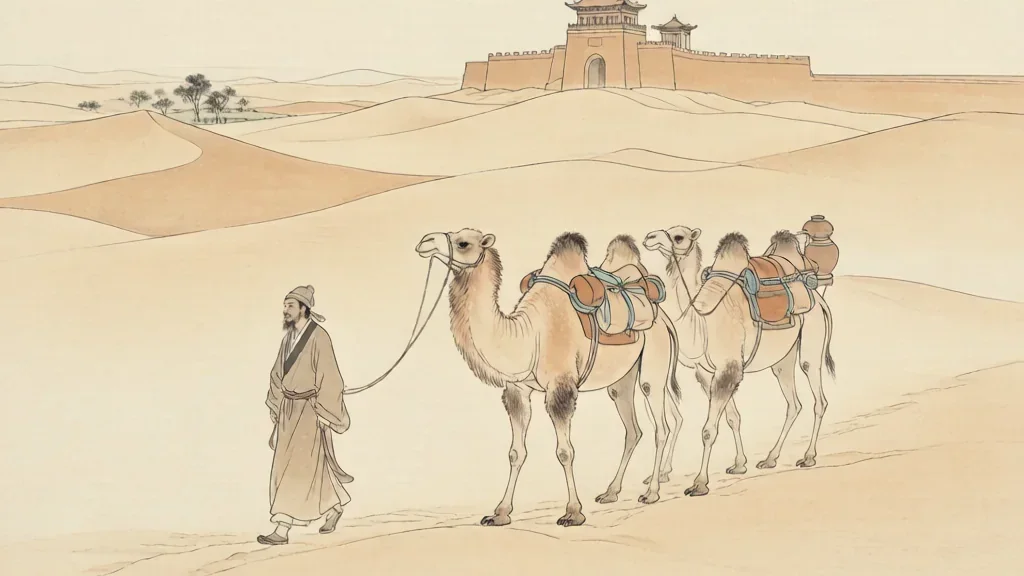
The Silk Road was not a single road. It was a sprawling, ever-shifting web of caravan trails, mountain passes, desert crossings, and river routes that, for over 1,500 years, stitched together the civilizations of China, Central Asia, Persia, India, and the Mediterranean. Along these dusty paths traveled more than silk — ideas, religions, technologies, languages, and entire ways of life crossed continents, reshaping the world on both ends. Today, the Silk Road endures as one of humanity's greatest achievements: proof that even in an age without engines or electronics, the human impulse to connect, trade, and share was unstoppable.
The Origins: Zhang Qian's Epic Journey
The Silk Road as we know it began with a mission of diplomacy and desperation. In the 2nd century BCE, the Han Dynasty faced a persistent threat from the Xiongnu, a powerful nomadic confederation that raided China's northern borders. Emperor Wu of Han decided on a bold strategy: forge an alliance with the Yuezhi people, who had been driven westward by the Xiongnu, and open a second front against their mutual enemy.
He chose Zhang Qian, a young palace attendant, to lead an embassy into the unknown. In 138 BCE, Zhang Qian departed Chang'an (modern Xi'an) with over one hundred men. They had barely crossed into Xiongnu territory when they were captured. For ten years, Zhang Qian lived as a prisoner among the Xiongnu, marrying, raising a family, and all the while memorizing everything he saw — the geography, the customs, the trade networks. When he finally escaped with his family and a loyal companion, he did not turn back to China. He pressed onward, crossing the Taklamakan Desert and the Pamir Mountains, eventually reaching the Yuezhi in what is now Afghanistan.
The Yuezhi, having found peace in fertile lands, declined the alliance. But Zhang Qian had not traveled in vain. He spent another year exploring Central Asia, visiting the Ferghana Valley, Bactria, and Parthia, before beginning the long journey home. When he finally returned to Chang'an in 126 BCE — thirteen years after leaving, with only one surviving companion — he brought back knowledge that would change history: descriptions of Central Asian kingdoms, reports of "heavenly horses" that sweated blood, and most importantly, the revelation that a world of wealthy, sophisticated civilizations lay to the west.
Zhang Qian's report electrified the Han court. Emperor Wu immediately began sending envoys and military expeditions westward. Trade routes that had existed as fragmented local paths were now linked, protected, and expanded. The Silk Road was born.
What Traveled the Silk Road
Silk gave the road its name, and for good reason. China had mastered sericulture — the cultivation of silkworms and the weaving of their cocoons into fabric — thousands of years before the Silk Road opened. To the Romans, this shimmering, impossibly smooth cloth seemed magical. Pliny the Elder wrote disapprovingly of Roman women who wore silk, lamenting the vast sums of gold flowing eastward. Silk became a currency in itself, used to pay soldiers in Central Asia and to bribe steppe nomads. The secret of its production remained China's most closely guarded monopoly for centuries.
But the caravans carried far more. Eastward came gold, silver, wool, linen, glassware from Rome, jade from Khotan, lapis lazuli from Afghanistan, spices from India, and fragrant incense from Arabia. Westward traveled not just silk, but also porcelain, lacquerware, bronze mirrors, paper, and iron. Central Asian merchants — particularly the Sogdians, whose homeland lay around Samarkand — became the indispensable middlemen, mastering multiple languages and establishing trading colonies from Chang'an to Constantinople.
Perhaps the most transformative westward export was paper. Invented in China during the Han Dynasty, papermaking spread along the Silk Road to Samarkand in the 8th century after Chinese prisoners revealed the secret. From there it traveled to Baghdad, Damascus, and eventually Europe, where it revolutionized record-keeping, scholarship, and eventually, printing.
Buddhism on the Silk Road
The most profound cargo on the Silk Road was invisible. Buddhism, born in India around the 5th century BCE, began traveling north and east along trade routes in the early centuries CE. Merchants carried not just goods but sutras; monks journeyed alongside caravans, translating texts and founding monasteries in oasis towns like Dunhuang, Kucha, and Turfan.
The great translators — Kumarajiva, Xuanzang, and others — were Silk Road travelers themselves. Xuanzang's seventeen-year pilgrimage to India in the 7th century, immortalized in the classic novel Journey to the West, was essentially a Silk Road journey in reverse. He followed the northern route out of China, crossed the Tian Shan mountains, and returned through the Karakoram, carrying hundreds of Sanskrit texts back to Chang'an.
Buddhism transformed the cultures it touched. Cave temples carved into cliffs along the trade routes — most spectacularly at Dunhuang, Bamiyan, and Kizil — filled with murals and sculptures that blended Indian, Persian, and Chinese artistic traditions. The religion spread from Central Asia into China, Korea, and Japan, while Nestorian Christianity, Zoroastrianism, Manichaeism, and eventually Islam all traveled the same paths. The Silk Road was the world's first great highway of faith.
Routes and Landscapes
The Silk Road was never a single path but a network of routes that shifted with politics, climate, and banditry. The main overland artery split around the Taklamakan Desert, the world's second-largest shifting-sand desert. The northern route passed through Hami, Turfan, and Kucha; the southern route skirted the desert's edge through Khotan and Yarkand. Both converged at Kashgar, the great crossroads of Central Asia, before climbing into the Pamir Mountains — the "Roof of the World" — and descending toward Samarkand, Bukhara, and Merv.
Traveling these routes was brutal. Summer temperatures in the Taklamakan could exceed 50°C (122°F); winter in the Pamirs brought blinding snowstorms. Caravans navigated by the skeletons of camels and horses that had perished along the way. The oasis towns that dotted the routes were literal lifelines, their date palms and melon fields sustaining travelers who had crossed hundreds of kilometers of barren desert.
Bactrian camels — the two-humped, shaggy beasts native to Central Asia — were the unsung heroes of the Silk Road. Unlike their single-humped Arabian cousins, Bactrian camels could endure both freezing winters and scorching summers, carry up to 500 kilograms, and go for days without water. A single caravan might include hundreds of camels, their bells ringing across the desert as they plodded from oasis to oasis.
Marco Polo and the European Imagination
The Silk Road reached the height of its connectivity under the Mongol Empire in the 13th century. For the first time, a single political authority — however loose — controlled nearly the entire length of the overland route from China to the Black Sea. It was during this Pax Mongolica, or "Mongol Peace," that a young Venetian merchant named Marco Polo made his legendary journey to the court of Kublai Khan.
Marco Polo's Description of the World introduced medieval Europe to the wonders of China: paper money, coal burning, a vast postal relay system, and cities of staggering wealth. His book fired the European imagination and, two centuries later, inspired Christopher Columbus to seek a westward sea route to the riches of the East. In a very real sense, the Silk Road led directly to the Age of Discovery.
The Decline and Rediscovery
The Silk Road declined slowly over several centuries. The fragmentation of the Mongol Empire disrupted the overland routes. The rise of maritime trade — pioneered by Chinese admiral Zheng He and later dominated by Portuguese and Dutch ships — offered faster, cheaper alternatives. By the 16th century, the great caravans of Bactrian camels had largely faded into memory.
Yet the Silk Road never truly vanished. In the late 19th and early 20th centuries, a new wave of explorers — Aurel Stein, Sven Hedin, Paul Pelliot — raced across Central Asia, uncovering buried cities, forgotten manuscripts, and the breathtaking cave temples of Dunhuang. Their discoveries, now held in museums and libraries worldwide, revealed the full richness of the Silk Road's cultural legacy.
Today, the Silk Road is being reimagined. The Belt and Road Initiative, launched in 2013, invokes its spirit with a massive program of infrastructure investment across Asia, Africa, and Europe. Modern highways, railways, and pipelines trace many of the same paths that Zhang Qian and Marco Polo once walked. The ancient bridge between East and West is being rebuilt, one more chapter in a story that has been unfolding for over two millennia.
The Cost of the Journey
Travel on the Silk Road was hazardous and slow, and the people who made it paid a steep price in hardship. Caravans could take years to complete a full journey between China and the Mediterranean, braving heat above fifty degrees in the desert and blinding snow in the high mountains. Water was scarce, raiders preyed on the unwary, and illness far from home was often fatal. Yet the rewards, profit, adventure, and the chance to carry a faith or a text to a new land, drew merchants, monks, and envoys onward. The route was held together not by any single state but by the practical cooperation of oasis communities and the shared hope of safe passage. To travel it was to accept risk as the price of connection, and the very danger is part of why the Silk Road still fascinates us.
The Silk Road's Lasting Echo
The Silk Road did not simply vanish with the rise of sea trade; its habits of exchange shaped the world that followed. Crops and cooking techniques moved along the routes, so that foods now considered quintessentially Chinese, such as noodles, may have arrived via Central Asia, while paper and printing from China reshaped learning in the West. The memory of the road also became a model for later projects of connection, from early modern postal and caravan reforms to today's continental infrastructure plans. More quietly, the road left a habit of mind: the assumption that distant peoples can meet as partners rather than strangers. In markets, monasteries, and museums from Xi'an to Venice, the Silk Road's echo can still be heard, a reminder that exchange, not isolation, has long been the engine of human progress.
❓ Frequently Asked Questions
📝 Chinese Vocabulary
- 丝绸之路 (Sīchóu zhī lù) — The Silk Road. Literally "Silk Road." The name was coined in 1877 by German geographer Ferdinand von Richthofen.
- 张骞 (Zhāng Qiān) — Zhang Qian, the Han Dynasty explorer whose journeys opened the Silk Road.
- 骆驼 (Luòtuo) — Camel. The Bactrian camel was the backbone of Silk Road transport.
- 长安 (Cháng'ān) — Ancient Chang'an, the eastern terminus of the Silk Road, now modern Xi'an.
- 西域 (Xīyù) — The "Western Regions," the Chinese term for Central Asia and the lands beyond.
🎉 Fun Facts
- The Silk Road was not named "the Silk Road" during its heyday. The name was invented by a German geographer in 1877, nearly 400 years after the overland routes declined.
- Bactrian camels can drink up to 135 liters of water in 13 minutes and survive losing 40% of their body weight to dehydration — a feat that would kill most mammals.
- The Han Dynasty kept the secret of silk production so closely guarded that revealing the process to foreigners was punishable by death. The secret held for over 2,000 years.
- The lost kingdom of Loulan flourished as a Silk Road oasis until it was swallowed by desert sands, and its ruins were found again only in the early twentieth century by explorers of Central Asia.
- The Taklamakan, the great desert at the heart of the route, carries a grim nickname often translated as 'enter and you will never leave,' a warning to those who crossed its dunes.
- Glassware was among the Western luxuries most prized in China, and Roman and later Islamic glass has been recovered from tombs along the eastern end of the route.