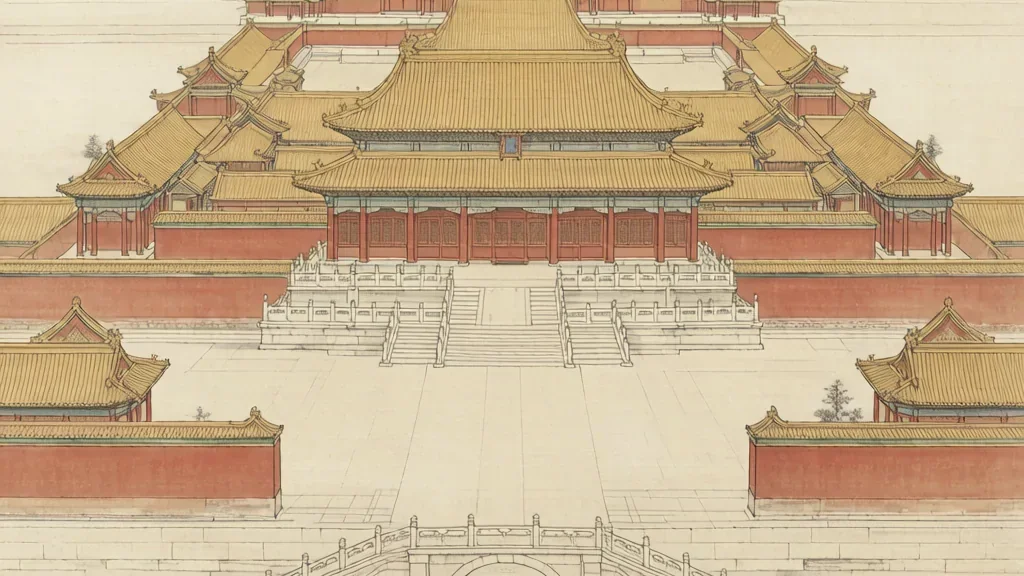
For five centuries, it was the most exclusive address on Earth. Behind its towering crimson walls and beneath its sweeping golden roofs, twenty-four emperors ruled an empire that was, for much of that time, the richest and most powerful on the planet. The Forbidden City — known in Chinese as the "Purple Forbidden City" — was not just a palace. It was the literal center of the universe, at least according to the cosmology of Imperial China. Today, as the Palace Museum, it welcomes over 16 million visitors annually, making it the most visited museum in the world. But to walk through its gates is still to feel the weight of 600 years of power, intrigue, and exquisite beauty.
A Capital Reborn: The Yongle Emperor's Vision
The Forbidden City owes its existence to one of the most ambitious rulers in Chinese history: the Yongle Emperor, third emperor of the Ming Dynasty. In 1402, Yongle seized the throne from his nephew in a bloody civil war. His legitimacy tainted by usurpation, Yongle decided to move the capital from Nanjing in the south to Beijing in the north — closer to the frontier he needed to defend against the Mongols, and far from the political networks of the court he had overthrown.
Construction began in 1406 and was completed in just 14 years, an astonishingly short time for a project of this scale. Over a million workers — including 100,000 master craftsmen — labored to transform Yongle's vision into reality. The finest timber was harvested from the remote forests of southwestern China and floated thousands of kilometers down rivers and canals. Massive stone blocks, some weighing over 200 tons, were dragged to the site on wooden sledges across ice roads created by pouring water on the frozen winter ground. The golden roof tiles were fired in imperial kilns, and the red walls were coated with a mixture of lime and glutinous rice.
In 1420, the Forbidden City was complete. On New Year's Day 1421, the Yongle Emperor formally inaugurated his new capital. From that moment until the abdication of the last emperor in 1912, the Forbidden City would be the political and ceremonial heart of China.
Architecture of the Cosmos
Every element of the Forbidden City's design is saturated with symbolic meaning. The complex is laid out along a strict north-south axis, with the most important buildings facing south to receive the sun's blessing. This arrangement reflects the Chinese belief that the emperor was the Son of Heaven, the pivot between the celestial and terrestrial realms. Just as the Pole Star sits at the center of the heavens, so the emperor sat at the center of the world.
The color scheme is equally deliberate. Yellow — the color of the emperor and of the earth — dominates the roof tiles. The walls are painted a deep vermilion red, the color of happiness and good fortune. Together, red and yellow create the unmistakable visual signature of imperial power. The numbers, too, carry meaning. The complex contains a mythical 9,999 rooms — just one short of the 10,000 rooms of the Jade Emperor's heavenly palace, a deliberate gesture of humility before the divine. In reality, there are about 980 surviving buildings with some 8,700 rooms.
The Forbidden City is divided into two main sections. The Outer Court, in the south, was the public face of imperial power — a vast ceremonial complex dominated by three great halls raised on a triple-tiered marble terrace. Here, the emperor held court, received foreign envoys, and presided over the most important state rituals. The Inner Court, in the north, was the private realm — the living quarters of the emperor, his empress, and his concubines, a cloistered world of gardens, pavilions, and whispered intrigues.
The Three Great Halls
The Hall of Supreme Harmony is the Forbidden City's crown jewel. At 35 meters tall, it is the largest wooden structure in China, and for 500 years, it was the tallest building in Beijing — imperial decree forbade any other structure from rising higher. Inside, the emperor sat upon the Dragon Throne, a magnificent golden seat surrounded by carved dragons, incense burners, and bronze cranes symbolizing longevity. Behind the throne, a carved screen depicted nine dragons writhing among clouds — the emperor alone was the dragon, the Son of Heaven.
Flanking the Hall of Supreme Harmony are the Hall of Central Harmony, where the emperor rehearsed ceremonies and rested before audiences, and the Hall of Preserving Harmony, where the highest-level imperial examinations were held. The examinations were the culmination of China's legendary civil service system — young men who passed the palace exam could rise from obscurity to the highest ranks of government, a meritocratic ideal that fascinated European Enlightenment thinkers.
Life Inside the Golden Cage
For all its grandeur, life inside the Forbidden City could be suffocating. The emperor rarely left. When he did, it was for grand processions to the Temple of Heaven or summer retreats to the imperial gardens. The Inner Court was a world unto itself, populated by thousands of eunuchs — men who had been castrated to serve in the imperial household — and hundreds of palace women, from the empress and high-ranking consorts to concubines and serving maids.
The eunuchs were a peculiar institution. Barred from fathering children and thus from founding dynasties of their own, they were theoretically the perfect servants. In practice, many became extraordinarily powerful, controlling access to the emperor and amassing vast wealth. At the height of the Ming Dynasty, there were reportedly over 70,000 eunuchs in the Forbidden City. Some, like Zheng He, the great admiral who led China's treasure fleets across the Indian Ocean, achieved genuine greatness. Others became notorious for corruption and cruelty.
The emperor's daily life was governed by elaborate ritual. He rose before dawn, attended by eunuchs who dressed him in sumptuous robes embroidered with dragons. His meals were prepared by a kitchen staff of hundreds, with every dish tasted by a designated taster to guard against poison. His sexual life was managed by a system of rotating concubines, their visits recorded by eunuchs to ensure the legitimacy of any resulting heirs. The emperor was, in many ways, the most powerful prisoner in China.
Fire, War, and Survival
The Forbidden City has survived catastrophes that would have destroyed lesser structures. In 1421, just months after its completion, lightning struck the Hall of Supreme Harmony, burning it to the ground — an omen that terrified the superstitious Yongle Emperor. It was rebuilt, only to burn again in 1557. In 1644, as the Ming Dynasty collapsed, rebel forces briefly occupied the palace before the Manchu armies swept in to establish the Qing Dynasty. The last Ming emperor, Chongzhen, hanged himself from a tree on Coal Hill, just north of the Forbidden City, as rebel forces breached the gates.
Under the Qing, the palace reached new heights of splendor. The Kangxi and Qianlong emperors, who between them ruled for over 120 years, were patrons of art and learning on a staggering scale. Qianlong, in particular, was an obsessive collector who amassed a collection of paintings, calligraphy, bronzes, jades, and ceramics that remains the core of the Palace Museum's holdings today.
The end came in the early 20th century. In 1900, during the Boxer Rebellion, foreign troops occupied parts of Beijing, though the palace itself was spared. In 1912, the child emperor Puyi abdicated, ending over 2,000 years of imperial rule. Puyi was permitted to live in the Inner Court until 1924, when he was finally expelled. The following year, the Forbidden City opened to the public as the Palace Museum.
The Palace Museum Today
Today, the Forbidden City is a living museum, a UNESCO World Heritage Site, and the most popular tourist attraction in China. The Palace Museum holds over 1.8 million artifacts, though only a fraction are on display at any time. Its collections span every category of Chinese art: ancient bronzes, jade carvings, ceramics, calligraphy, painting, lacquerware, clocks, and imperial treasures of staggering beauty.
In recent years, the museum has undergone a remarkable transformation. Under the leadership of dynamic directors, it has embraced digital technology, launched popular social media accounts, and opened previously sealed sections of the complex. Restoration work is constant — teams of conservators labor in workshops within the walls, cleaning centuries of grime from paintings, repairing fragile textiles, and revealing the original colors that time had obscured.
The Forbidden City is not a relic. It is a bridge between China's imperial past and its digital future, a place where ancient craftsmanship meets modern conservation science. To walk through the Gate of Supreme Harmony and gaze across the vast marble courtyard toward the golden roofs beyond is to step into a different world — a world of dragons and emperors, of whispered conspiracies and celestial mandates, of a civilization that believed, with absolute conviction, that it stood at the center of all things.
The Imperial Art Collection
The Forbidden City's greatest treasure is not its buildings but the art they hold. For five centuries the Ming and Qing courts amassed paintings, calligraphy, bronzes, jades, ceramics, and clocks, much of it through the obsessive collecting of the Qianlong Emperor, who compiled illustrated catalogues of his holdings. When the last emperor left in 1924, the collection became the core of the Palace Museum, now numbering more than 1.8 million objects spanning five thousand years. Only a small fraction can be shown at once, so the museum rotates its treasures and has digitized many for online viewing. In this way the palace turned from a private vault of the Son of Heaven into a public trust of the Chinese people, a transformation unique among the world's great palaces.
The Restoration Workshops
Behind the tourist routes, teams of conservators work inside the walls in workshops that resemble small factories of memory. Using methods passed down for generations alongside modern science, they clean centuries of grime from scroll paintings, consolidate flaking lacquer, and rebuild faded textiles thread by thread. Structural crews monitor the timber frames for insects and moisture, while digital teams create three-dimensional scans of halls and objects. The aim is not to make the palace look new but to let its original colors and joinery survive for another six hundred years. This quiet, continuous labor is why a building meant for one family still functions as a living museum, bridging imperial craftsmanship and twenty-first-century conservation.