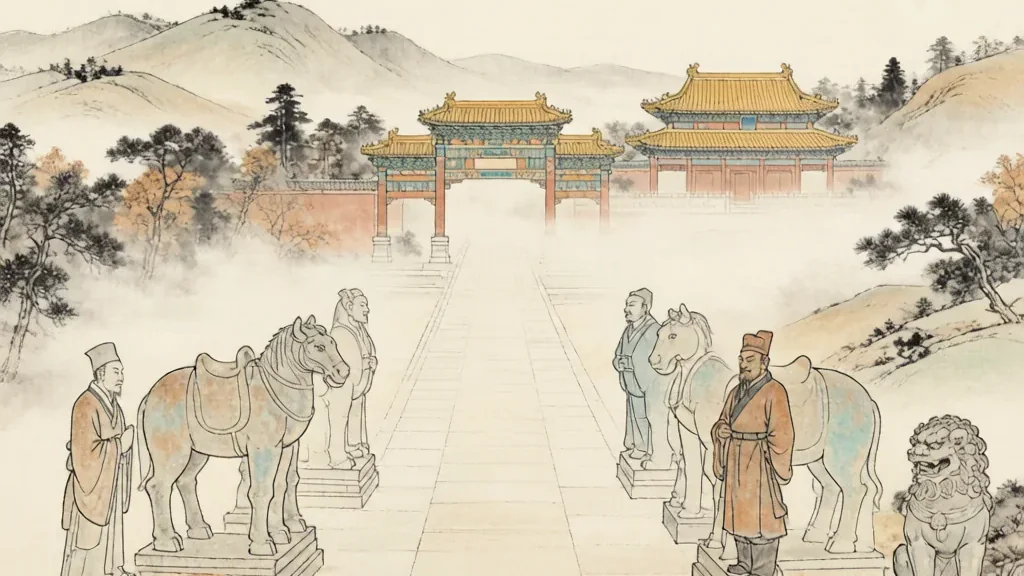
In the rolling hills of Hebei province, southeast of the old Ming capital region, a second great necropolis holds the rulers of China's last dynasty. Known in Chinese as 清东陵 (Qīng Dōng Líng), the Eastern Qing Tombs are the principal burial ground of the Manchu Qing emperors who governed China from 1644 to 1912. Five emperors, fifteen empresses and imperial consorts, and scores of princes and princesses lie within its walled precincts. The site is the largest and most complete cluster of Qing imperial mausoleums, and it preserves the full theatrical splendor of Qing funeral art at its peak. To visit is to walk through the final chapter of imperial China's architecture of death — a chapter that ends, almost literally, with the last emperor's grandmother.
The Choice of the Eastern Site
When the Qing conquered China in the mid-seventeenth century, they faced a delicate problem. As a conquering dynasty of Manchu origin, they needed to bury their dead according to their own traditions while also claiming legitimacy as heirs to the Chinese imperial order. The solution was to build grand tombs in the Chinese style, sited by the same geomantic principles used at the Ming Tombs. The Eastern Qing Tombs were begun in 1661, during the reign of the young Kangxi Emperor, on a site at Malanyu chosen for its protective hills and auspicious streams.
A western cluster, the Western Qing Tombs, was added later by the Yongzheng Emperor, who broke with the custom of burying each ruler beside his predecessor. The result is that the Qing, unlike the Ming, are divided between two necropolises. The eastern site, however, remained the more prestigious and the more lavishly developed. Its central axis runs for several kilometers from a monumental gate through a spirit way to the tomb mounds, echoing the Ming layout while adding the richer decorative vocabulary of the later period.
Emperors and Empresses at Rest
The Eastern Qing Tombs hold some of the most consequential names in Chinese history. The Kangxi Emperor, who reigned for sixty-one years, rests here in the Jingling tomb. So does the Qianlong Emperor, whose long and celebrated reign is marked by the most opulent mausoleum of the complex, the Yuling. The most famous occupant, however, is the Empress Dowager Cixi, the de facto ruler of late Qing China for nearly half a century, whose Dingdongling tomb was rebuilt at staggering cost and adorned with carved dragons, phoenixes, and a wealth of gilded detail.
Not everyone buried here met a peaceful end. The Xianfeng Emperor, who fled Beijing during the Anglo-French occupation of 1860, is entombed in the Dingling. The presence of so many women of power — empresses, dowagers, and consorts — gives the eastern site a distinctive character. The Qing, more than earlier dynasties, granted substantial tomb complexes to reigning empresses, and the result is a necropolis where female authority is literally carved in stone.
Spirit Ways,Archways, and Stone Armies
As at the Ming Tombs, the approach to the Eastern Qing Tombs is governed by a Sacred Way lined with stone. The great spirit way of the Kangxi Jingling sets the tone: an avenue of paired stone figures — lions, horses, camels, elephants, and qilin — followed by carved civil and military officials. These stand as both protectors and a permanent court assembled for the dead emperor. The proportion and finish of the Qing carvings are finer than their Ming predecessors, and the weathering of two centuries has given them a softer, almost living surface.
At the entrance stands one of the most celebrated structures of the site, a towering stone archway of glazed and carved white marble, said to be among the finest of its kind in China. Beyond it lie the individual tomb precincts, each enclosed by red walls and entered through a gate, a hall of offering, a soul tower, and the earthen mound. The Qianlong Yuling is especially remarkable for its underground palace, whose vaulted walls are covered with Buddhist inscriptions and imagery carved in Sanskrit and Tibetan as well as Chinese, a reflection of the multicultural Qing court.
The Architecture of the Underground Palaces
The underground palaces, or 地宫 (Dìgōng), are the hidden heart of the Qing tombs. Unlike the Ming, whose subterranean chambers were relatively plain, the Qing emperors turned their burial vaults into intricately decorated shrines. The Yuling of Qianlong descends through multiple拱券 (gǒngquàn) stone vaults, the walls and ceilings alive with tens of thousands of carved Buddhist characters and images. The intent was devotional as well as monumental: to surround the emperor's coffin with scripture that would speed his passage into the next world.
The Cixi tomb's underground palace, though smaller, is famous for its wealth. When it was opened in the twentieth century, it revealed coffins enclosed in elaborate chambers and a tradition of burial goods that included jade, gold, and pearls. The craftsmanship of the stone vaulting, fitted without mortar from precisely cut blocks, has withstood earthquakes and floods for more than two hundred years. These rooms are among the most atmospheric spaces in all of Chinese heritage — dark, cold, and hushed, with scripture pressing in on every surface.
Plunder, Restoration, and World Heritage
The Eastern Qing Tombs suffered a dramatic violation in 1928, when a warlord's troops dynamited their way into the Qianlong and Cixi tombs and looted the burial goods, an event that scandalized the country and became a symbol of the chaos of the Republican era. The incident damaged both the underground palaces and the reputation of the new order that had allowed it. For decades afterward the site fell into neglect, its halls roofless and its walls crumbling.
Systematic restoration began in the late twentieth century, and in 2000 the Eastern Qing Tombs were inscribed by UNESCO as part of the World Heritage listing of the Ming and Qing imperial tombs. Today the precincts are restored, the spirit way is walkable, and the great tombs of Kangxi, Qianlong, and Cixi draw scholars and pilgrims alike. The site stands as a reminder that the architecture of empire is fragile, and that its survival depends as much on later generations as on the rulers who first built it.
What the Tombs Tell Us About the Qing
The Eastern Qing Tombs are more than a cemetery; they are a condensed argument about legitimacy. By adopting Chinese funerary forms while filling them with Manchu, Mongol, Tibetan, and Chinese symbolism, the Qing announced themselves as universal rulers of a multi-ethnic realm. The very richness of the carving, the multilingual scripture on the vault walls, and the prominence given to empresses all speak to a dynasty that governed through synthesis rather than separation.
For the modern visitor, the tombs offer a last, lingering image of imperial China before the curtain fell. Standing before the mound of the Empress Dowager Cixi, one stands at the threshold of the modern age — the point where two thousand years of monarchy gave way to a republic. The hills of Malanyu keep that transition quietly, in stone and soil, for anyone willing to walk the long spirit way and listen.
The Tomb of Empress Dowager Cixi
No occupant of the Eastern Qing Tombs is more famous than the Empress Dowager Cixi, who dominated late-Qing China for nearly half a century. Her Dingdongling was rebuilt at enormous expense and is the most richly decorated of the empress tombs, its halls and screens carved with dragons and phoenixes and gilded in lavish detail. When the underground palace was opened in the twentieth century it revealed coffins and burial goods of jade, gold, and pearls, the wealth of a ruler who controlled the court's purse to the end. Cixi is the only woman among the site's great occupants, and her tomb stands as proof that Qing imperial power was not solely male. To stand before her mound is to stand at the threshold of the modern age, where two thousand years of monarchy gave way to a republic.
The Western Qing Tombs: A Second Necropolis
The Qing are unusual among China's dynasties in being divided between two burial grounds. The Yongzheng Emperor broke the custom of joint burial beside his predecessors and founded the Western Qing Tombs at Yixian, in the hills of Hebei, southwest of the capital. There the Kangxi's successors in the direct line after Yongzheng were laid to rest, including the Jiaqing, Daoguang, and Tongzhi emperors, in a layout that echoes the eastern site. The western cluster is smaller and quieter, its forests denser, and it receives fewer visitors, yet it preserves the same fusion of Chinese funerary form with Manchu and Tibetan ornament. Together the two necropoleis show a dynasty negotiating tradition and choice, splitting its dead across the landscape even as it claimed to rule a single, unified realm.
❓ Frequently Asked Questions
📝 Chinese Vocabulary
清东陵 — : The Eastern Qing Tombs, the principal Qing imperial necropolis.
地宫 — : The underground palace or burial vault beneath an imperial tomb.
慈禧 — : The Empress Dowager Cixi, the powerful late-Qing ruler.
乾隆 — : The Qianlong Emperor, whose Yuling tomb is the most richly decorated.
拱券 — : A stone vault or arch, used in the construction of underground palaces.
清西陵 — : The Western Qing Tombs, the second necropolis founded by the Yongzheng Emperor.
康熙 — : The Kangxi Emperor, whose sixty-one-year reign is the longest verified in Chinese history and who rests in the Jingling.
裕陵 — : The Yuling, the Qianlong Emperor's tomb, whose underground palace is carved with tens of thousands of Buddhist characters.
🎉 Fun Facts
- The Kangxi Emperor buried here reigned for sixty-one years, the longest verified reign in Chinese imperial history.
- The underground palace of the Qianlong tomb is carved with tens of thousands of Buddhist characters in Chinese, Sanskrit, and Tibetan.
- The 1928 looting of the Cixi tomb was so infamous that it became a flashpoint in the politics of the early Republic.
- The Eastern Qing Tombs hold five emperors, fifteen empresses and consorts, and scores of princes and princesses within their walled precincts.
- Cixi's Dingdongling tomb was rebuilt at staggering cost and is especially lavish, its chambers adorned with carved dragons and phoenixes.
- The site blends Manchu, Mongol, Tibetan, and Chinese symbolism, a visual statement of the Qing as rulers of a multi-ethnic realm.