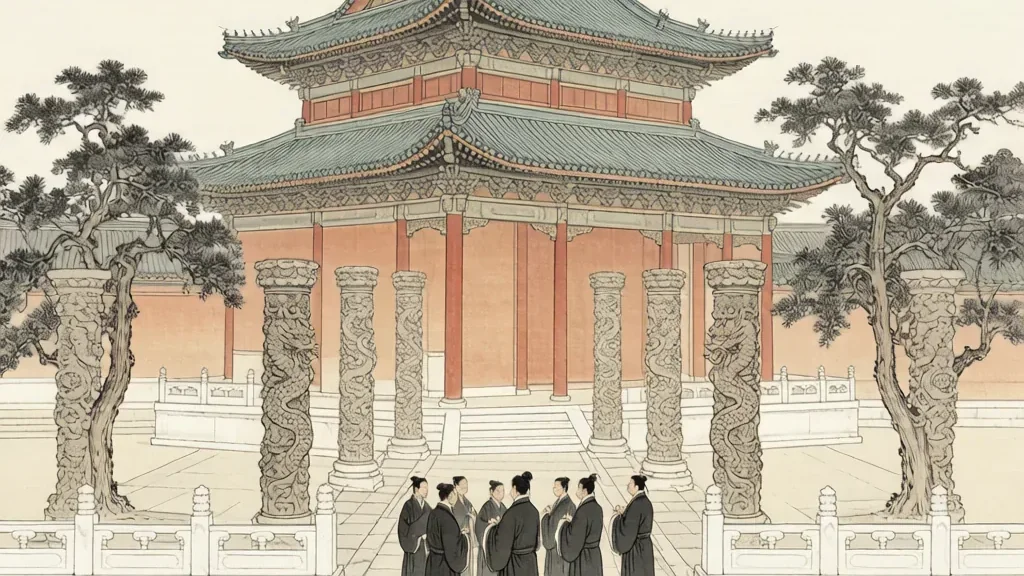
In the flat plains of southwest Shandong province lies a modest city that shaped the moral imagination of an entire civilization. Known in Chinese as 曲阜三孔 (Qūfù Sān Kǒng), Qufu is the hometown of Confucius, the teacher whose ideas ordered Chinese life for more than two thousand years. The name "Three Kong" refers to the three great Confucian sites of the city: the Confucius Temple, the Cemetery of Confucius, and the Kong Family Mansion. Together they form one of the most important cultural landscapes in China, a place where philosophy became architecture and a family became an institution. To visit Qufu is to stand at the source of the Confucian tradition that still informs Chinese ideas of family, education, and government.
The City of Confucius
Qufu was already an ancient settlement when Confucius was born there around 551 BCE, during the turbulent Spring and Autumn period of the Zhou dynasty. The philosopher, known in Chinese as 孔子 (Kǒngzǐ), spent most of his life in and around the city, teaching a small circle of disciples and arguing for a return to humane and ritual order. He never held the highest office he sought, and he died believing himself a failure. Yet within a few centuries his teachings became the foundation of imperial statecraft.
The city's fortune rose with his reputation. As Confucianism became the official ideology of the Chinese empire, Qufu was maintained as a sacred town, its streets and walls oriented around the memory of the master. Remarkably, the Kong family — said to be descended directly from Confucius — was granted hereditary privileges and allowed to manage the site for generation after generation, making it perhaps the longest continuously documented family line in the world.
The Confucius Temple (Kong Miao)
The Confucius Temple, or 孔庙 (Kǒng Miào), began as a small shrine erected by the ruler of the local state shortly after the philosopher's death. Over two millennia it grew into a vast complex of more than a hundred buildings arranged along a central axis, with nine courtyards, ancient cypress trees, and steles recording imperial visits. Successive dynasties expanded it, and by the Ming and Qing periods it rivaled a palace in scale.
At its heart stands the main hall, the Dacheng Hall, whose massive columns are carved with coiled dragons in a style normally reserved for the emperor. Here, on fixed dates, ceremonies are still performed in honor of Confucius, complete with music and dance in the ancient style. The temple is not a place of worship in the religious sense but of veneration — a site where scholars and officials through the ages came to pay respect to the teacher of teachers. Its very layout teaches the Confucian ideals of order, hierarchy, and harmony made visible in wood and stone.
The Cemetery of Confucius (Kong Lin)
Just north of the city lies the Cemetery of Confucius, or 孔林 (Kǒng Lín), a walled forest cemetery where the master and his descendants have been buried for twenty-five centuries. Covering several square kilometers, it is the largest and oldest family graveyard in the world, threaded by paths shaded by ancient trees and marked by thousands of tombstones. Confucius himself is said to lie beneath a simple mound, surrounded by the graves of his followers and, later, his vast lineage.
To walk the Kong Lin is to walk through time. The tombstones record the names and ranks of generations stretching back to antiquity, a literal genealogy inscribed in stone. The cemetery embodies the Confucian emphasis on filial piety and ancestral reverence — the belief that the living owe respect and memory to those who came before. For the Kong family, tending this forest was both a sacred duty and a statement of continuity that outlasted dynasty after dynasty.
The Kong Family Mansion (Kong Fu)
Between the temple and the cemetery stands the Kong Family Mansion, or 孔府 (Kǒng Fǔ), the residential compound of the hereditary line of Confucius's descendants, who held the title Duke Yansheng. For centuries this family administered the Confucian sites, received imperial officials, and managed extensive lands granted by the throne. The mansion is a miniature of a princely residence, with audience halls, living quarters, and gardens, and it preserves the daily material culture of a family that functioned almost like a noble house within the empire.
The mansion tells a quieter story than the grand temple. Here were kept the registers of descent, the robes of office, the archives of correspondence with emperors. The Duke Yansheng was, in effect, a living link between the throne and the tradition of Confucius, and the Kong Fu is the physical record of that role. Together, the temple, forest, and mansion show how a philosophy became not just an idea but an institution woven into the fabric of the state.
Ritual, Learning, and Living Tradition
Qufu has never been a dead monument. The rites performed at the Confucius Temple follow forms codified centuries ago, and the city remains a center of Confucian study and commemoration. In recent decades there has been a revival of interest in Confucian values, and Qufu hosts ceremonies, forums, and educational programs that draw visitors from across China and the world. The annual memorial rite for Confucius, with its music and dances, is a carefully preserved performance of cultural memory.
This living quality is what distinguishes Qufu from a mere archaeological site. The Three Kong are still used, still honored, still taught from. In an age when many ask what classical wisdom might offer the modern world, Qufu serves as a working laboratory of tradition — a place where the ideas of a fifth-century teacher continue to be enacted by his descendants' city two and a half millennia later.
World Heritage and Enduring Meaning
In 1994 the Temple, Cemetery, and Family Mansion of Confucius at Qufu were inscribed together on the UNESCO World Heritage List, recognized for their outstanding testimony to the Confucian tradition and their remarkable state of preservation. The designation secured international attention and support for the site's conservation, even as it continued to serve its original cultural functions.
Qufu matters because it is the wellspring of a worldview that shaped not only China but Korea, Japan, and Vietnam. The values associated with Confucius — education, propriety, family loyalty, and morally responsible government — remain part of the living heritage of East Asia. To stand in the Dacheng Hall, or among the tombs of the Kong Lin, is to touch the origin point of an idea that ordered the lives of hundreds of millions of people for two thousand years, and that shows no sign of losing its power to provoke reflection.
Steles and Imperial Inscriptions
The grounds of Qufu are crowded with stone steles, carved tablets that form a documentary record spanning more than a thousand years of imperial attention. Successive dynasties erected these monuments to record royal visits, poems, and edicts honoring Confucius, and the finest stand in long covered galleries within the temple precinct. The most famous is the stele of Emperor Xuanzong of Tang, whose calligraphy praises the master, while many later steles bear the words of Ming and Qing rulers who used the site to proclaim their own legitimacy. Reading them is like reading the official diary of the Chinese state, written in stone. Because Confucius was venerated by every dynasty, the steles survive as one of the most continuous written archives in the world, linking the fifth-century BCE teacher to emperors who lived two thousand years after him.
Qufu as a Living Center of Learning
Qufu has never been only a place of tombs and temples; it has also been a school. From the Confucian academies of imperial times to the modern Qufu Normal University nearby, the city has long drawn students of the classics, and the annual memorial ceremony for Confucius is still performed with music and dance in the old style. In recent decades there has been a marked revival of interest in Confucian values, and the city now hosts forums, lectures, and educational programs that bring scholars and visitors from across China, Korea, Japan, and Vietnam. The result is a rare kind of heritage site: one where the subject of study is still taught on the ground where it began. To study in Qufu is to learn not from a book about Confucius but from the city his students built around his memory.
❓ Frequently Asked Questions
📝 Chinese Vocabulary
曲阜三孔 — : The Three Kong sites of Qufu — temple, cemetery, and mansion.
孔子 — : Confucius, the teacher whose thought shaped Chinese civilization.
孔庙 — : The Confucius Temple, the ceremonial heart of the Qufu complex.
孔林 — : The Forest of Confucius, the family cemetery stretching back millennia.
孔府 — : The Kong Family Mansion, home of Confucius's hereditary descendants.
大成殿 — : The Dacheng Hall, the main ceremonial hall of the Confucius Temple.
衍圣公 — : Duke Yansheng, the hereditary title of the senior descendant of Confucius.
杏坛 — : The Apricot Altar, the spot where Confucius is said to have taught his disciples.
🎉 Fun Facts
- The Kong family of Qufu claims an unbroken documented line of descent from Confucius stretching over twenty-five hundred years.
- The Cemetery of Confucius is the largest and oldest family graveyard in the world.
- The Dacheng Hall's columns are carved with imperial dragons, a honor normally reserved for the emperor himself.
- The Apricot Altar within the temple marks the place where Confucius is said to have taught his followers beneath an apricot tree.
- When the emperor visited Qufu, the dragon-carved columns of the Dacheng Hall were wrapped in red cloth so they would not appear to rival the throne's own dragons.
- Qufu's old city walls were kept low and its streets narrow so that no ordinary building would rise above the Confucius Temple, keeping the teacher's shrine as the city's spiritual high point.