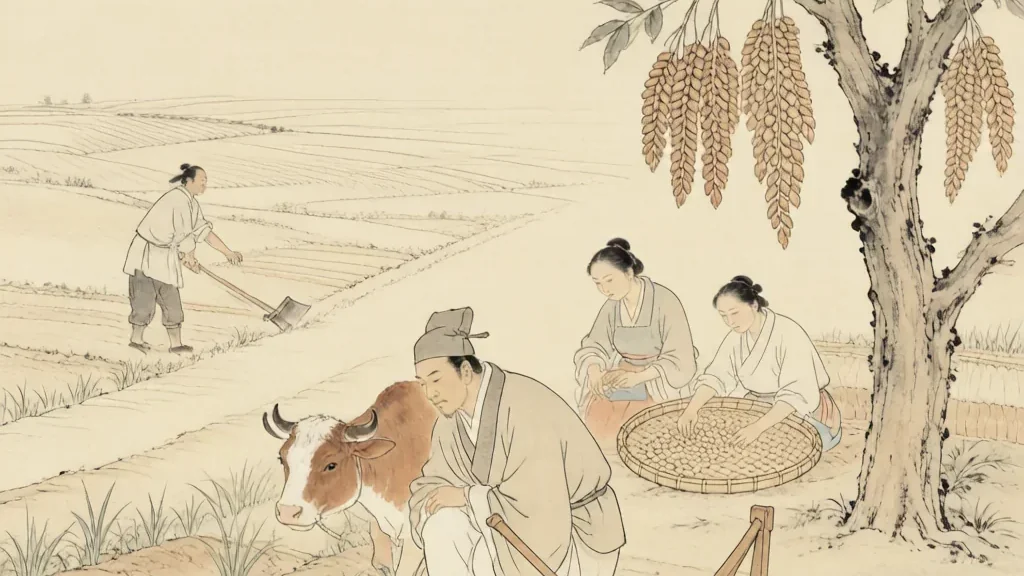
More than fourteen centuries ago, a Northern Wei official named Jia Sixie sat down to record everything he knew about growing food, raising animals, and preserving the harvest. The result was the 齐民要术 (), often translated as "Important Methods for the Common People's Livelihood" or "The Art of Farming." Completed around 540 AD, it is the earliest complete agricultural encyclopedia to survive from China, and arguably from anywhere in the world. Its importance reaches far beyond farming trivia: it is a foundational document of agronomy, food science, and ecological thinking, showing that systematic, observation-based agriculture was already highly developed in early medieval China.
The Author and His Age
Jia Sixie (贾思勰) served as a local magistrate in the state of Eastern Wei during the Northern and Southern Dynasties period, a time of division and warfare in China. He was not a court philosopher but a practical administrator who saw that a stable state depended on full granaries. Little is known of his biography, but his book reveals a man who traveled, questioned farmers, read widely, and tested advice against his own experience. He wrote during a century when northern China was recovering from conflict and needed reliable guidance on feeding its people.
The title itself signals his purpose. "Qi min" means the common people, and "yao shu" means essential techniques or methods. Jia Sixie explicitly wanted to gather the best available knowledge so that ordinary households could avoid famine and waste. In this democratic spirit the book reads less like a scholar's treatise and more like a comprehensive manual for self-sufficient living, blending quoted classics, folk wisdom, and the author's own corrections of earlier errors.
What the Book Actually Contains
The Qimin Yaoshu runs to ten volumes and ninety-two chapters, an enormous compilation by the standards of its day. It opens with crop cultivation, devoting enormous detail to millet, wheat, beans, and vegetables, including exactly when to sow, how deep to plant, how to treat seed, and how to rotate fields. It then moves through horticulture, forestry, and the raising of silkworms, livestock, poultry, and fish. The later chapters cover food processing: brewing, making soy paste and fermented bean products, pickling, and preserving.
One striking feature is Jia Sixie's reliance on experimentation and cited sources. He quotes earlier agricultural writings and then notes where they disagree with what he observed. He records specific yields, dates, and temperatures, the kind of quantitative detail we associate with modern science. The brewing sections, for example, give precise ratios of grain, water, and starter culture, anticipating the microbial science of fermentation that would not be named as such for more than a thousand years.
Principles Ahead of Their Time
Several ideas in the Qimin Yaoshu feel strikingly modern. Jia Sixie stressed crop rotation and the value of alternating grains with legumes to restore soil fertility, a principle only formalized in the West in the eighteenth century. He understood that seed selection improved strains over generations, essentially an early grasp of selective breeding. He advised matching the crop to the soil and the season rather than forcing the land, an ecological sensibility that resonates with today's sustainable agriculture.
He also paid close attention to the living soil. The book recommends composting, the use of manure, and careful water management, treating the farm as an integrated system rather than a collection of separate tasks. This systems thinking, the idea that farming, animal husbandry, and food preservation form one cycle, is perhaps the book's deepest legacy. It treats self-sufficiency not as isolation but as intelligent organization of resources.
Food, Fermentation, and Daily Life
Roughly a third of the Qimin Yaoshu concerns turning harvest into durable, tasty food. Jia Sixie gives recipes for making vinegar, wine, soy sauce precursors, pickled vegetables, and cured meats. These sections are invaluable to historians of food because they preserve the working methods of Chinese fermentation cuisine at its formative stage. Many of the products he describes, such as fermented bean relishes, remain staples of the Chinese table today.
The emphasis on preservation reflects a harsh reality: a good harvest could rot before it was eaten. Drying, salting, fermenting, and pickling were technologies of survival as much as flavor. By codifying them, Jia Sixie helped stabilize rural life. His instructions are practical down to the gestures, specifying the feel of the dough or the color the liquid should reach, the kind of embodied knowledge passed from cook to cook and now fixed in writing.
Why the Qimin Yaoshu Endures
The Qimin Yaoshu was copied, quoted, and built upon for centuries. Later agricultural writers from the Tang through the Qing treated it as a foundation, and fragments survive because it was so often reprinted. Modern agronomists study it not only for history but for techniques, such as intercropping and natural pest control, that interest organic farmers today. It is a bridge between ancient field wisdom and contemporary concerns about food security.
More than a farming manual, the book is a portrait of a civilization that took the land seriously. In a culture that revered scholars, Jia Sixie insisted that the work of growers and cooks deserved rigorous study. The Qimin Yaoshu therefore stands as evidence that Chinese science long prized the practical and the useful, and that the most enduring inventions are sometimes the ones that simply help people eat.
Sericulture and Animal Husbandry
Beyond crops, the Qimin Yaoshu is a handbook of living things. A large portion concerns sericulture, the careful raising of silkworms on mulberry leaves, with advice on timing, temperature, and hygiene that determined whether a season's silk would succeed. It also covers livestock such as oxen, sheep, pigs, and poultry, and even fish ponds, treating animals as part of the same productive cycle as the fields. Jia Sixie gives practical husbandry: what to feed, how to shelter, when to breed. This breadth makes the book a true rural encyclopedia rather than a planting guide alone. By linking silk, meat, and fish to the grain economy, it shows an early grasp of mixed farming, the idea that a household's survival depended on many coordinated activities, not a single crop.
Seed, Soil, and the Craft of Sowing
The agronomic core of the Qimin Yaoshu is intensely practical about the basics. Jia Sixie describes how to select the best seed, treat it before planting, choose the right depth, and match each crop to its soil and season. He records which fields should rest and which should carry a second crop, and he warns against forcing land beyond its means. His instructions are precise, citing dates and yields, the mark of a writer who observed rather than guessed. The emphasis on seed quality as a way to improve strains over generations is an early form of selective breeding, arrived at through patient farm experience. In these pages the act of sowing becomes a craft with rules, the quiet foundation on which the book's more famous ideas about rotation and fertility were built.
The Qimin Yaoshu and Later Agronomy
The book's influence outlasted its own century. From the Tang onward, agricultural writers measured their work against Jia Sixie, quoting him on everything from soybean rotation to vinegar brewing. Yuan, Ming, and Qing treatises folded his methods into larger compilations, and officials promoting farming circulated simplified versions. Because it preserved both folk wisdom and the author's corrections of error, it became a trusted warehouse of technique that later farmers could mine. Modern agronomists still turn to it for practices like intercropping and natural pest control that interest organic farming today. Few ancient technical books kept such authority across fifteen hundred years; the Qimin Yaoshu endured because it was genuinely useful, a manual that kept teaching long after its author's world had vanished.
❓ Frequently Asked Questions
📝 Chinese Vocabulary
齐民要术 — : "Essential Methods for the Common People's Livelihood," the agricultural encyclopedia.
贾思勰 — : Jia Sixie, the author and Northern Wei official.
农 — : farming or agriculture.
发酵 — : fermentation, a major theme of the book's food chapters.
轮作 — : crop rotation, a practice the book advocates for soil fertility.
桑蚕 — : Sericulture, the raising of silkworms on mulberry leaves, a major section of the book.
绿肥 — : Green manure, the practice of plowing plants into soil to restore its fertility.
酿造 — : Brewing, the fermentation processes for wine and vinegar the book records in detail.
🎉 Fun Facts
- The Qimin Yaoshu has ten volumes and ninety-two chapters, making it one of the largest technical books of its era.
- Jia Sixie recommended rotating grains with beans centuries before crop rotation was formalized in Europe.
- The book preserves some of the earliest written recipes for fermented soybean foods still eaten in China.
- Despite wars and book burnings, the text survived because later dynasties kept copying and quoting it.
- Jia Sixie tested advice against his own observations and openly corrected older texts when they disagreed with what farmers actually did.
- The book's brewing chapters give exact ratios of grain, water, and starter, a quantitative approach rare in premodern writing about food.