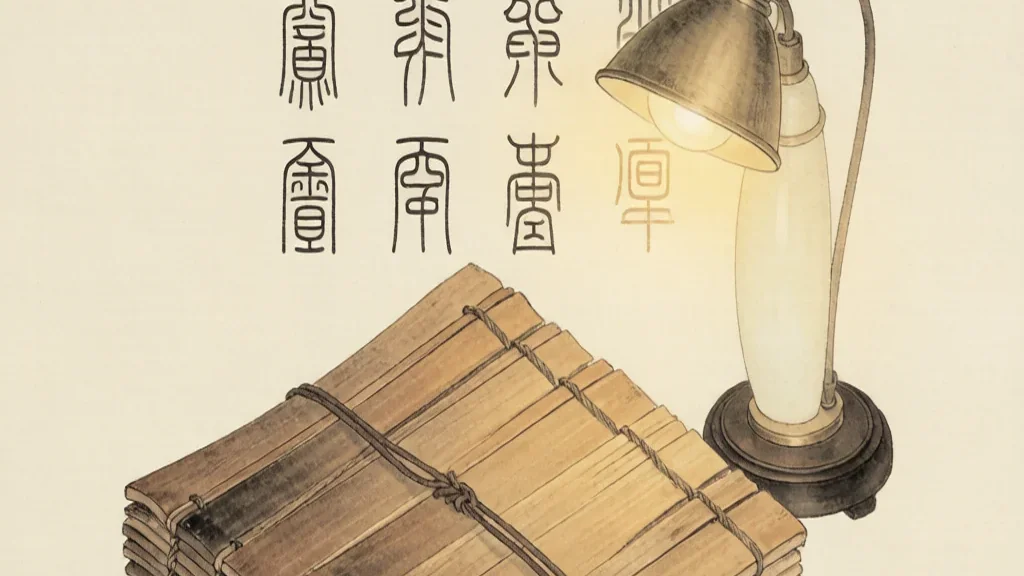
For more than a thousand years, from the late Zhou through the Han dynasty, the ordinary medium of Chinese writing was not paper but narrow strips of bamboo and wood. Scholars wrote vertically with brush and ink on these slips, bound them with cords into scrolls, and stored them in libraries and tombs. The bamboo-slip script therefore spans the crucial transition from the angular, pictographic forms of the early empire to the mature clerical script. Because so many slips were sealed in tombs and abandoned caches, modern archaeology has recovered tens of thousands of them, offering an unparalleled window onto how people actually wrote, read, and administered a pre-paper civilization.
What Bamboo Slips Were
A typical slip was a thin strip of split bamboo about the width of a chopstick and roughly twenty to sixty centimeters long, depending on the text. A scribe ruled faint lines, then wrote a single column of characters per slip using a brush of animal hair and carbon-or plant-based ink. Several dozen slips were threaded together with hemp or silk cords through notched holes to form a "scroll" (册, whose very shape depicts bound slips). A full book might run to hundreds of slips, kept rolled and stored in silk or lacquer boxes.
Mistakes were scraped off with a knife (the 刀 that became a symbol of the editor's craft), and a slip's limited width is why classical Chinese prose is so terse — every character had to earn its place on the narrow strip.
The Script on the Slips
The writing on bamboo slips is usually a form of clerical script (隶书) or its immediate predecessor, the "proto-clerical" hands of the Warring States. Compared with the solemn, balanced seal script used on bronze and stone, slip writing is faster, more cursive, and more irregular: strokes flatten, tails flick, and rounded lines give way to the "silkworm head and goose-tail" flourishes that define clerical script. In the hands of humdrum scribes we see the script evolving in real time, not in the polished monuments of the court.
From Seal Script to Clerical on Bamboo
Historians link the turn to clerical script with the administrative demands of the Qin and Han empires. Legend credits the Qin official Cheng Miao with formalizing a simpler hand suited to the mountains of official documents; whether or not that story is true, the slips show the change plainly. The same word may appear on an early slip in near-seal form and on a later one in fluent clerical style. Bamboo thus preserves the very moment Chinese writing became practical for bureaucracy.
Famous Discoveries
The twentieth and twenty-first centuries have seen spectacular finds. The "Jiudian" and "Guodian" slips of the Chu state (around the 4th century BCE) preserved early Confucian and Daoist texts unknown from later tradition. The "Mawangdui" silk and slip manuscripts (2nd century BCE) included medical, military, and cosmic writings. Most recently, the "Qinghua" slips (donated to Tsinghua University) and the "Liye" Qin slips — tens of thousands of administrative records from a single county — have transformed our knowledge of law, math, and daily governance.
What the Slips Reveal
Because slips were used for everything from imperial edicts to shopping lists, they show writing at every social level. We find tax rolls, legal cases, calendars, medical recipes, military drills, and private letters. They reveal how characters were taught, how numerals and units were written, and how scribal habits varied by region and office. A slip archive is, in effect, a snapshot of a literate society before paper flattened the record.
Preservation and Decay
Bamboo survives best in dry caves or waterlogged, sealed tombs where rot and oxygen were kept out. Once excavated, slips are fragile: they shrink, warp, and the ink can flake away, so conservation is urgent and delicate. Teams photograph, scan, and reconstruct the order of slips whose cords have long since rotted, sometimes using the shaped joins of the 册 form or parallel passages in transmitted texts.
Legacy in the Writing System
The bamboo medium left permanent marks on the script. The vertical column of writing, the top-to-bottom reading order, and the habit of binding "volumes" all descend from the slip. Even the character 册 (book/volume) is a picture of bound slips, and 典 (canon) shows slips resting on a stand. When paper finally arrived, it inherited the slip's columns and the reader's eye — a quiet debt the writing system still pays to bamboo.
Bamboo and the Spread of Literacy
Because bamboo was cheap and abundant compared with bronze or silk, the slip democratized writing in a way earlier media could not. Ritual bronzes recorded the elite; slips reached clerks, teachers, doctors, and merchants. The very volume of surviving administrative slips shows a working bureaucracy that read and wrote constantly, not a script reserved for priests. Literacy, measured by who could commission or consult a slip, broadened markedly during the Han, and the portable scroll let texts travel between regions and generations. In this sense the humble bamboo strip was an engine of cultural unification, carrying a single written standard across a vast empire long before printing existed.
Slips and the Birth of the Book
The bamboo slip is, quite literally, where the Chinese "book" was born. The character 册, still meaning volume or booklet, is a picture of several slips bound by cords, and 编 (to compile or edit) originally meant threading those slips together. When a text grew long, it became a set of bound bundles stored in a box — the ancestor of the chapter and the codex. Imperial libraries counted their holdings in "swords" of slips, and losing a cord could scatter a work across the floor. This physical reality shaped literature itself: authors wrote in compact, allusive sentences because space on bamboo was precious, a discipline that still marks the Chinese prose style.
❓ Frequently Asked Questions
What are bamboo slips?
They are narrow strips of split bamboo on which Chinese scribes wrote with brush and ink, binding them into scrolls before paper existed.
What script appears on the slips?
Mostly clerical script or its Warring States predecessors, written faster and more cursively than the formal seal script of monuments.
Why are bamboo-slip finds important?
They preserve everyday writing — laws, letters, accounts, and lost texts — giving a real picture of literacy and administration.
How were slips kept in order?
They were threaded on cords through notches; when cords rotted, archaeologists reorder them using shape and parallel texts.
Where have major slips been found?
Key sites include Guodian, Mawangdui, Shuihudi, Liye, and the Qinghua collection, spanning Chu, Qin, and Han.
How did slips shape later writing?
The vertical column, top-to-bottom reading, and the concept of a "volume" all descend from the bound bamboo slip.