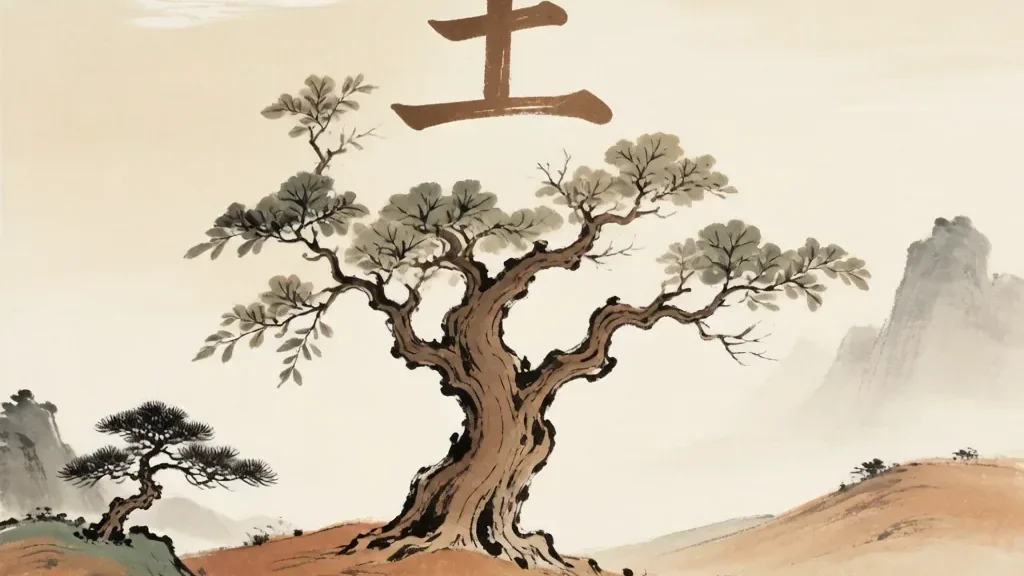
The earth radical, written 土 (tǔ), is one of the 214 traditional radicals and a cornerstone of the Chinese script's vocabulary of land, ground, and building. As the element "earth" in the Five Phases (wuxing), it is paired with the center and the color yellow, giving it a cosmological weight that goes far beyond "dirt." Hundreds of characters carry 土 as their meaning-component, from 地 (earth, ground, the very word for "the earth") to 城 (city wall), 墙 (wall), 坐 (to sit), and 堂 (hall). Studying the earth radical is therefore a fast route into the large family of characters about place, construction, and the settled human world.
The shape and origin of 土
The Shuowen Jiezi defines 土 as 地之吐生物者也, "that from which the earth sends forth living things." Its written form is commonly read as a picture of a mound of earth: a horizontal line for the ground with a vertical stroke rising from it, like a small heap or a sprout emerging from soil. Whether one sees a mound or a plant, the image is of earth as the source of growth.
In the oracle-bone and bronze forms, 土 often appears as a simple upright mark on a base, and it was also used as a cult object—an altar mound representing the soil god (后土, Hòutǔ, the Earth God). The radical thus carries both a physical and a sacred sense of "ground."
Earth in the Five Phases
In wuxing, 土 is the element of the center, balancing wood, fire, water, and metal at the four quarters. It corresponds to the color yellow (黄), the season of late summer, and the taste of sweetness. Because the center is the pivot of the cosmos, earth was honored as the stabilizing element beneath all change.
This is why imperial Yellow (associated with earth) and the "Middle Kingdom" (中国) both draw on the earth radical's symbolism. To write or read 土 is to touch a whole theory of how the world holds together.
地: the word for "earth" and "ground"
地 (dì) is the most important character built from 土. It pairs the earth radical with the phonetic 也 (yě) and means "earth, ground, soil, territory." It appears in 地图 (map), 地球 (the globe/Earth), and 地方 (place, locality). Philosophically, 地 forms the pair with 天 (heaven): 天地 means "heaven and earth," the foundational couple of Chinese cosmology.
Because 地 also means "place" or "field of activity," it shows how the earth radical easily slides from literal soil to abstract location, a move repeated across the radical's family.
Walls, cities, and settlement
Many earth-radical characters describe the built environment, reflecting a civilization that built with rammed earth (夯土, hāngtǔ). 城 (chéng) is a city or its wall; 墙/牆 (qiáng) is a wall; 坦 (tǎn) is level or flat ground; 坑 (kēng) is a pit; 坡 (pō) is a slope; 堆 (duī) is a heap or pile.
These words record the material history of Chinese architecture, where earth was shaped, compressed, and raised into the walls that defined towns and homes. The radical is a quiet archive of how people made space livable.
Sitting, halls, and social space
A few earth-radical characters encode posture and social architecture. 坐 (zuò, to sit) shows two figures (人) on a base of earth 土—people seated on the ground, as was traditional. 堂 (táng) is a hall or main room, the central space of a household or temple. 基 (jī) is a foundation, the earth-supported base of a building.
Such characters remind us that "earth" is not only nature but the floor of human life: where we sit, gather, and build. The radical links the soil underfoot to the institutions above it.
Adjectives of solidity and quality
Earth-radical characters also express stability and moral weight. 坚 (jiān) means firm, hard, or resolute—"solid as earth." 境 (jìng) means boundary or territory, the limit of a land. 块 (kuài) is a lump or chunk (often a measure word for pieces). 塑 (sù) is to model or sculpt, shaping earth-like material.
These extend the radical into abstractions of firmness and extent, showing how a concrete element becomes a metaphor for dependability and scope.
Earth in place-names and culture
The earth radical is dense in Chinese geography and ritual. 土地 (tǔdì) means "land" and also names the local Earth God (土地公, Tǔdì Gōng), worshipped at small roadside shrines across China. 土 is also used for "native" or "local" (土产, local product; 土话, local dialect), and even "unrefined" (土气, countrified), showing the word's social shading.
In festivals, earth is honored alongside heaven, and the altar to 后土 stands in the imperial temple complex. The radical thus bridges daily speech, local religion, and state ritual.
Earth vs. the other element radicals
土 belongs to a set of elemental radicals—wood 木, fire 火, water 水/氵, metal 金, and earth 土—each heading a large character family. Knowing all five lets a learner predict meaning: a character with 土 likely concerns land or building, just as one with 水 concerns liquid and one with 火 concerns heat.
This network is one of the script's great teaching tools. The earth radical, sitting at the conceptual center of the five, is a natural anchor for learning how radicals organize meaning.
Earth in idiom and literature
The earth radical enriches daily phrasing. 土地 (land) and 本土 (homeland) anchor a vocabulary of belonging, while 土生土长 ("born and raised on native soil") praises local roots. In contrast 土 can gently mock the rustic (土气, "countrified"), showing how the same radical signals both honored origin and plainness.
Poets invoke 大地 (the great earth) as the mother that receives all, and 国土 (national territory) binds soil to the state. The radical's range—from a clod to the realm—mirrors how Chinese thought moved easily between the concrete ground and the abstract polity built upon it.
Modern legacy
Today the earth radical remains productive. New characters and compounds for construction, geology (地质, geology), and territory keep it busy, and 土 appears in everyday words from 土豆 (potato, "earth bean") to 土地 (land/real estate). Calligraphers treat the two strokes of 土 as a basic exercise in balance.
Whether in a map, a wall, or a prayer to the soil god, 土 continues to carry the sense of the ground that supports everything—a small character with a very large footprint in the language.
❓ Frequently Asked Questions
What does the earth radical 土 look like and mean?
土 is a horizontal ground line with a vertical stroke rising from it, read as a mound of earth or a sprout from soil; it means earth, soil, and serves as the meaning-radical for land and building words.
How is earth placed in the Five Phases?
Earth is the central element, balancing wood, fire, water, and metal; it pairs with yellow, the center, and late summer, and underlies the idea of the "Middle Kingdom."
Why are so many building words written with 土?
Because traditional Chinese construction used rammed earth for walls and foundations, so characters like 城 (city wall), 墙 (wall), and 基 (foundation) naturally took the earth radical.
What is the connection between 地 and 天?
地 (earth/ground) and 天 (heaven) form the foundational cosmic pair 天地, "heaven and earth," in Chinese philosophy and daily phrasing.
Who is the Earth God (土地)?
土地公 (Tǔdì Gōng) is the local Earth God worshipped at roadside shrines, guardian of a locality's soil and harvest; 后土 is the higher Earth deity paired with Heaven.
How does 土 relate to the other element radicals?
土 is one of five element radicals (wood, fire, water, metal, earth); each heads a meaning-family, so a 土 character usually concerns land or building, helping learners predict sense.