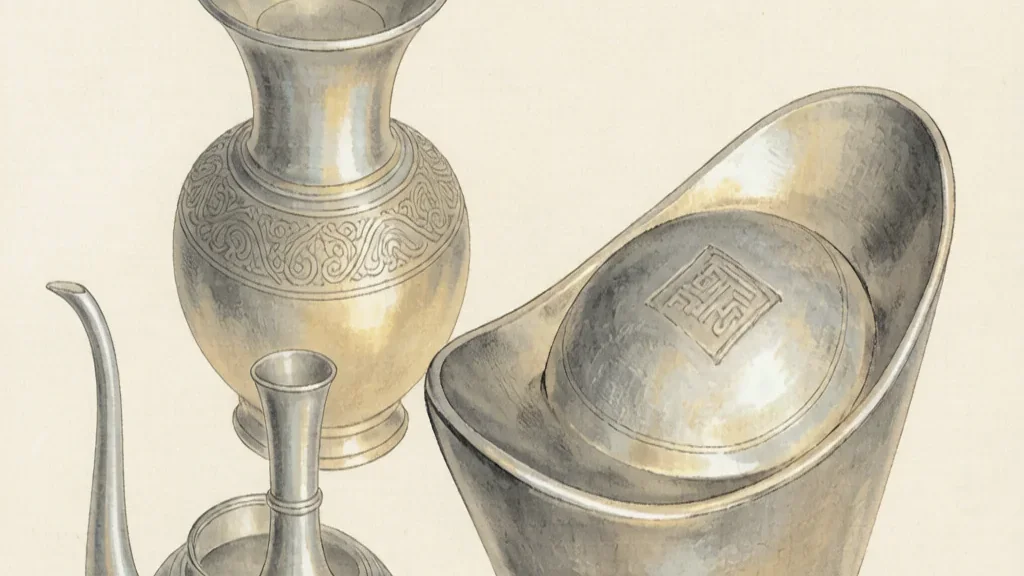
The metal radical, written 金 (jīn) and shortened to 钅 on the left in simplified characters, is one of the five elemental radicals and the head of a rich family of words about gold, metals, money, and tools. As the element "metal" in the Five Phases (wuxing), it pairs with the west, the color white, and the autumn season. From 金 (gold/metal) itself to 银 (silver), 铜 (copper), 铁 (iron), 钱 (money), and 镜 (mirror), the radical records China's long history of metallurgy—the bronze rites, the iron plow, and the coin that made trade possible. This article surveys the metal radical's form, its role in the script, and the characters forged under its sign.
The shape and origin of 金
金 (jīn) is a phonosemantic compound whose lower part is 土 (earth) with dots above, interpreted as metal nuggets contained in or yielded by the earth, and an upper sound component. The Shuowen defines 金 as "the metal of five colors," a general term for the metallic element before it narrowed to mean "gold" specifically.
In compound characters the radical shrinks to 钅 on the left, so 银, 铜, 铁, and 钢 all declare their metallic nature at a glance. This left-side form is one of the most recognizable radicals in daily vocabulary.
Metal in the Five Phases
In wuxing, metal is the element of the west, the autumn, the color white, and the pungent taste. It is the contracting, descending force—the opposite of wood's growth—and it was linked to the White Tiger of the west. Bronze and iron, the metals of ritual and war, thus sat within a whole cosmic scheme.
This placement meant that metal characters could carry not just material meaning but seasonal and directional symbolism, so that "metal" in a phrase might evoke autumn's clarity or the west's brightness as much as a lump of ore.
Gold and the precious metals: 金, 银, 铜
金 (jīn) means both "metal" in general and "gold" in particular; it is the standard word for gold and appears in 黄金 (gold) and in auspicious terms like 金子 (gold piece). 银 (yín, silver) pairs the metal radical with 艮; silver was the metal of everyday precious payment. 铜 (tóng, copper) pairs metal with 同 and names the metal of the great bronze age.
These three metals structured Chinese economy and ritual: copper for bells and vessels, silver for ingots and later currency, gold for supreme value and ornament. The radical groups them as one family of valued substances.
Iron and steel: 铁, 钢
铁 (tiě, iron) pairs metal with 失 (sound) and names the metal that transformed agriculture and war through iron plows and weapons. 钢 (gāng, steel) pairs metal with 冈 and names refined iron—the material of modern industry and of the famous "steel" campaigns of the twentieth century.
China's early mastery of cast iron (by the Han dynasty) was a world-leading technology, and the iron/steel characters preserve that heritage of furnaces and forges in the script itself.
Money: 钱 and the coin
钱 (qián, money) pairs the metal radical with 戋 and originally meant a farming hoe (a metal tool); it was borrowed for "money" because metal coins replaced tool-money. 银 (silver) and 金 (gold) also serve as units of value, and traditional coins were round with a square hole, cast in bronze (铜钱).
The fact that "money" is written with the metal radical is a small history lesson: wealth was literally metallic, first as tools, then as ingots and coins. The radical ties economics to the smelter.
Mirrors and bells: 镜, 钟
镜 (jìng, mirror) pairs metal with 竟; before glass, mirrors were polished bronze, and the character recalls that craft. 钟 (zhōng, bell) pairs metal with 中 and names the great bronze bells of ritual and music. Both show metal shaped into objects of reflection and sound.
Bronze bells (编钟, bell sets) from tombs like Marquis Yi's demonstrate the high art of metalworking, and the metal radical quietly marks these as products of the foundry as much as of the temple.
Blades and edges: 锋, 针, 钉
Many metal characters name tools and weapons. 锋 (fēng, blade, edge) pairs metal with 夆, the cutting point of a sword. 针 (zhēn, needle) pairs metal with 钅 and 十, a slender metal point. 钉 (dīng, nail) pairs metal with 丁. Each records a shaped piece of metal doing work.
These words show the radical's practical side: metal is what holds, cuts, and sews the material world together, from the tailor's needle to the builder's nail.
Metal vs. the other element radicals
金 is one of the five elemental radicals alongside wood 木, fire 火, water 水/氵, and earth 土. A character with 金 or 钅 almost always concerns a metal, money, or a metal tool, just as a 火 character concerns heat. This makes the elemental radicals strong predictors of meaning for learners.
Learning 金 together with its siblings lets a student sort a large share of the lexicon into five semantic fields, turning a long character list into a coherent map of the material world.
Gold, art, and ornament
Beyond tools and coins, the metal radical covers the finer arts of gilding and jewelry. 金 appears in 金子 (gold), 金牌 (gold medal), and 金库 (treasury, "gold store"), while 锋 (edge) and 锐 (sharp) extend the metal idea into sharpness of mind and argument. Gold leaf adorned statues and scriptures, and the goldsmith's craft produced the filigree and inlay seen in museums today.
In idiom, 金 is a mark of value and purity: 金玉良言 ("gold-and-jade good words") means excellent advice, and 挥金如土 ("spend gold like earth") warns against waste. The metal radical thus carries aesthetic and moral weight as well as material fact, linking the foundry to praise.
Modern legacy
The metal radical remains essential: it is in 银行 (bank, "silver shop"), 铁路 (railway, "iron road"), 钢琴 (piano, "steel qin"), and 金属 (metal). Industry, finance, and music all lean on 金-family characters, proof that metallurgy still underpins modern life.
Whether in a coin, a bell, or a steel beam, 金 continues to carry the weight of a civilization that learned early to draw metal from the earth and shape it into the tools of culture.
❓ Frequently Asked Questions
What does the metal radical look like and where does it appear?
金 is the full form; in compounds it shortens to 钅 on the left, as in 银, 铜, 铁, 钢, signaling that the character concerns a metal, money, or a metal tool.
How is metal placed in the Five Phases?
Metal is the western element, linked to white, autumn, and a contracting force; it pairs with the White Tiger and contrasts with wood's growth energy.
Why is the word for money (钱) written with the metal radical?
钱 originally meant a metal hoe used as tool-money, then was borrowed for "money" as metal coins and ingots became currency, so wealth was literally metallic.
What does 镜 (mirror) tell us about history?
Before glass, mirrors were polished bronze, and the metal radical records that craft; the character is a small artifact of ancient metalworking.
Which metals have their own characters?
Gold (金), silver (银), copper/bronze (铜), iron (铁), and steel (钢) each have metal-radical characters, reflecting their economic and ritual importance.
How does 金 relate to the other element radicals?
It is one of five elemental radicals (wood, fire, water, metal, earth); a 金/钅 character usually concerns metal or money, helping learners predict meaning.