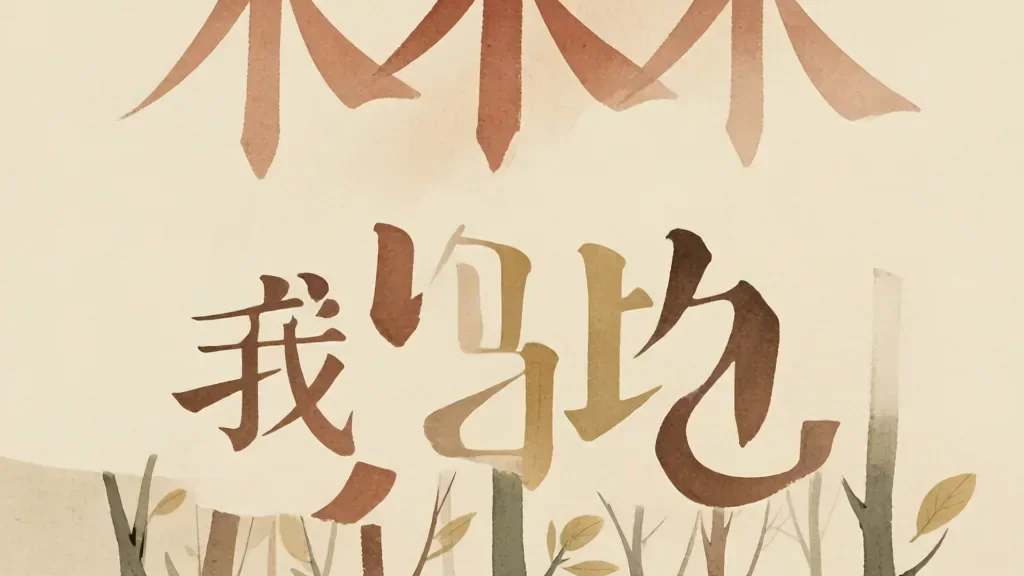
The wood radical, 木 on its own and on the left of compounds, is among the most fertile radicals of the Chinese script. As a standalone character 木 means "tree" or "wood," and as a component it heads a huge family of characters for trees, timber, plants, and wooden objects, as well as for growth, rigidity, and the eastern direction in cosmic theory. In an agrarian civilization where forests, lumber, and farmland shaped daily life, the wood family became both linguistically large and culturally central. This article maps the radical's forms, its semantic range, notable characters, and its place in Chinese cosmology and craft.
The Form of the Radical
The character 木 is a pictograph of a tree: a vertical trunk with branches above and roots below. As a standalone word it means "tree" or "wood." In compounds it usually sits on the left as 木, but it can appear at the bottom (朵, "a cluster of flowers") or surround other parts.
When doubled as 林 (lín) it means "forest," and tripled as 森 (sēn) it means "dense forest," a neat visual buildup from one tree to many. These stacked forms show the pictograph doing double duty as both a word and a multiplier.
Beyond the visible tree, 木 also appears in characters for the results of woodworking and forestry. 案 (àn, a low table or legal case) and 楼 (lóu, a multi-story building) both rely on timber construction, while 枯 (kū, withered) and 植 (zhí, to plant) track the life of plants. The radical thus spans the wild forest, the cultivated field, and the crafted object in a single family, mirroring how wood moved through every stage of classical life, from the standing tree to the finished beam. Learning it opens a large, coherent corner of the vocabulary at once.
The Semantic Field of Wood
The wood radical heads tree and plant words: 树 (shù, "tree"), 枝 (zhī, "branch"), 根 (gēn, "root"), 叶 (yè, "leaf"), 花 (huā, "flower"). It also marks wooden objects: 桌 (zhuō, "table"), 椅 (yǐ, "chair"), 桥 (qiáo, "bridge"), 桶 (tǒng, "bucket").
Further out, it gathers words for cultivation and growth: 材 (cái, "timber, talent"), 植 (zhí, "to plant"). The radical thus spans the living plant, the worked material, and the human activities built upon both.
Trees and Forests
The tree-to-forest buildup is a favorite teaching example. 木 (one tree), 林 (two, a grove), 森 (three, a thick forest) illustrate how Chinese can compound pictographs to scale meaning. Each adds visual density to signal abundance.
Many specific tree names use the radical with a phonetic: 桃 (táo, "peach"), 柳 (liǔ, "willow"), 松 (sōng, "pine"), 柏 (bǎi, "cypress"). The wood radical tells you "this is a tree," while the other half hints at the sound and sometimes the species.
Wooden Objects and Craft
Furniture and tools made of wood naturally carry the radical. 桌 and 椅 are everyday; 梯 (tī, "ladder") and 梳 (shū, "comb") show specialized wooden items. 板 (bǎn, "plank") and 棍 (gùn, "stick") name raw forms of timber.
This cluster reveals a material culture built on wood: before metal and plastic, most utensils were carved or joined from timber. The script preserves that dependency in the radicals of ordinary objects.
Growth, Talent, and Material
The character 材 (cái) means both "timber" and "talent," a famous overlap. Just as wood is the raw material of craft, a person's ability is their inner material — the radical links the two concepts by metaphor.
Similarly 植 (to plant) and 村 (cūn, "village," originally a cluster of dwellings among trees) extend wood into social and agricultural life. The radical is not confined to botany; it reaches into how people build and grow.
Wood in the Five Phases
In the Five Phases (五行), wood (木) is one of the five elements, associated with the east, spring, the color green or blue-green, and the quality of upward, outward growth. Its phase partners are fire, earth, metal, and water in a cycle of generation and control.
This assigns wood a cosmic role: it is the rising, sprouting force of the year's beginning. Medical and calendrical texts use the wood phase to explain temperament and season, so the radical appears in technical as well as rustic vocabulary.
Wood Versus Other Nature Radicals
Wood belongs to the elemental set with 水 (water), 火 (fire), 土 (earth), and 金 (metal). Each heads its family, and together they form the script's elemental backbone. 植物 (zhíwù, "plant") pairs the plant radical 艹 with 物 using 牜... actually 物 uses 牛; the point is that botany spreads across radicals.
A learner should not confuse 木 with the grass radical 艹, which heads smaller plants and herbs. Trees take 木; grasses and flowers often take 艹. Telling them apart is key to correct filing.
The Grass Radical Distinction
Although 花 (flower) and 草 (grass) concern plants, 花 uses 木 while 草 uses 艹. The dividing line is roughly tree-versus-herb, though historical usage is not perfectly consistent. Both radicals together cover the plant kingdom.
This split reflects classical Chinese biological分类: woody plants versus soft-stemmed ones were seen as different kinds, each with its own written family. The script thus encodes a small folk-botany within its radicals.
Wood in Culture and Proverbs
Wood appears in sayings about character and fate. 木讷 (mùnè) describes a slow, plain-spoken person, literally "wooden and reticent." 麻木 (mámù) means numbness, "numb as wood." The substance supplies metaphors for temperament.
Craft traditions — carpentry, joinery, boat-building — gave wood radical words for tools and trades. To know the wood family is to glimpse the workshop and forest that sustained classical life.
Learning the Wood Family
For learners, 木 is a high-value radical because tree and furniture words are frequent. Recognizing it flags "plant or wooden object," a strong clue. Practicing common 木 characters builds rapid recognition across daily vocabulary.
The visual buildup 木→林→森 also makes a memorable lesson in how the script compounds pictures. Few radicals demonstrate the pictographic logic of Chinese as clearly as wood does.
Wood in Architecture
Classical Chinese building was a timber craft, and its key terms carry the wood radical. 柱 (zhù) is a pillar, 梁 (liáng) a roof beam, 栋 (dòng) the main ridge purlin, and 梯 (tī) a staircase. The entire frame of a hall was joined from wood without nails, using brackets (斗拱) to spread weight.
This dependence on wood shaped both engineering and aesthetics: buildings could be flexible against earthquakes yet were vulnerable to fire, and their warm, grained surfaces became a standard of beauty. To read the wood radical in architectural words is to read the skeleton of traditional Chinese construction itself.
❓ Frequently Asked Questions
What does the wood radical look like?
It is 木, a pictograph of a tree, used standalone and on the left of compounds heading tree and wooden-object words.
What characters use the wood radical?
Trees, branches, roots, flowers, furniture, bridges, buckets, and words for planting and talent all use 木.
What is the 木 to 林 to 森 pattern?
It compounds the tree pictograph: one tree, two for a grove, three for a dense forest, scaling meaning visually.
How is wood used in the Five Phases?
Wood is an element linked to east, spring, green, and upward growth, used in medical and calendrical theory.
Wood versus grass radical?
木 marks trees and woody plants; 艹 marks herbs and small plants, a folk-botanical split in the script.
Why does 材 mean both timber and talent?
It metaphorically links raw material for craft with a person's inner ability, both being the "stuff" one is made of.