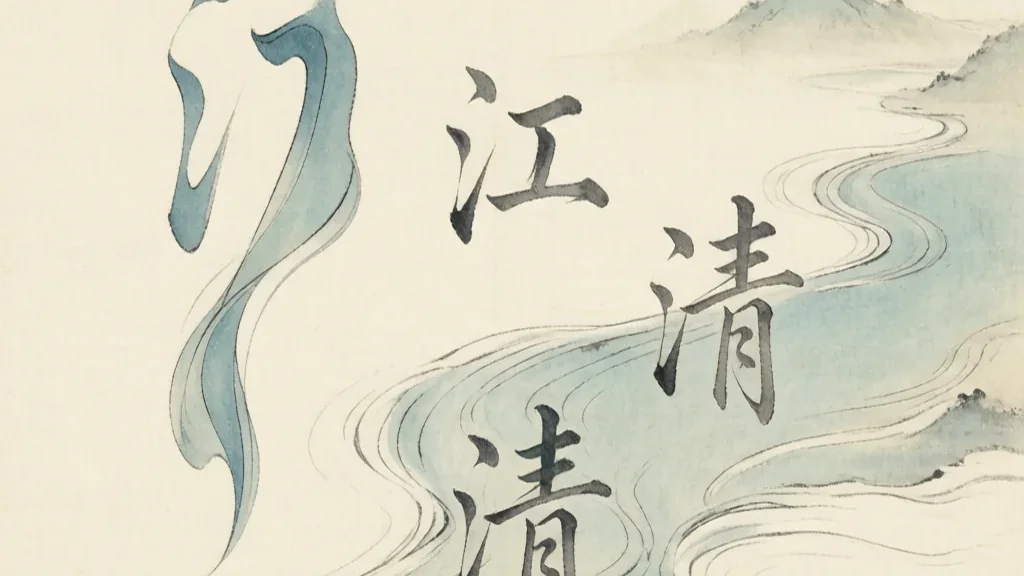
The water radical, 水 on its own and 氵 (the "three-dot water") when sitting on the left of a character, is one of the most productive radicals in the Chinese script. As a standalone word 水 means "water," and as a component it heads a vast family of characters for rivers, seas, rain, washing, swimming, and abstract flows of feeling and fortune. Because water was central to agriculture, transport, and cosmology in classical China, the water family is both linguistically huge and culturally revealing. This article maps the radical's forms, its semantic range, notable characters, and the deeper associations of water in Chinese thought.
Two Faces of the Radical
The water radical has two shapes. As a full character 水 (shuǐ) it stands alone meaning "water," and it appears whole at the bottom of characters like 汞 (gǒng, "mercury") or 泰 (tài, "peace," with water beneath). On the left of compounds it compresses to 氵, three short strokes called "three-dot water."
This split is positional: the same meaning element shows differently depending on where it sits. Learners must recognize both the full 水 and the abbreviated 氵 as the same radical, or they will mis-file characters in the dictionary.
Counting the characters filed under 氵 in a standard dictionary yields several hundred entries, a measure of how water-saturated the vocabulary is. From weather to travel to emotion, the radical threads through daily life: 泳 and 游 name swimming and wandering, 泪 and 泣 name tears and weeping, 温 and 凉 name warmth and coolness. Even 永 (eternal), the calligraphy drill character, contains a water root in its seal form, linking the abstract idea of permanence to a flowing stream. To learn the water radical is thus to learn a large and central slice of the language at once.
The Semantic Field of Water
The water radical heads characters for bodies of water: 河 (hé, "river"), 海 (hǎi, "sea"), 湖 (hú, "lake"), 溪 (xī, "stream"), 江 (jiāng, "large river"). It also marks actions involving water: 洗 (xǐ, "wash"), 泳 (yǒng, "swim"), 浮 (fú, "float"), 渡 (dù, "cross a river").
Beyond the literal, it gathers words for moisture and weather: 汗 (hàn, "sweat"), 泪 (lèi, "tears"), 漏 (lòu, "leak"). The radical thus spans the physical and the bodily, always by the thread of water.
Notable River Characters
Several famous characters are water-radical names of rivers. 江 and 河 name the Yangtze and Yellow Rivers, the two great arteries of Chinese civilization. 淮 (huái), 济 (jǐ), and 汉 (hàn) name other historic rivers that structured the landscape and the states along them.
Because rivers defined regions, many place names and surnames carry the water radical. The character 汉 (Hàn) gave its name to the Han dynasty and thereby to the Han Chinese majority, showing how a water word became an ethnic and historical label.
Abstract and Emotional Flows
Water metaphors flood the abstract vocabulary. 清 (qīng, "clear") and 浊 (zhuó, "muddy") describe both water and moral character; 深 (shēn, "deep") and 浅 (qiǎn, "shallow") apply to water, feeling, and relationship alike.
Words for temperament use water too: 平静 (píngjìng, "calm") relates to still water. The radical lets Chinese express inner states through outer fluid imagery, a hallmark of the language's concrete, embodied style of abstraction.
Water in Cosmology
In the Five Phases (五行, wǔxíng) system, water (水) is one of the five elemental forces, associated with north, winter, the color black, and the quality of flowing downward. Its paired phase-radical characters appear in medical and cosmological texts.
This placement shows water as more than a substance: it is a principle of the cosmos, linked to storage, concealment, and nourishment. The radical therefore sits inside technical as well as everyday vocabulary, from herbology to divination.
Water Radical Versus Other Nature Radicals
Water is one of several nature radicals — alongside 木 (wood), 火 (fire), 土 (earth), and 金 (metal). Each heads its own family, and together they form the elemental vocabulary of the script. 冰 (bīng, "ice") uses a variant of water (冫, "two-dot ice") to mark cold frozen water.
The two-dot ice form 冫 is easily confused with three-dot water but signals cold rather than liquid. Telling 氵 from 冫 is a classic learner trap: 江河 are rivers, 冰冷 are ice-cold.
Water in Place Names and Surnames
Countless Chinese place names contain 水 or 氵 characters, from 上海 (Shànghǎi, "above the sea") to 杭州 (Hángzhōu, on the 杭 river system). Rivers were the original addresses of settlement, so the script remembers them.
Some surnames also carry water imagery, and clan genealogies often explain a surname by a riverside origin. The radical thus threads through geography and identity, not just physics.
Learning the Water Family
For learners, the water radical is an early and friendly friend: once recognized, it flags a character as "about water or flow," which is a strong guess even before the phonetic is known. Practicing a list of common 氵 characters builds quick recognition.
The regular left-position of 氵 also makes scanning easy: most water words line up their radical on the left, so the eye learns to expect it there. This predictability is why radicals speed dictionary lookup and reading alike.
Cultural Legacy
Water's cultural weight appears in proverbs — "water can carry a boat or capsize it" (水能载舟亦能覆舟), a warning about popular support — and in Daoist reverence for yielding water as the model of the sage. The radical carries this philosophy inside ordinary words.
To study the water radical is therefore to study a civilization's relationship with its rivers, rains, and the fluid metaphors by which it understood power, feeling, and the world. The three dots on the left of a character are a small glyph of a whole worldview.
Water in Medicine and Healing
The water radical also heads characters of medicine and care, because healing was long bound to fluids and decoctions. 汤 (tāng) means both "hot water" and "herbal decoction," the standard form of classical medicine. 治 (zhì, "to cure, to govern") pairs water with a phonetic, imagining order brought to what is turbulent like floodwater.
This link runs deep: to treat illness was to harmonize the body's inner waters, and to govern a state was likewise to channel its people as a ruler channels a river. The same radical thus connects the clinic, the apothecary's pot, and the throne, all through the metaphor of managed flow.
❓ Frequently Asked Questions
What does the water radical look like?
It is 水 as a full character and 氵 (three-dot water) on the left of compounds, heading water and flow words.
What characters use the water radical?
Rivers, seas, lakes, washing, swimming, sweating, and abstract flows like clarity and depth all use 氵.
How is water different from ice radical?
Three-dot 氵 means liquid water; two-dot 冫 means ice or cold, as in 冰 and 冷.
Why is water important in thought?
It is a Five-Phase element and a Daoist model of yielding strength, and it supplies metaphors for character and power.
Which famous rivers use it?
江 (Yangtze) and 河 (Yellow River), plus 汉 which named the Han people and dynasty.
How does it help learners?
Spotting 氵 flags a character as water-related, a strong meaning clue even before the phonetic is known.