The Earthly Branches, called 地支 (dìzhī) in Chinese, are a set of twelve characters—子, 丑, 寅, 卯, 辰, 巳, 午, 未, 申, 酉, 戌, 亥—that form one half of the traditional Chinese system for counting time and ordering the cosmos. Paired cyclically with the ten Heavenly Stems (天干), the twelve branches generate the famous sixty-year sexagenary cycle used for years, months, days, and double-hours. Each branch also carries a zodiac animal, a compass direction, and a season, making these twelve characters a compact code for an entire way of mapping reality. This article introduces the branch characters, what they meant originally, and how they still organize calendars and horoscopes today.
What the Earthly Branches are
The twelve Earthly Branches are, in order: 子 (zǐ), 丑 (chǒu), 寅 (yín), 卯 (mǎo), 辰 (chén), 巳 (sì), 午 (wǔ), 未 (wèi), 申 (shēn), 酉 (yǒu), 戌 (xū), 亥 (hài). Together with the ten Heavenly Stems they form the sexagenary (sixty-term) cycle, the backbone of traditional Chinese chronology for more than two thousand years.
Unlike the stems, which are more abstract, the branches were closely tied to observation of the sky and the agricultural year. They name the twelve "double-hours" of the day, the twelve months, and the twelve years of the animal zodiac, so a single branch can mean a time of day, a season, and a creature at once.
The twelve zodiac animals
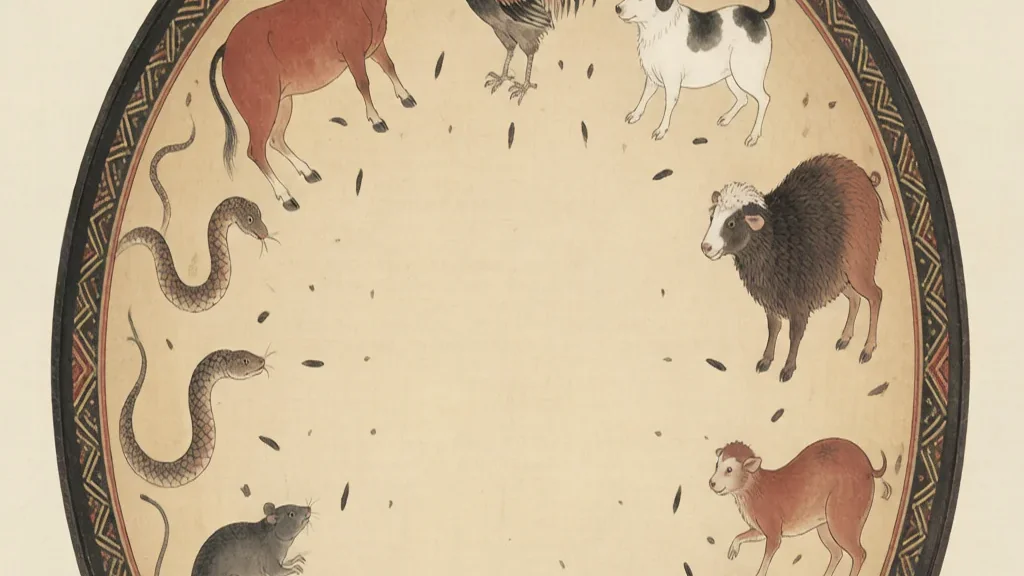
Each branch is linked to a zodiac animal, and this is how most people meet them today: 子 is the Rat, 丑 the Ox, 寅 the Tiger, 卯 the Rabbit, 辰 the Dragon, 巳 the Snake, 午 the Horse, 未 the Goat, 申 the Monkey, 酉 the Rooster, 戌 the Dog, and 亥 the Pig. The year of your birth branch is said to shape personality and fortune.
The animal order is fixed by the well-known legend of the Great Race, in which the animals competed to cross a river and the Jade Emperor assigned them their sequence. Whether or not one credits the tale, the branch-animal pairing is the most widely recognized use of these characters worldwide.
子 and 丑: beginning the cycle
子 (zǐ) opens the cycle and is the branch of the Rat and of the double-hour around midnight (11 p.m.–1 a.m.), when the day is reborn. Its ancient form is a pictograph of a baby or a seed, fitting its role as the "first" and most generative branch. 子 also appears in words for children and seeds.
丑 (chǒu), the Ox branch, covers the small hours before dawn (1–3 a.m.). Its original shape is debated—some read it as a hand or a ritual object—but it became the marker of the second position and, in drama, the name of a clown role (丑角).
寅, 卯, 辰: tiger, rabbit, dragon
寅 (yín), the Tiger branch (3–5 a.m.), is associated with the pre-dawn and with the east-northeast. 卯 (mǎo), the Rabbit branch (5–7 a.m.), was pictured as a double door or window opening to the morning sun, and it marks the spring equinox month. 辰 (chén), the Dragon branch (7–9 a.m.), is a complex character possibly showing a clam or a farming tool, and it governs the third month and the direction east-southeast.
These three branches thus move the day from deepest night through dawn into morning, each tied to an animal and a stretch of time that farmers and astronomers tracked closely.
巳, 午, 未: snake, horse, goat
巳 (sì), the Snake branch (9–11 a.m.), is often read as a coiled snake pictograph. 午 (wǔ), the Horse branch (11 a.m.–1 p.m.), originally depicted a pestle or a crossing, and it marks true noon—the pivot of the day. 未 (wèi), the Goat branch (1–3 p.m.), is pictured as a tree with drooping branches and is linked to late summer and the southwest.
The Horse branch 午 is especially important because "noon" (中午) and the verb "to face" (used in 午睡, afternoon nap) both draw on it; the branch sits at the top of the daily arc.
申, 酉, 戌, 亥: monkey to pig
申 (shēn), the Monkey branch (3–5 p.m.), is sometimes read as a pictograph of lightning or a stretching figure. 酉 (yǒu), the Rooster branch (5–7 p.m.), clearly depicts a wine jar and is the root of characters about fermentation (酒, alcohol). 戌 (xū), the Dog branch (7–9 p.m.), shows an axe or halberd shape, while 亥 (hài), the Pig branch (9–11 p.m.), closes the cycle and was pictured as a child or a root, signaling completion.
These closing branches carry the evening and night, and 酉's wine-jar shape is a favorite example of how a branch character also seeded a whole family of related meaning.
The sexagenary cycle with the Heavenly Stems
The branches are rarely used alone for years; instead they combine with the ten Heavenly Stems in sequence, so stem 1 (甲) meets branch 1 (子) as 甲子, then 乙丑, 丙寅, and so on. Because 10 and 12 share no common factor but their least common multiple is 60, the pairings repeat every sixty terms—the sexagenary cycle.
A given year is therefore named by its stem-branch pair (e.g., 壬寅年), and this nomenclature appears on calendars, on fortune-telling slips, and even on old coins and official documents. The branches supply the "slot," the stems the "flavor."
Branches for time, months, and direction
Beyond years, the branches named the twelve double-hours (时辰), the twelve months (with 寅 as the first month of spring in some systems), and the twelve compass directions. A compass could be divided into twelve branch-sectors, and a person's "birth chart" (八字, bāzì, the "eight characters") records the stem-branch of their year, month, day, and hour of birth.
This tight linking of branch to time and space is why the twelve characters feel less like words and more like coordinates—a way to place any event in the cosmic grid.
Modern legacy
The Earthly Branches survive in everyday life through the zodiac, the lunar calendar, and the still-common habit of naming the year by its animal. Lunar New Year decorations announce the incoming branch-animal, and people still speak of someone as "a Dragon" or "a Rabbit."
For students of characters, the twelve branches are a fascinating set: some are transparent pictographs (酉, the wine jar), others obscure (辰, 申), and all of them reward close look at how abstract time was made visible in writing.
❓ Frequently Asked Questions
What are the Earthly Branches used for?
They number the twelve years of the zodiac, the twelve double-hours of the day, the twelve months, and the twelve compass directions, and they combine with the Heavenly Stems to form the sixty-year sexagenary cycle.
How do the branches relate to the Heavenly Stems?
The ten stems and twelve branches are paired in sequence; because their least common multiple is sixty, the pairs repeat every sixty terms, giving each year a stem-branch name such as 甲子 or 壬寅.
Which animal goes with each branch?
Rat(子), Ox(丑), Tiger(寅), Rabbit(卯), Dragon(辰), Snake(巳), Horse(午), Goat(未), Monkey(申), Rooster(酉), Dog(戌), Pig(亥).
Are the branch characters pictographs?
Some are transparent pictures—酉 is a wine jar, 巳 a coiled snake—while others like 辰 and 申 have debated or obscure origins, but all are ancient forms fixed by the Han period.
What is a birth chart (八字)?
It records the Heavenly-Stem/Earthly-Branch pair for a person's birth year, month, day, and hour—eight characters in total—used in traditional fortune calculation.
Do people still use the Earthly Branches today?
Yes; the zodiac animal year is announced every Lunar New Year, and the branch-animal identity remains common in daily conversation and culture across East Asia.