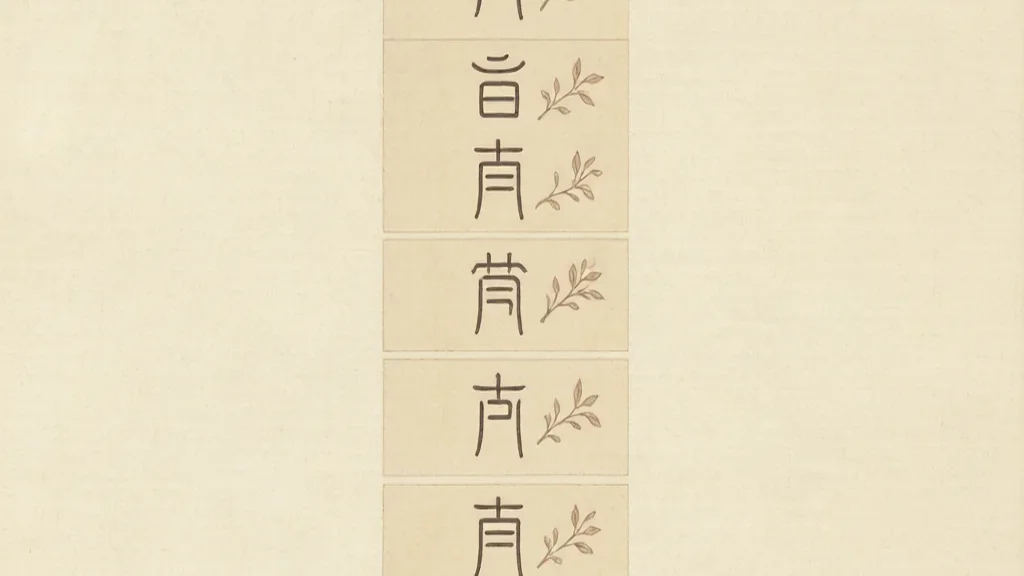
The Heavenly Stems (天干, tiāngān) are a set of ten cyclical characters that, together with the twelve Earthly Branches, form the backbone of traditional Chinese calendrics, divination, and ordinal numbering. Individually they are 甲, 乙, 丙, 丁, 戊, 己, 庚, 辛, 壬, 癸 — pronounced jiǎ, yǐ, bǐng, dīng, wù, jǐ, gēng, xīn, rén, guǐ. Long before they indexed years, the stems served as day-counts in Shang royal divination and as a lexical skeleton for naming everything from reign periods to medicinal herbs. Understanding these ten signs opens a window onto how the Chinese imagined time not as a straight line but as a rotating wheel of paired symbols, a system still quietly alive in almanacs, astrology, and the bones of the language itself.
Origins in the Shang Dynasty
The earliest secure attestation of the ten stems comes from oracle bone inscriptions of the late Shang period (roughly the thirteenth to eleventh centuries BCE). On turtle plastrons and ox scapulae, scribes recorded divinations "on the jiǎ day" or "on the yǐ day," proving the stems already functioned as a ten-day week — a xún (旬) — long before written histories existed. The characters most likely began as tallies or as labels for ancestral spirits and directions, only later hardening into the abstract cycle we know.
Because each Shang king and ancestor was routinely addressed by a stem name (the "Wǔ Dīng" lineage, for instance), the ten signs carried deep ritual weight. They were never merely numbers; they were persons, powers, and positions in a cosmological order. This sacral quality helps explain why the stems resisted replacement by plain numerals even as mathematics advanced.
The Ten Signs and Their Sequence
The canonical order is fixed and must be memorized as a single string: 甲乙丙丁戊己庚辛壬癸. Traditionally the odd-numbered stems (甲, 丙, 戊, 庚, 壬) are classed as yáng (阳, active), while the even ones (乙, 丁, 己, 辛, 癸) are yīn (阴, receptive). This pairing anticipates the yin–yang logic that pervades later Chinese thought, letting the stems double as a compact model of alternating force.
Each stem also acquired a bundle of associated meanings in correlative cosmology: 甲 marks the first, the shell of a seed, the east, and spring; 丙 links to fire and brightness; 壬 to water and flow. Medieval technical literature — on acupuncture points, the sexagenary "na yin" tones, or the "ten heavenly stems hiding" (shi gan qi cai) of fengshui — leans heavily on these associations.
Pairing with the Earthly Branches
On their own the ten stems cannot mark a full year or month, so they were interlaced with the twelve Earthly Branches (地支, dìzhī): 子丑寅卯辰巳午未申酉戌亥. The two series are combined so that each year, month, day, and hour receives a paired "stem-branch" label. Because ten and twelve share only a factor of two, a given stem meets a given branch only once every sixty combinations, producing the famous sexagenary cycle.
This gānzhī (干支) pairing is the true engine of the traditional calendar. A person's birth "eight characters" (bā zì) are simply the four stem-branch pairs for year, month, day, and hour, still consulted by fortune-tellers today. The same labels once stamped imperial reigns and official documents, anchoring administration to cosmic rhythm.
The Sexagenary Cycle in Practice
The sixty-term round — beginning 甲子, 乙丑, 丙寅… and ending 癸亥 — repeats without end. Historians can date events centuries apart by naming the cycle year; the system is internally consistent back to the Han and is invoked, with care, even for Shang materials. A notable modern echo is the year 1984, a 甲子 year, and 2044 the next.
Because the cycle is positional, two people born sixty years apart "share" a stem-branch year, a fact celebrated in elder birthdays. The rotating wheel also structures the traditional almanac (tōngshū), which advises on auspicious days by reading the stem-branch against the deity of the day.
Calendrical and Administrative Use
Beyond years, the stems tag months, days, and the twelve double-hours. Day-counting by stems is especially ancient: Shang diviners already used a ten-day xún, and the Han "day stems" survive in idioms like 甲子日. Imperial reign titles (nián hào) were often chosen to harmonize with the current stem, while astronomers logged eclipses and novae against the cycle for precision.
In daily administration the system gave every record a checksum. A document dated "guǐwèi day, third month" could be cross-filed and verified against the reign calendar — a low-tech but robust integrity mechanism across a vast bureaucracy that left no stone (or bone) unlabeled.
Evidence from Bones and Bronzes
Oracle bones show the stems already standardized, while Western Zhou bronze inscriptions use them to date cast vessels and to name honored ancestors. The character shapes evolved from angular bone forms to the rounded seals and finally the regular script, yet the underlying ten-sign list never budged. That stability is a rare constant in three thousand years of writing.
Scholars such as Dong Zuobin, who reconstructed Shang chronology from bone day-counts, leaned on the stems to build a relative timeline of kings. The fact that a scribe's "jiǎ day" lines up consistently across thousands of fragments is itself proof of a disciplined, centralized calendrical science.
Astrology, Medicine, and Daily Life
In Chinese medicine the stems map onto the "ten heavenly stem energies" that some schools use to interpret constitution and pulse. In fengshui the "hidden stems" of a house's sitting direction are read for fortune. Folk almanacs still print the daily stem-branch and warn against, say, "breaking ground on a 戊 day." The signs are woven into the texture of ordinary caution.
Even language learners meet them early: 甲乙丙丁 is the Chinese equivalent of "A, B, C, D" for listing items, and 丁 is the familiar grading tier in "丁级" lower-ranked things. The stems thus live on as a default ordinal scheme whenever speakers want a neutral, traditional sequence.
Modern Survival in the Language
Although the Gregorian calendar governs public life, the stems and branches appear on lunar-new-year prints, in horoscope apps, and in the names of typhoons and sporting-event years in some contexts. Calligraphers still practice the ten-character string as a warm-up, and designers borrow 甲子 motifs for retro branding.
The ten signs also anchor technical jargon: 甲基 (jiǎ jī) is the "methyl" group in chemistry, 乙 (yǐ) marks the second carbon, 丙 the third — a neat survival where western science borrowed the stem order as a labeling convention. The bones of an ancient calendar now index molecules.
Learning the Stems Today
Memorizing the ten stems is a manageable first step for any student of Chinese culture. Mnemonics help: the list can be sung to a tune, or associated with the fingers of both hands in traditional counting gestures. Once internalized, the stems unlock the logic of the sexagenary cycle and make classical dates legible.
More importantly, they reveal a worldview in which time is cyclical, correlated, and named rather than numbered. To know 甲乙丙丁 is to hold a small key to the Chinese imagination — one that turns smoothly in the lock of history, medicine, and metaphor alike.
❓ Frequently Asked Questions
What are the Heavenly Stems?
They are ten characters — 甲乙丙丁戊己庚辛壬癸 — used in pairs with the twelve Earthly Branches to count years, months, days, and hours in traditional China.
How do the stems differ from the Earthly Branches?
The stems are ten in number and carry yin–yang and elemental associations, while the branches are twelve and align with animals and directions; together they form the sixty-term cycle.
Why is the cycle sixty years long?
Ten and twelve share only the factor two, so a given stem meets a given branch once every sixty combinations before the pattern repeats.
Yes. The stems appear on lunar-new-year prints, in horoscope and fengshui apps, and as a default A-B-C-D style list in speech.
Are the Heavenly Stems still used today?
Where do I see the stems in modern Chinese?
In phrases like 甲乙丙丁 for listing, in the "eight characters" of birth astrology, and in chemical naming conventions for carbon chains.
How old is the stem system?
It is attested on Shang oracle bones from the late second millennium BCE, making it over three thousand years old and remarkably stable.