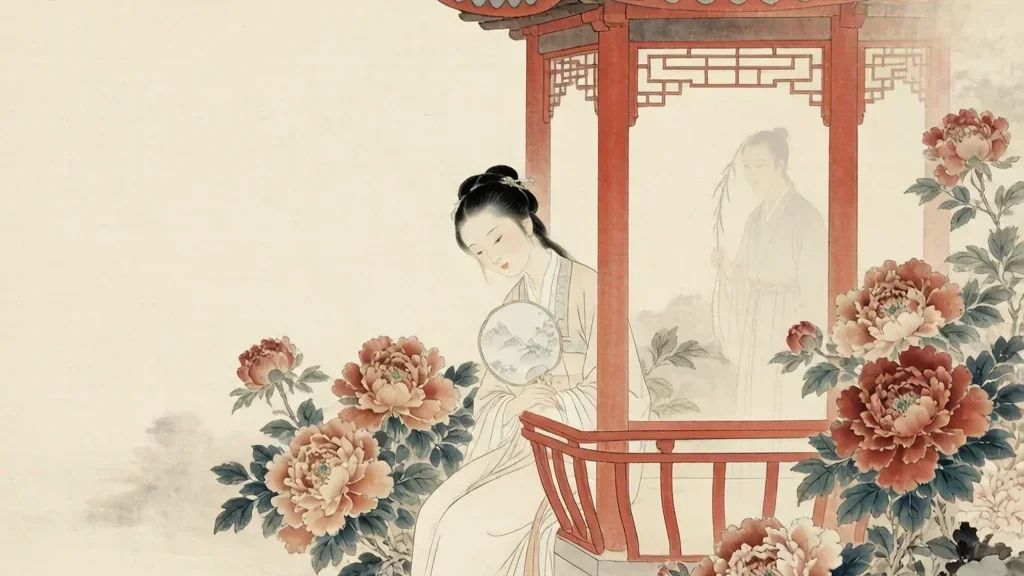
What if love were so strong it could wake the dead? Mudan Ting, "The Peony Pavilion," asked exactly that in 1598 and changed Chinese theatre forever. Written by Tang Xianzu at the height of the Ming dynasty, it is a fifty-five-scene opera about a girl who falls in love in a dream, pines to death for the stranger she met, and is brought back to life when that very young man finds her portrait. For English readers, "The Peony Pavilion" is the supreme achievement of Chinese romantic drama — a work that treats desire not as sin but as a force of nature, and that dares to say the heart's longings are more real than the rules that suppress them.
The Playwright: Tang Xianzu
Tang Xianzu (1550–1616) was a scholar, official, and dramatist from Jiangxi who, like many gifted men, chafed under the examination-and-court system. He held minor posts, offended powerful patrons, and retired early to write. "The Peony Pavilion" is the second and greatest of his "Four Dreams" — plays built around dreams that blur the line between sleeping and waking, illusion and truth. Tang was a literary rival in spirit to the great Shakespeare, and the two were near-contemporaries; both used the stage to explore love, identity, and the fluid self.
Tang's language is famously lush and difficult, packed with allusion and musical subtlety. He cared more for emotional truth than for tidy plot, and "The Peony Pavilion" shows that priority everywhere: the dream is treated as more vivid than the waking world, and the dead girl's longing is the most alive thing on stage.
The Story: A Dream That Kills and Heals
The heroine, Du Liniang, is a sheltered sixteen-year-old confined by her strict Confucian father. A spring day, a stroll in the garden, and a nap by the peony pavilion bring a dream of a handsome stranger, Liu Mengmei, who makes love to her among the flowers. She wakes to find the garden empty and the dream unbearably real. She paints a self-portrait, inscribes it with longing, and wastes away from love-sickness, dying before she ever meets the man. Her grieving father builds a shrine; her tutor paints a "picture of the fallen lady."
Years pass. Liu Mengmei, a poor scholar, happens to lodge near her grave and discovers the portrait; he falls in love with the painted girl. Du Liniang's ghost visits him, they consummate their love, and with his help she is resurrected — the grave opens, and she returns to the living. The play's long comic-bureaucratic finale, in which the doubting father and the emperor must confirm the miracle, turns the private dream into public fact.
Themes: Love as a Cosmic Force
The play's famous credo is that "love does not spring from nothing; it reaches deep enough to bring the living to death, and the dead back to life." This is a radical claim in a culture that officially prized restraint, filial duty, and social order. Tang makes desire the engine of the cosmos, a power that can override even death and the grave. Du Liniang's love-sickness is not a disorder to be cured but a truth to be honored; her return from death is the universe correcting an injustice.
There is also a feminist edge. Liniang's confinement — physical and mental — is the real death; the garden dream is her first taste of freedom. By dying and choosing to return on her own terms, she asserts a self her society denied. The play quietly argues that the rules meant to protect young women were often the things that killed them.
Form: Chuanqi Drama and the Power of Song
"The Peony Pavilion" is a chuanqi, the southern musical drama that dominated the late imperial stage, with dozens of scenes and arias set to southern tunes. Its words were written to be sung, and the arias carry the emotion the prose only frames. The famous scene "A Walk in the Garden" and its reprise "The Interrupted Dream" are performed alone to this day, the singer conveying longing through melody as much as text.
The length — fifty-five scenes — was normal for chuanqi, meant for all-day or multi-day performance. Modern stagings usually cut drastically, but the full work's leisure lets Tang dwell on a single feeling until it becomes luminous. The form itself enacts the play's theme: give love time and space, and it will not be rushed or contained.
Reception and the Cult of the Play
From the start "The Peony Pavilion" was a sensation. Legend tells of women readers so moved they fell ill or died — a real echo of Liniang's fate — and of a devoted fan, the young woman Yu, who traveled to Tang's door and is said to have died of disappointment at not meeting him. Such stories show how powerfully the play spoke to precisely the confined, longing women it portrayed. It became a touchstone of the "cult of qing," the late-Ming celebration of feeling over doctrine.
In the twentieth and twenty-first centuries the play has been revived in full, translated, and filmed, including a celebrated all-female Kunqu production. Its reputation as the pinnacle of Chinese romantic theatre is secure, and scholars rank Tang Xianzu beside Shakespeare as a dramatist of the inner life.
Why It Still Matters
"The Peony Pavilion" matters because it took desire seriously at a time when seriousness belonged to duty. By letting a girl die of a dream and return for love, Tang asserted that the heart's truths are not lesser than the state's truths. The play is also a feast of language, a demonstration that Chinese theatre could be at once philosophically bold and achingly beautiful. For readers new to Chinese drama, it is the perfect summit: climb here and you see the whole landscape — the garden, the grave, the portrait, and the lover who crosses the boundary of death because a dream told him to. Love, Tang insists, is the one law that needs no emperor's seal.
Kunqu and the Music of the Play
The Peony Pavilion was composed as a chuanqi for the Kunqu stage, and its words were written to be carried by melody rather than read in silence. Kunqu singing is slow, ornamented, and intimately tied to the meaning of each syllable, so a single aria can unfold for minutes as the performer shapes a single feeling. The famous garden scenes depend on this music: the longing of Du Liniang is conveyed as much by a held note as by a line of text. Because the form demands both literary polish and vocal training, the play has always belonged to performers as much as to readers. Modern full stagings still use Kunqu vocal technique, which is why the work survives not only as literature but as a living operatic art.
The Play in Modern Adaptation
The Peony Pavilion has proven unusually adaptable across the last century. Full-length Kunqu productions, sometimes running more than eight hours, have toured internationally and won new audiences, while shortened versions keep the garden and dream scenes at the center. Filmed and recorded performances, including celebrated all-female casts, have carried Tang's romance beyond the opera house. Scholars and directors alike return to it as a founding text of Chinese feminist reading, since Liniang's assertion of self speaks to modern questions of choice and identity. Far from being a museum piece, the play keeps generating fresh stagings, translations, and interpretations, each generation finding in its love-death-resurrection plot a mirror for its own ideas about feeling and freedom.
❓ Frequently Asked Questions
📝 Chinese Vocabulary
牡丹亭 — : The Peony Pavilion, Tang Xianzu's great romantic drama.
汤显祖 — : Tang Xianzu, the Ming playwright who wrote it.
杜丽娘 — : Du Liniang, the heroine who dies of love and returns to life.
情 — : Feeling, passion, or love — the force the play exalts above doctrine.
传奇 — : Chuanqi, the southern musical drama form of the play.
昆曲 — : Kunqu, the refined southern operatic style in which The Peony Pavilion was written to be sung, and a UNESCO-recognized intangible heritage.
临川四梦 — : The Four Dreams of Linchuan, Tang Xianzu's four dream-centered plays, of which The Peony Pavilion is the greatest.
游园惊梦 — : A Walk in the Garden and The Interrupted Dream, the two famous scenes still performed alone as a showcase of the play's longing.
🎉 Fun Facts
- Tang Xianzu wrote the play in 1598, the same era Shakespeare was writing his great tragedies.
- Legend says some women readers were so moved by the play they fell ill or died, mirroring the heroine's fate.
- Only two scenes — "A Walk in the Garden" and "The Interrupted Dream" — are still performed regularly on their own.
- The play helped launch the late-Ming "cult of qing," which prized feeling over Confucian doctrine.
- The Kunqu style in which The Peony Pavilion is sung was proclaimed a Masterpiece of the Oral and Intangible Heritage of Humanity by UNESCO in 2001, a tribute to its six-century-old musical tradition.
- Tang Xianzu finished the play in 1598 and ranked it first among his Four Dreams; it remained the most staged of his works for centuries and is still revived in full today.