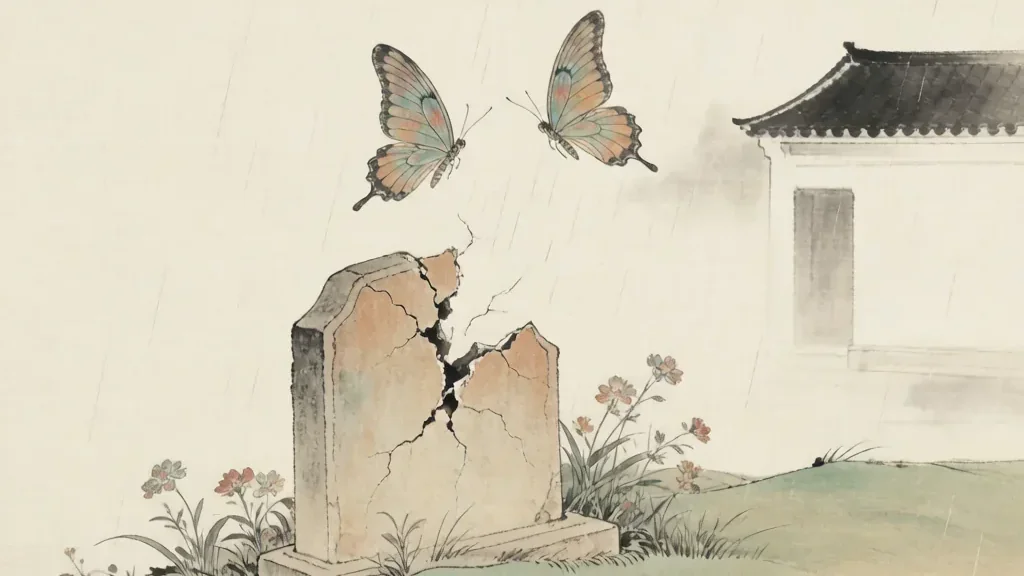
Of all China's love stories, none ends more purely than the one where the lovers simply grow wings. Liang Zhu, known in English as "Butterfly Lovers," is one of the four great Chinese folktales and arguably the most beloved. It tells of a girl who disguises herself as a boy to attend school, befriends a classmate who never suspects she is female, and loses him to fate and a forced marriage — only to be reunited with him at last as a pair of butterflies. For English readers it is China's "Romeo and Juliet" with a difference: here death is not the end but the transformation, and the grave opens into wings.
The Tale's Beginnings
Like most great folktales, "Liang Zhu" has no single author. It emerged from the oral culture of the lower Yangzi, with the earliest written echoes in the Tang dynasty and a settled shape by the Ming and Qing. Local gazetteers around Zhejiang and Jiangsu claimed real tombs and hills as the lovers' own, and villagers told of butterflies rising from their grave. The story belonged to the people long before it belonged to books, passed down by storytellers, balladeers, and opera troupes who polished its emotional beats.
What gave the tale staying power was its mixture of the everyday and the miraculous. School friendship, a father's marriage order, a graveside suicide — these are ordinary injustices. The butterflies are the wish beneath them: that love, denied in life, might at least fly free in death.
The Story: A Girl in Boys' Clothes
Zhu Yingtai is a bright, restless girl whose family will not send daughters to school. She disguises herself as a young man and travels to study, where she meets Liang Shanbo, a gentle, bookish fellow student. For three years they share a desk and a room, and Liang never guesses his closest friend is a woman. When family calls Zhu home, she hints at a "sister" she wants Liang to meet, promising a match. Liang, slow to understand, arrives too late: Zhu has been promised to a wealthy man, Ma Wencai. Heartbroken, Liang falls ill and dies.
On her wedding day, Zhu asks the procession to stop at Liang's tomb. She pours out her grief; the earth splits, and she leaps in to join him. From the grave rise two butterflies that circle each other and never part — the lovers transformed, finally free of families, class, and death itself.
Themes: Gender, Friendship, and Resistance
The disguise is the tale's engine and its sharpest comment. Zhu Yingtai wants what her society denies women — education, travel, the company of minds — and she takes it by borrowing a male identity. The poignancy is that the disguise works too well: the one person she loves cannot see her. The story thus sits on the boundary of gender, asking what is really hidden when a girl pretends to be a boy, and what is lost when love cannot cross the lines drawn by family and rank.
It is also a protest against arranged marriage. Zhu's father binds her to a richer, higher family; Liang dies of a love he was never allowed to claim. The butterflies are small revenge on a social order that treated daughters as alliances. In later performances the grave-splitting scene became the emotional climax, a moment of pure defiance aimed at every parent who valued status over a child's heart.
From Folktale to Violin Concerto
"Butterfly Lovers" found its widest modern audience through art music. The "Butterfly Lovers Violin Concerto" of 1959, by He Zhanhao and Chen Gang, weaves operatic and folk melodies into a Western form, telling the whole story in sound. It became the single most famous piece of modern Chinese orchestral music, introducing the legend to listeners who never read a line of it. The concerto shows how thoroughly the tale had entered the national bloodstream.
The story also thrives in Yue opera, where the meeting, the parting, and the tomb scenes are performed with stylized grace. Each generation re-costumes the lovers — Ming robes, Republican school uniforms, even modern dress — while the shape of the feeling stays constant. The butterflies are infinitely adaptable because they stand for something everyone recognizes.
Why Butterflies, Not Ghosts
Chinese storytelling has many revenants — ghosts who return to right wrongs — but "Liang Zhu" chooses transformation over haunting. The butterflies are not a loophole in death; they are a new kind of life, weightless and equal. This soft ending may be why the tale feels gentler than "Romeo and Juliet" even as it shares the same grief. The lovers do not merely die; they change form and keep company, suggesting that some bonds outlast the bodies forced to contain them.
There is also a quiet ecological tenderness in the image. The grave, a place of ending, becomes a birthplace for wings. The tale asks us to imagine death not as a wall but as a chrysalis. That hope, modest and luminous, is probably why villagers for centuries claimed to see the butterflies themselves above the lovers' mound.
Legacy and Lasting Meaning
Today "Butterfly Lovers" is shorthand in Chinese culture for devoted, thwarted, transcendent love. It appears in film, animation, advertising, and schoolbooks, and it travels well: the violin concerto has been performed worldwide. For readers coming from the West, it offers a useful contrast with familiar tragic romance. Where Shakespeare's lovers lie dead in a tomb, China's rise from the tomb as living wings — a different answer to the same question of whether love can survive the world's cruelty.
The legend endures because it holds two truths at once: that society will try to arrange our lives for us, and that some connections are stronger than arrangement, stronger even than death. Zhu Yingtai's leap and Liang Shanbo's answer in the air remain the most graceful rebellion in Chinese folklore — proof that the smallest, frailest creature can carry the largest human hope.
Stages of the Lovers
Long before film, the story lived on stage. Yue opera made the meeting, parting, and tomb scenes staples of the repertoire, with actresses often playing both leads in an all-female tradition that suited the tale's gender play. Storytellers and balladeers carried it through villages, adjusting the wording but keeping the emotional beats: the disguise, the missed hints, the graveside leap. Regional forms from Sichuan to Cantonese added local music and costume. Because the plot is short and the feelings large, it fits almost any medium, which helped it spread far beyond its lower Yangzi birthplace into a genuinely national legend performed in many tongues.
The Butterfly's Many Meanings
The butterfly that closes the tale has taken on a life of its own in Chinese culture. Beyond the lovers, it evokes freedom from constraint, the soul's survival after death, and the fragile persistence of joy, echoing older images such as Zhuangzi's dream of the butterfly. Artists paint paired butterflies as emblems of devoted love, and the motif appears on wedding goods and festival art. In this way a local folktale's ending became a portable symbol, reusable for any occasion that honors lasting affection. The wings thus carry more than two lovers: they carry a whole vocabulary of hope that death and social rules cannot cancel.
❓ Frequently Asked Questions
📝 Chinese Vocabulary
梁山伯与祝英台 — : Liang Shanbo and Zhu Yingtai, the Butterfly Lovers.
祝英台 — : Zhu Yingtai, the girl who disguises herself as a boy to study.
梁山伯 — : Liang Shanbo, the gentle classmate who loves her without knowing her secret.
化蝶 — : "Transforming into butterflies," the tale's famous ending.
同窗 — : "Same window," a classical term for schoolmates who studied together.
马文才 — : Ma Wencai, the wealthy man to whom Zhu Yingtai is promised in marriage.
越剧 — : Yue opera, the regional form most closely associated with the tale.
十八相送 — : The Eighteen Send-offs, the farewell scene heavy with missed signals.
🎉 Fun Facts
- The Butterfly Lovers Violin Concerto (1959) is the most performed modern Chinese orchestral work abroad.
- Zhu Yingtai is one of China's four great folktale heroines, alongside the White Snake's Bai Suzhen.
- Local traditions in Zhejiang claim actual tombs and butterfly-haunted mounds for the lovers.
- The story has been restaged in settings from Ming costumes to modern school uniforms without losing its shape.
- The story is counted as one of the four great Chinese folktales, alongside the White Snake, the Cowherd and Weaver Girl, and the Legend of Meng Jiangnu.
- In the opera and ballad versions, Zhu Yingtai often drops hints about her true sex during the journey home, which Liang misses until it is too late.