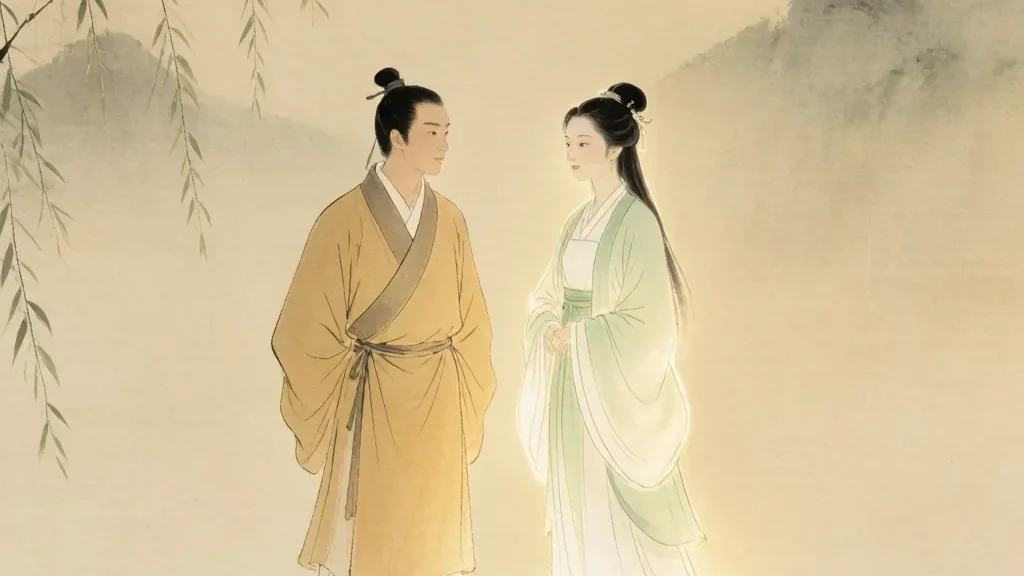
Some love stories are told to make us sigh; the legend of the White Snake was told to make us question where humanity ends and the natural world begins. Baishe Zhuan, "The Legend of the White Snake," is one of China's four great folk tales, the story of a thousand-year-old white snake spirit who takes human form, falls in love with a mortal pharmacist, and battles a jealous monk to keep him. Across centuries it has lived as oral tale, drama, novel, and film. For English readers it is a fairy tale with teeth — about devotion, transformation, and the suspicion that those who love most fiercely may not be human at all.
Origins in Oral Tradition
The tale grew from the storytellers' booths and local cults of the lower Yangzi region, especially around Hangzhou's West Lake and the town of Zhenjiang. Its earliest written traces appear in the Ming dynasty, and it was fleshed out in Qing-era plays and the novel "The Three Paths of the White Snake." Unlike courtly literature, this was popular entertainment shaped by audiences who wanted both wonder and feeling. The setting — misty lakes, rainy bridges, tea houses — is as much a character as the people, grounding the fantasy in a real, beloved landscape.
Over time the snake woman changed from a dangerous demon into a wronged lover. That shift is the tale's whole emotional engine: the monster becomes the heroine, and the pious monk becomes the villain. The story's moral center moved as it was retold, proof that folk narratives are living things.
The Story: A Meeting on the Bridge
In the best-known version, a white snake spirit named Bai Suzhen, having cultivated magical power for a millennium, takes the shape of a beautiful woman and descends to the human world with her companion, the green snake Xiaoqing. On the Broken Bridge during a rainstorm she meets Xu Xian, a kind young pharmacist, and they marry. Their drugstore prospers and they seem a happy couple — until the Buddhist monk Fahai decides that a demon has no right to human love and sets out to separate them.
Fahai tricks Xu Xian into believing his wife is a serpent and urges him to give her a wine that forces her true shape. Horrified, Xu Xian falls ill or dies of shock, and Bai Suzhen, now pregnant, braves the mountain to steal a magical herb to revive him. When Fahai later imprisons Xu Xian in a monastery, she floods the monastery with the aid of the water spirits to rescue him — an act that seals her as a rebel against heaven's enforcer.
Themes: Love Across the Species Line
At its core the legend asks what makes a person. Bai Suzhen is a snake, yet she loves, labors, and suffers more faithfully than the humans around her. The monk Fahai, supposedly holy, is driven by a rigid purity that cannot tolerate difference. The story thus pits compassionate, embodied love against cold doctrine — and lets the reader side with the serpent. It is one of China's most moving arguments that humanity is measured by devotion, not by birth.
There is also a feminist charge. Bai Suzhen defies the heavenly order, the monastic authority, and the social rules to claim a life and a husband of her choosing. She is active where women in official tales are passive, and her power is not punished as mere wickedness but mourned as tragic. The tale gives its female spirit more agency than many "respectable" heroines ever get.
The Famous Endings
Different versions end differently, and the ending carries the moral. In one, Fahai traps Bai Suzhen under the Leifeng Pagoda by West Lake, separating mother from the child she has just borne; the pagoda becomes a symbol of unjust confinement, and later reformers literally called for its destruction as a stand-in for oppressed women. In gentler versions, the son grows up, excels in exams, and frees his mother, reuniting the family. The contrast shows how the tale could be both protest and comfort.
The Leifeng Pagoda was real, standing at Hangzhou until it collapsed in 1924. Its fall was widely read as a small victory for the white snake — a folk story reaching out and toppling its own prison. That overlap of fiction and stone is part of why the legend feels so alive.
Stage, Screen, and Living Symbol
"The Legend of the White Snake" became a staple of regional opera, especially the Yue opera, where the scenes on the Broken Bridge are performed as love duets of great delicacy. In the twentieth century it was filmed and televised repeatedly, each era finding its own meaning: romance, resistance to authority, or the pain of divided identity. The image of the white and green snakes endures as a symbol of loyal friendship and transgressive love.
The tale also fed a wider cultural grammar about spirits who are more human than humans. Alongside "Butterfly Lovers" and "Lady Meng Jiang," it forms part of a folk canon that lets ordinary people imagine love stronger than death, law, or even species. For readers new to Chinese storytelling, the white snake is the perfect entry: familiar as any fairy tale, yet distinctly Chinese in its lakes, its pagodas, and its gentle suspicion of the pious.
Why the White Snake Endures
The legend survives because it refuses to choose between wonder and feeling. It gives us magic and a marriage, a monk and a monsoon, a prison and a child who grows up to open it. More than that, it keeps asking a question modern audiences still feel: who gets to be called human, and who decides? By making the answer a loving serpent and a rigid monk, the tale takes a side that has pleased crowds for four hundred years. To read the White Snake is to watch a monster become a wife, a wife become a rebel, and a rebel become a symbol — all in the rain on a single bridge.
Xu Xian, the Mortal Husband
Xu Xian is the story's anchor in ordinary humanity. A gentle pharmacist who runs a small shop, he is kind, a little naive, and genuinely in love, which makes his betrayal, when Fahai tricks him into seeing his wife's true shape, all the more painful. His weakness is not cruelty but suggestibility: he believes the monk, frightens himself, and collapses, and only later is restored by Bai Suzhen's desperate act to save him. In the best versions he grows across the tale, moving from passive husband to a man who must choose between doctrine and the wife who loves him. By giving the mortal real fears and a real arc, the legend keeps the fantasy believable; the serpent may be magical, but the husband is someone the audience recognizes, which is why his choice carries the story's moral weight.
Animal Spirits in Chinese Folklore
The white snake belongs to a wide family of Chinese tales in which animals cultivate spiritual power and take human form. Fox spirits, rabbit immortals, and snake ladies populate the folklore, usually testing the boundary between the human and the natural world. What makes Bai Suzhen unusual is that her transformation serves love rather than mischief; she is the monster who turns out more humane than the holy man. This pattern, the animal who surpasses humans in feeling, recurs in tales of fox wives and bird maidens across China. The White Snake became the most famous of them because it balances wonder with a domestic marriage plot. Reading it among its kind shows how Chinese storytelling uses animal spirits not just for fright but for asking who truly deserves to be called human.
❓ Frequently Asked Questions
📝 Chinese Vocabulary
白蛇传 — : The Legend of the White Snake, one of China's four great folk tales.
白素贞 — : Bai Suzhen, the white snake spirit who becomes a devoted wife.
法海 — : Fahai, the monk who opposes the snake woman's human love.
断桥 — : The Broken Bridge on West Lake where the lovers first meet.
雷峰塔 — : Leifeng Pagoda, where Bai Suzhen is imprisoned in many versions.
许仙 — : Xu Xian, the kind mortal pharmacist who marries Bai Suzhen.
小青 — : Xiaoqing, the green snake spirit and loyal companion of Bai Suzhen.
西湖 — : West Lake in Hangzhou, the misty setting where the lovers meet.
🎉 Fun Facts
- The White Snake is one of China's "four great folktales," alongside Butterfly Lovers, Lady Meng Jiang, and the Cowherd and Weaver Girl.
- The real Leifeng Pagoda at Hangzhou collapsed in 1924, widely celebrated as the white snake's symbolic liberation.
- Bai Suzhen's companion is a green snake spirit named Xiaoqing, her loyal ally through every version.
- The tale shifted over centuries from "dangerous demon" to "wronged lover," showing how folk stories evolve with their audiences.
- The White Snake is one of the most staged works in Chinese opera, with the Broken Bridge scene considered a showcase for lead actresses in Yue, Kun, and Peking opera.
- Modern retellings range from lavish television dramas to a popular animated film, showing the legend still speaks to audiences about love, identity, and standing up to authority.