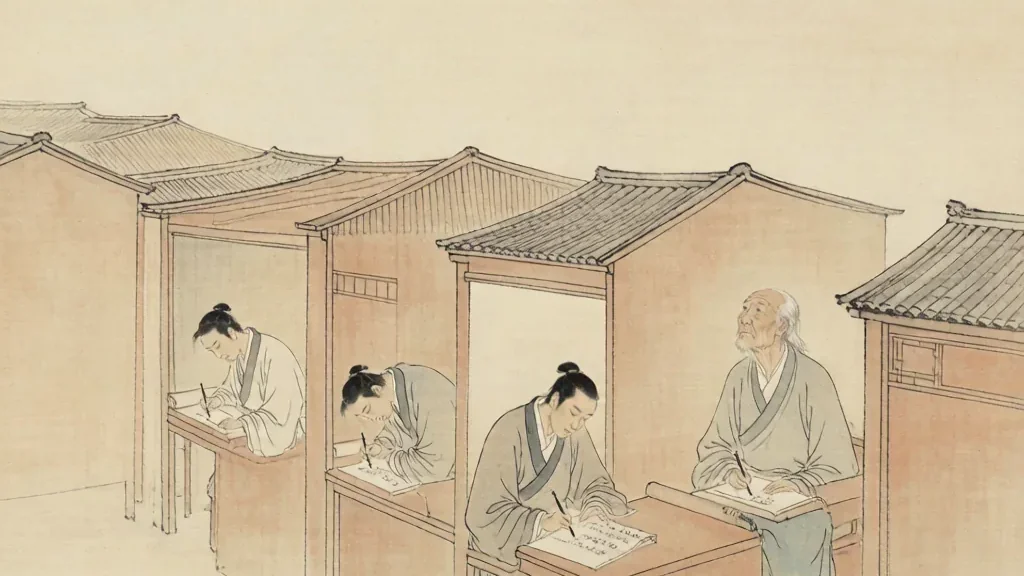
What happens to a society that teaches its brightest young men that the only worthy goal in life is to pass an exam? Rulin Waishi, "The Scholars," answered that question with a hundred chapters of savage, loving, and very funny satire. Published in the mid-eighteenth century during the Qing dynasty and attributed to Wu Jingzi, it is the first great Chinese novel built not on heroes or ghosts but on the petty ambitions of real-looking people. Its subject is the examination system and the "confucian forest" of scholars it produced — men who can recite the classics but often cannot think, feel, or govern. For an English reader, "The Scholars" is China's answer to a novel of manners, a comedy of credentials that feels startlingly modern.
The Man Who Wrote It
The author, Wu Jingzi, was born around 1701 into a family of examination success. He himself tried the system, won a minor degree, and then watched his fortune and his relatives with clear, skeptical eyes. By most accounts he was generous to a fault, drank freely, and grew disillusioned with the scholarly elite he was born into. He spent his later years in poverty in Nanjing, writing "The Scholars" out of intimate knowledge of the world he mocked. The novel is thus a kind of confession as well as an exposé: its sharpest laughter comes from someone who knew the game from inside.
Wu's own life — giving away money, refusing office, preferring the company of actors and artisans to pompous degree-holders — mirrors the book's quiet praise of people who live by warmth and honesty rather than by rank. The satire bites because the satirist has nothing to prove.
Structure: A String of Lives, Not a Single Plot
Unlike a tightly plotted novel, "The Scholars" moves episodically from one character to the next, each chapter introducing new figures and drifting forward through the decades. There is no single hero carrying the story; instead a chain of scholars, fools, hypocrites, and a few genuine souls passes before us. This loose structure lets Wu paint a whole society rather than one destiny. The reader meets the same types again and again — the greedy examiner, the pompous widower, the talented man who never passes — until the pattern becomes impossible to ignore.
The episodic shape also serves the satire. Because no character is safe and no storyline resolves into tidy moral victory, the book feels like real life observed through a window. Its famous opening, about a man who ruins his family chasing a degree, sets the tone: this is a world where the wrong things are rewarded, and everyone pretends not to notice.
The Examination System Under the Microscope
The beating heart of the novel is the imperial civil service examination, the route by which China chose its officials for six hundred years. Success brought wealth, status, and power; failure brought shame. "The Scholars" shows how this single institution bent every family's hopes and distorted every mind. Men spend decades memorizing the eight-legged essay — a rigid, formulaic form — and emerge unable to do anything useful. Fathers bankrupt themselves tutoring sons; widows are praised for starving so a brother-in-law can study; whole households revolve around a result that may never come.
Wu is not against learning. He is against the fetish of the credential, the way a degree becomes a mask for greed and vanity. The book's funniest scenes are also its saddest: a man who finally passes, goes mad with joy, and is "cured" only when someone shouts that he has failed again. The satire spares no one, least of all the examiners who profit from the misery they administer.
Hypocrisy, Money, and the Performance of Virtue
A second target is the theater of Confucian respectability. Characters loudly advertise their filial piety, chastity, and modesty while scheming for money and status. A rich man buys the title of "worthy widow" for a relative to polish his name; scholars who cannot bear to spend a coin weep publicly over ritual. Through such scenes Wu exposes virtue as a costume worn for audiences. The contrast with a few unlettered, warm-hearted people — a boatman, a craftsman, a reformed actor — makes the point without sermonizing.
This is satire with affection. Wu lingers on his fools, gives them families and fears, and lets us laugh with recognition rather than contempt. The result is a book that ridicules a system while pitying the people trapped inside it — a much harder and more honest thing than pure mockery.
What the Book Praises
Amid the comedy, "The Scholars" quietly honors a different ideal: the independent, decent person who refuses the ladder. Several of its most appealing figures are men who paint, drink, and keep company across class lines, asking nothing from the state. The novel's closing chapters, with their gathering of eccentric, talented friends, suggest that true cultivation lies in friendship and freedom, not in rank. Wu seems to say that the "confucian forest" forgot what Confucius actually taught about humanity and right conduct.
In this the book is quietly radical. It does not propose a new system; it simply shows, again and again, that the official measures of a good life are not the only ones, and rarely the best ones. That gentle heresy is why the novel has outlived the examinations it mocked, which were finally abolished in 1905.
Legacy and Why It Still Speaks
"The Scholars" is a cornerstone of the Chinese realist novel and a direct ancestor of twentieth-century Chinese satire. Lu Xun called it the first true work of realistic fiction in China and praised its power to expose without caricature. Its influence runs through modern Chinese literature's distrust of hollow conformity. For readers today, its comedy needs no translation: we too live in cultures that confuse credentials with character, and we too laugh at the pompous and pity the trapped. "The Scholars" remains a clear-eyed, kindhearted mirror — proof that the best satire is less about destroying its targets than about seeing them whole.
Language and the Art of Comic Detail
The Scholars is written in a clear, supple vernacular that lets Wu Jingzi stage comedy through small, exact details rather than broad farce. A character's stinginess shows in the oil he refuses to spend on a lamp; a widow's fake virtue shows in the mourners she hires; a scholar's vanity shows in the guests he condescends to. Wu rarely comments directly. He places the telling gesture, the awkward pause, the contradicted boast, and lets the reader draw the verdict. This restraint is what makes the satire durable: the fools are funny because they are recognizable, not because they are caricatures. The prose thus performs the book's argument, showing a society observed with affectionate precision and inviting laughter that is also a kind of pity.
The Scholars and the Chinese Realist Novel
The Scholars stands at the head of the Chinese realist tradition because it treats everyday social life as worthy of serious fiction. Before Wu, the great novels favored heroes, ghosts, or bandits; his subject is the examining, marrying, dining, and posturing of ordinary gentry. Later writers from Li Ruzhen to the modern May Fourth authors drew on its example when they wanted to critique conformity and hollow ritual. Lu Xun's praise of it as China's first true realist novel fixed its reputation, but its influence runs deeper: it showed that the novel could be a mirror held up to living society rather than an escape from it. In doing so, The Scholars helped redefine what Chinese fiction was allowed to be, a legacy visible in the social novels of the twentieth century.
❓ Frequently Asked Questions
📝 Chinese Vocabulary
儒林外史 — : The Scholars, "Unofficial History of the Confucian Forest."
科举 — : The imperial civil service examination system that selected officials.
八股文 — : The "eight-legged essay," the rigid formulaic form demanded by the exams.
吴敬梓 — : Wu Jingzi, the novel's author.
儒林 — : The "forest of Confucians," the community of scholars and degree-holders.
范进 — : Fan Jin, the novel's most famous character, who waits decades to pass the provincial exam and loses his mind with joy when he finally does.
南京 — : Nanjing, the city where Wu Jingzi spent his later impoverished years and the backdrop for much of the book's comedy.
野史 — : Unofficial history, the 'outer' record the title claims to be, set against the authorized dynastic histories.
🎉 Fun Facts
- The author Wu Jingzi was born into an exam-winning family but ended his life poor in Nanjing, watching the world he mocked.
- A famous scene shows a man driven mad by joy at passing the exam, "cured" only when someone shouts that he failed.
- The novel has no central hero; it drifts through dozens of lives to show a whole society's distortion.
- The imperial examination system the book satirizes was finally abolished in 1905.
- The novel opens with a butcher named Hu, so moved by his brother-in-law's exam success that he presses silver on him and weeps, a scene that sets the book's tone of worldly comedy.
- Wu Jingzi set much of the story in Nanjing, where he lived in poverty, and the city's scholars, temples, and teahouses appear throughout as the stage of his satire.