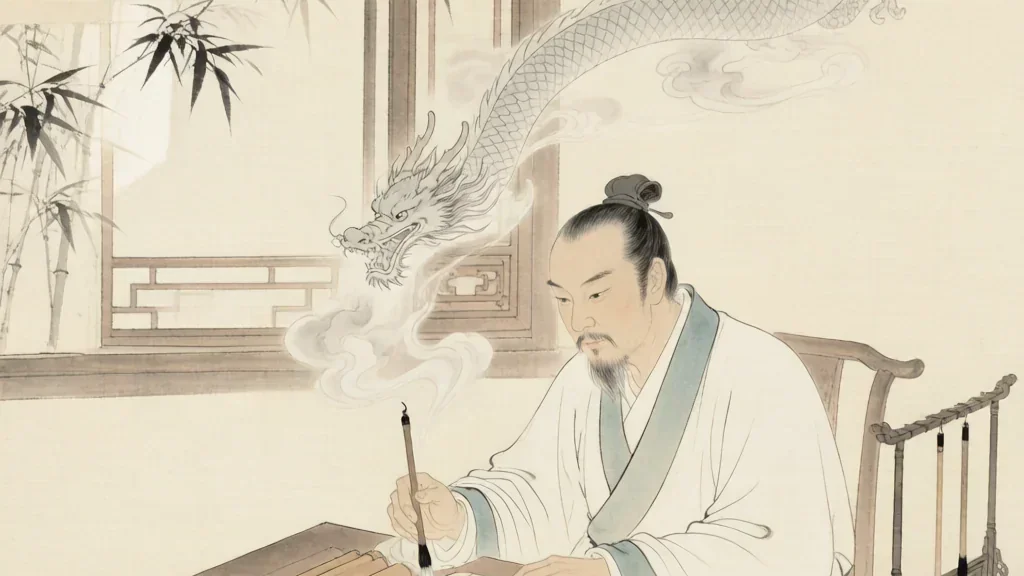
The Wenxin Diaolong (文心雕龙), conventionally rendered into English as The Literary Mind and the Carving of Dragons, is the single most comprehensive and systematic treatise on literary theory and criticism produced in premodern China. Completed around the year 501 or 502 CE by the scholar and monk Liu Xie (刘勰), the work survives as a complete book of fifty chapters that surveys the origins, forms, stylistic principles, and evaluative standards of Chinese writing from the earliest canonical texts down to the author's own age. Unlike the scattered judgments of earlier critics, who tended to praise or blame individual writers in brief essays, Liu Xie set out to build a coherent framework in which the craft of composition could be explained as a disciplined art rooted in the natural order of the cosmos. For more than fifteen centuries the book has served as the foundational reference for anyone seeking to understand how classical Chinese authors conceived of language, emotion, structure, and moral force, and it remains the starting point for serious study of Chinese literary thought.
Historical Background and Authorship
Liu Xie lived during a period of political fragmentation known as the Northern and Southern Dynasties, when the Chinese heartland was divided between rival regimes and the scholar-official class increasingly turned to literature, philosophy, and Buddhism for meaning. He was born late in the fifth century, probably around 465 CE, into a family of modest standing, and he was orphaned young, which shaped a life of relative poverty and devoted study. Rather than pursue the conventional route of office through the examination of accepted texts, Liu Xie attached himself to a Buddhist monastery, the Dinglin Monastery near the southern capital, where he lived for a long stretch of years immersed in both Confucian learning and Buddhist scripture.
It was during these monastic years that he composed the Wenxin Diaolong, working over a period that traditional accounts describe as several years of concentrated effort. The book was not an immediate sensation. According to a well-known story preserved in the official history of the Liang dynasty, Liu Xie was so anxious that his work would be ignored that he waited by the roadside with the manuscript to present it personally to the powerful literary statesman Shen Yue (沈约), who upon reading it declared it worthy to be weighed against the classic Analects. That endorsement secured the work's reputation, and Liu Xie himself eventually entered government service, though late in life he took monastic vows and withdrew from public affairs.
The Meaning of the Title
The title Wenxin Diaolong is itself a compressed statement of the book's ambition. The character wen (文) carries a cluster of meanings central to Chinese aesthetics: it signifies pattern, ornament, visible design, and by extension the written word and literature itself. The phrase wen xin, the literary mind, points to the inner sensibility of the author, the wellspring of feeling and imagination from which genuine writing flows. The second half, diao long, literally means to carve or sculpt a dragon, an image drawn from the ornamental dragons that decorated the columns and beams of imperial halls. Dragons were the supreme emblem of dynastic authority and creative potency, and to carve them was the highest test of a craftsman's skill.
Taken together, the title promises a study of how the mind's inner pattern is shaped into literature with the same disciplined artistry that a master carver brings to a dragon. The metaphor also signals Liu Xie's conviction that literary excellence is not spontaneous effusion alone but the product of training, control, and respect for inherited models. Modern translators have offered variations on the English title, but the carving-dragon image has proved durable because it captures the union of natural vitality and painstaking form that the book repeatedly urges upon its readers.
The Structure of the Fifty Chapters
The completed treatise is organized into fifty chapters, called pian, each addressing a distinct topic and written in the elevated parallel prose that was the prestige style of the age. The first chapter, Yuan Dao (Tracing the Way), lays the cosmological foundation by arguing that literary pattern is ultimately an expression of the universal principle inherent in heaven, earth, and the human heart. The second, Zheng Sheng (Rectifying the Sounds), and the third, Za Wen (Miscellaneous Writings), continue the foundational argument before the work turns to the survey of genres.
Chapters four through twenty-five are largely devoted to the description and evaluation of specific literary kinds, ranging from the shi poetry and the fu rhapsody to official documents, elegies, biographies, and Buddhist apologetics. Chapters twenty-six through forty-nine shift from form to method, examining the psychology of composition, the management of style, the use of allusion, and the standards by which a critic should judge a work. The fiftieth chapter, Xu Zhi (Explaining the Intent), is Liu Xie's own preface, in which he recounts his motives and maps the design of the whole. This architecture gives the book a rare completeness, moving from cosmic first principles to practical craft and finally to self-reflection.
Part One: Genres and the Origins of Form
In the genre chapters Liu Xie follows the classical Chinese habit of tracing each literary kind back to its earliest exemplars in the canonical and historical texts. He treats the Book of Documents, the Book of Songs, and the speeches preserved in the histories as the original wells from which later forms drew their water. For the fu rhapsody, he sketches a lineage running from the poems of the south through the great Han dynasty practitioners, noting how the form grew more ornate and self-conscious over time. For epistolary and administrative writing, he distinguishes the registers appropriate to memorials, instructions, and private letters.
A striking feature of these chapters is Liu Xie's resistance to pure antiquarianism. While he reveres the ancients, he is willing to argue that later writers sometimes surpassed their models in subtlety, and he regularly faults contemporaries for empty display. His discussions of the shi and the fu therefore function less as a catalogue than as a running argument about what each form is for and where his own era has gone wrong. The genre chapters thus prepare the reader for the theoretical claims of the second half by establishing that form is never neutral: every pattern carries an ethical and expressive charge.
Part Two: Creative Principles and the Work of Criticism
The second half of the treatise is where Liu Xie earns his title as China's first systematic literary theorist. He opens this portion with the chapter Shen Si (Spiritual Thinking), a remarkable account of the imaginative state in which a writer conceives a work. Liu Xie describes the mind in composition as roaming beyond the limits of sight and sound, gathering images from the distant past and the unseen future, so that a single thought may span a thousand years and a square inch of quiet may hold the shape of the entire world. He insists, however, that such soaring must be anchored by learning and by constant practice, lest imagination dissolve into incoherence.
Subsequent chapters examine Feng Gu (Wind and Bone), the paired qualities of moral vitality and structural firmness; Qing Cai (Feeling and Talent), on the relation of emotion to native ability; Ding Shi (Fixing the Affinity), on choosing the right mode for a given subject; and Bian Sao (Distinguishing the Modes), on the differences between plain and ornate manners. The closing critical chapters, especially Zhi Yin (Knowing the Sound), turn to the reader and judge, warning that partial taste and personal prejudice blind critics to true merit. Throughout, Liu Xie insists that judgment must be founded on the text itself and on an understanding of the writer's circumstance.
The Concept of Wen and Its Cosmic Ground
The most philosophical thread running through the book is the claim that human writing participates in a universal patterning. Liu Xie argues that just as the heavens display their order in the movement of stars and the earth displays hers in the veins of mountains and the markings of birds, so the human heart naturally gives rise to pattern when stirred by things. Literature, on this view, is not a decorative addition to life but a third realm of cosmic design alongside heaven and earth, and the writer is a kind of co-worker with nature.
This elevation of wen has consequences for how Liu Xie assigns value. Because pattern is grounded in the Way, writing that departs from sincerity and moral gravity is not merely bad taste but a disorder in the relation between mind and cosmos. At the same time, Liu Xie is no puritan about ornament: he values beauty and openly delights in the music of language. His position is better described as a demand that embellishment serve feeling and principle rather than replace them, so that the dragon carved on the beam is at once splendid and true to the living creature it represents.
Style, Parallelism, and the Art of Phrasing
Much of the second half is given to the concrete mechanics of style, and here Liu Xie addresses the dominant taste of his era for parallel prose, in which paired clauses balance tone, image, and syntax. He devotes chapters to Lici (Refining Diction), Lici paired phrasing, the use of allusion, and the management of sound. His advice is practical and unsentimental: avoid forced matches, do not let the search for symmetry crush the sense, and let the weight of a sentence fall where the feeling demands.
Liu Xie is especially alert to the danger that an admired manner can harden into mannerism. He observes that fashions swing between plainness and opulence, and that each new generation rebels against the last, yet truly durable writing transcends the pendulum by remaining faithful to its subject. His discussions of tone and rhythm anticipate modern concerns with voice and pacing, and they show that the Chinese critical tradition was capable of fine technical analysis long before the arrival of Western literary science. The care he devotes to such matters confirms that for him theory and craft were a single discipline.
The Doctrine of Feng Gu
Among the book's many ideas, none has proved more influential than feng gu, usually translated as wind and bone. Feng, the wind, names the vital force by which a work moves and persuades its reader, the moral breath that carries feeling outward like a gust through the trees. Gu, the bone, names the inner skeleton of a composition, the firm articulation of language and argument that keeps it from sagging into vagueness. A strong work, Liu Xie teaches, must possess both: wind without bone is mere effusion, bone without wind is dead structure.
The doctrine of wind and bone became a standing criterion in later Chinese criticism, invoked by poets and essayists who wanted to defend vigor and sincerity against what they saw as the decadence of mere prettiness. It also supplied a vocabulary for describing failure, since a critic could diagnose a poem as lacking wind or a treatise as lacking bone. In this way Liu Xie gave later writers a portable standard, one that did not depend on quoting rules but on sensing the living tension between force and form. The phrase remains current in Chinese literary discussion to this day.
Influence on Later Literary Theory
The fortunes of the Wenxin Diaolong rose steadily after the Tang dynasty, as the practice of poetry and prose became central to education and examination. Commentators in the Song, Ming, and Qing periods produced annotations, abridgments, and imitations, and the book's chapter headings entered the common language of criticism. Its genre classifications shaped the organization of numerous anthologies, while its emphasis on moral vitality informed the great neo-Confucian arguments about the relation of writing to character.
In the modern era the treatise has been studied both within China and abroad as a document of comparative literary theory, and scholars have noted affinities between Liu Xie's concerns and those of Western critics who worry about the ethics of form. The survival of the complete text, unusual for a work of its antiquity and ambition, has made it possible to read the whole argument rather than reconstructed fragments. Editions, translations, and specialized studies now exist in several languages, and the book is regularly taught as the cornerstone of premodern Chinese aesthetics, a position it has held for more than a millennium.
Manuscript Transmission and Modern Scholarship
Like most works of its period, the Wenxin Diaolong was preserved through hand copying long before the age of print, and the text that survives carries the marks of that transmission in scattered variant readings and the occasional corrupted character. Scholars of the Qing dynasty undertook the first rigorous collations, comparing editions and citing the work as quoted in contemporary encyclopedias to recover the likely original wording. Their labors established the stemma of texts that modern editors still consult.
In the twentieth century the application of philological method, together with access to earlier printed editions and to manuscript fragments, allowed a far more secure reconstruction of Liu Xie's language. Contemporary scholarship tends to read the book not as a static monument but as a contested text whose meaning is reconstructed through debate about dating, interpolation, and the author's possible Buddhist commitments. Whatever the unresolved questions, the consensus remains that the treatise is a unified composition with a coherent design, and that its survival intact is one of the fortunate accidents of Chinese literary history.
Liu Xie's Place in the Critical Tradition
Before Liu Xie, Chinese reflection on literature had been brilliant but unsystematic, scattered across prefaces, letters, and occasional judgments by figures such as Cao Pi, Lu Ji, and Zhi Yu. Each of these predecessors had advanced an insight, whether about the rivalry of writers, the difficulty of composition, or the classification of styles, but none had attempted a total account. Liu Xie's achievement was to gather such insights into a single architecture and to root them in a cosmology that explained why literature matters at all.
For this reason he is often called the father of Chinese literary criticism, a title that slightly understates the case by suggesting a single founding act rather than a synthesis. What he founded was less a school than a vocabulary and a method: the habit of asking, for any work, what its pattern expresses, what force moves it, what bone supports it, and whether the critic has heard it truly. That habit outlived every dynasty and continues to shape how readers approach the Chinese literary past, making the carving of the dragon a craft with no end.
❓ Frequently Asked Questions
What is the Wenxin Diaolong?
It is a fifty-chapter treatise on literary theory and criticism written by Liu Xie around 501 or 502 CE, covering the origins, genres, craft, and evaluative standards of Chinese writing from the classics to his own time.
Who wrote it and when?
The author was Liu Xie, a scholar who lived through the Northern and Southern Dynasties and later became a monk; he completed the work near the turn of the sixth century during the Liang period.
Why is it considered important?
It is the first systematic and complete work of literary criticism in China, moving beyond scattered judgments to build a coherent framework linking cosmic order, emotional sincerity, and craft.
What does the title mean?
The Literary Mind and the Carving of Dragons combines wen xin, the patterned mind of the author, with diao long, the master craftsman's carving of ornamental dragons, signaling art born of both feeling and discipline.
What is the doctrine of wind and bone?
Feng gu teaches that a strong work needs feng, the vital force that moves the reader, and gu, the firm structure that supports meaning; one without the other produces either empty effusion or dead form.
How is the book organized?
It opens with cosmological foundations, surveys literary genres in its middle chapters, turns to creative method and criticism in the later chapters, and closes with the author's own preface explaining his design.