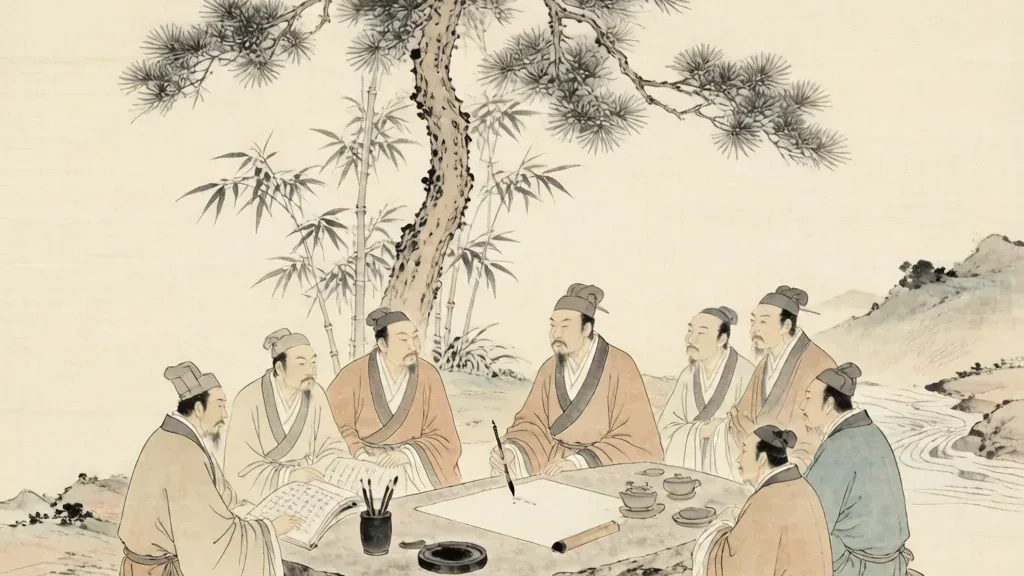
When the Chinese wanted to define good prose, they named eight men. Tang Song Ba Da Jia, "The Eight Masters of Tang and Song," is the collective name for the writers who revived and perfected guwen, "ancient-style prose" — clear, direct writing modeled on the pre-imperial classics rather than the ornate parallel prose of their day. Chosen centuries later by the Ming critic Tang Shunzhi and popularized by Mao Kun, the group includes Han Yu and Liu Zongyuan of the Tang, plus the Song figures Ouyang Xiu, the Su father and sons, Wang Anshi, and Zeng Gong. For English readers it is the story of how Chinese literature purified its own language — a revolution in plainness that still sets the standard for good writing.
What "Ancient-Style Prose" Means
For centuries, formal Chinese prose had been dominated by pianwen, "parallel prose," in which every pair of lines matched in length, rhyme, and allusion — beautiful but heavy, and often empty. The guwen movement argued for a return to the unadorned, forceful prose of the Han and pre-Han masters like Sima Qian and the philosophers. The goal was not archaism for its own sake but clarity, argument, and sincerity: writing that said something. "Ancient style" meant a living simplicity, not a dead imitation.
The Eight Masters are the writers who made this style the new norm. Their collected works became the textbook for every later essayist and every exam candidate, which is why their influence is hard to overstate.
The Tang Pioneers: Han Yu and Liu Zongyuan
Han Yu (768–824) is the movement's prophet. He attacked the fashionable Buddhism and the hollow parallel style alike, urging writers to "fish the meaning from the Classics" and express it plainly. His own essays — on teachers, on heresy, on drought — are blunt, witty, and confident, and he practically invented the polemical personal essay in Chinese. Liu Zongyuan (773–819), his friend and fellow exile, wrote exquisite lyric essays, especially his "Eight Records of Yongzhou," where landscape becomes a vehicle for quiet grief and integrity. Together they proved guwen could be both argument and art.
Both men were officials as well as writers, and both suffered for their principles — Liu spent years in exile. Their lives gave their prose a weight that purely literary men lacked. They wrote from experience of power and its costs.
The Song Masters
The Song dynasty completed the revolution. Ouyang Xiu (1007–1072), the gentle giant of the age, mentored a generation and wrote essays of calm reason and warmth; he also reformed the examination essays toward clarity. Su Xun, his son Su Shi, and Su Zhe — the "three Sus" — brought brilliance and ease; Su Shi in particular is beloved for essays that wander charmingly from a trivial scene to a profound point. Wang Anshi, the reforming statesman, wrote taut, forceful argument; Zeng Gong wrote careful, moral exposition. Between them they made guwen the natural voice of the educated class.
The Song masters differed in politics — Wang the activist reformer, Ouyang and the Sus more measured — but they shared a faith in plain, purposeful prose. Their disagreements, conducted in essays, are themselves a model of civilized argument.
Themes and Values
The Eight Masters valued several things consistently. First, sincerity: writing should express a real conviction, not display. Second, function: a piece should do work — persuade, explain, console, or record. Third, restraint: ornament serves meaning, never the reverse. They also believed the writer's character mattered; style was the man. These values made their prose feel moral without being preachy, and literary without being precious.
Underneath was a Confucian confidence: that clear language could carry the weight of state and self, and that the classics offered a usable model for both. The movement was thus conservative in taste and progressive in effect, freeing prose from a straitjacket.
How the Canon Was Made
Curiously, the Eight Masters were not a self-identified group. The label was invented later, by Ming-dynasty critics who selected them as the purest exponents of guwen and promoted their collected works as a curriculum. Tang Shunzhi and Mao Kun's anthologies fixed the list, and from then on "the Eight" were taught as a unit. This shows how canons are built — by later readers deciding what to imitate. The group's unity is a tribute to editors as much as to authors.
That constructed quality does not diminish the writers. It reminds us that "great literature" is partly a tradition of teaching, a chain in which each age tells the next whom to read. The Eight Masters won because generation after generation found them useful to imitate.
Legacy and Why It Matters
The guwen style became the default for Chinese prose for eight hundred years and remains the model of good essay writing in the classical language. Modern Chinese vernacular prose, though in a different language, inherited the same ideal of clarity and function. To study the Eight Masters is to learn what China decided "good writing" should be: honest, purposeful, and uncluttered. For readers of Chinese literature in English, they are the link between the ancient historians and the modern essay — the moment prose learned to breathe.
Their lesson travels beyond China. In any language, the call to say what you mean, plainly and with conviction, is the foundation of writing worth reading. The Eight Masters of Tang and Song are the Chinese name for that enduring, quiet revolution.
The Essay as Moral Argument
The guwen essay was never purely literary; it was an act of persuasion aimed at both the heart and the court. The Eight Masters treated argument as craft, opening with a concrete scene or a single striking image, then letting the point unfold through parallel examples rather than abstract theory. Han Yu's essays on teachers and on mourning begin in everyday circumstance and arrive, almost casually, at a moral claim, so that the reader is convinced before noticing the argument. This method, show first and state second, is why guwen feels alive while the parallel prose it displaced feels ornamental. A good guwen essay persuades by modelling the clarity it preaches, and its practitioners believed that muddled style betrayed muddled thinking.
Why the Masters Still Teach Writers
Centuries after the examination system that sustained them disappeared, the Eight Masters remain a working model for clear writing in Chinese. Modern essayists and even textbook editors return to their collected works because the virtues they prized, sincerity, restraint, and a sense of audience, travel across languages and eras. The guwen ideal also survives in the way Chinese schools still teach composition: say something true, say it plainly, and let the form serve the thought. For readers outside China, the Masters offer a useful counterweight to the idea that good prose must be elaborate; their lesson is that discipline and feeling are not opposites. To read Han Yu or Su Shi is to see how economy and warmth can share the same sentence, a balance every writer still struggles to find.
❓ Frequently Asked Questions
📝 Chinese Vocabulary
唐宋八大家 — : The Eight Masters of Tang and Song, the guwen prose models.
古文 — : "Ancient-style prose," the clear prose the masters promoted.
韩愈 — : Han Yu, the Tang prophet of the guwen movement.
欧阳修 — : Ouyang Xiu, the Song master who mentored a generation.
苏轼 — : Su Shi, the most beloved of the Song essayists.
骈文 — : Parallel prose, the ornate, matched-line style that the guwen movement rejected.
柳宗元 — : Liu Zongyuan, the Tang essayist famed for his lyric travel sketches.
苏辙 — : Su Zhe, the younger of the two Su brothers among the Eight Masters.
🎉 Fun Facts
- The "Eight Masters" were not a self-identified group; the label was invented by Ming-dynasty anthologists.
- Three of the eight are a single family: Su Xun and his sons Su Shi and Su Zhe.
- Han Yu attacked both fashionable Buddhism and the ornate parallel-prose style in the same breath.
- Their guwen style remained the model for classical Chinese prose for roughly eight hundred years.
- Ouyang Xiu discovered and championed the young Su Shi, helping to launch the most celebrated essayist of the Song.
- Liu Zongyuan's Eight Records of Yongzhou turned landscape essays into a vehicle for quiet personal feeling and remains a model of Chinese travel writing.